Success story: Children in Sobral participate in reading time. Sobral has undergone a transformation from one of the poorest places in Northeast
Brazil to a municipality that regularly hosts visits to schools regarded as among the best in Brazil. Photo: Centre for Reinventing Public Education
In November 2025, the R50 million Funda Uphumelele National Survey (FUNS) delivered the first comprehensive measurement of early-grade reading in all official languages.
The findings confirmed what researchers suspected: only 31% of Grade 1 learners can identify 40 letter-sounds per minute — the minimum threshold for reading readiness. By Grade 3, 15% cannot read a single word.
Yet we have ample evidence showing what interventions work: structured phonics instruction, high-quality materials, teacher coaching, classroom libraries and time on task.
In Makhanda, interventions by education NGOs such as GADRA, Funda Wande and the Lebone Centre, with support from Rhodes University, have helped 41% of public school Grade 4 learners read for meaning — more than twice the national average.
In Sobral, Brazil, a a poor city transformed from worst to first in national literacy rankings through sustained reform. If we know the problem and the solutions, why does the crisis persist? The answer is not just pedagogical. It is political.
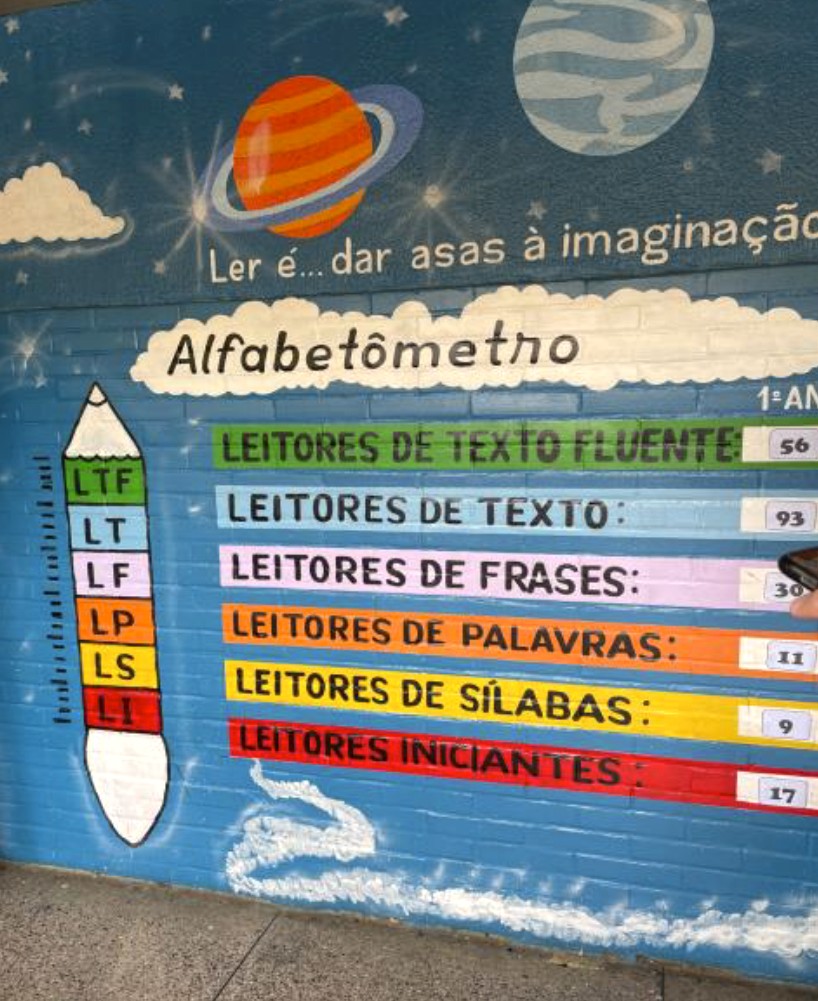 Barometer: A school poster in Sobral, Brazil, tracks literacy progress in schools. Photo: Centre for Global Development
Three models of change
Three distinct approaches to literacy reform can be identified, each with different assumptions about how change occurs.
1. The Sobral model: state-led transformation: In 1997, nearly half of Sobral’s second-graders were unable to read simple words. Twenty years later, the Brazilian municipality ranked first among 5 570 for basic education.
The transformation didn’t require massive new funding. It required political will. When diagnostic assessments revealed the crisis, the mayor announced the results on the radio to all citizens: despite renovated buildings, children were not learning. Schools displayed performance targets on banners.
Teachers who met targets received salary increases; those who persistently failed were retrained or dismissed. The reforms were institutionalised in municipal law to protect them from political cycles.
In November 2025, Almaret du Toit, the chief education specialist at the Western Cape Education Department (WCED) and Portia October, who leads the education NGO Funda Wande’s Western Cape intervention, visited Sobral. They concluded that infrastructure and resources alone don’t drive improvement — it is about teacher practice, attitude, pedagogy and accountability.
2. The Western Cape model: government-civil society cooperation: The Western Cape is attempting Sobral-style reform through partnership. Unlike provinces where NGOs work around dysfunctional education departments, the WCED and Funda Wande are collaborating, studying the same evidence and implementing coordinated reforms.
Research describes the WCED as a professional, rule-bound bureaucracy low leadership turnover and sophisticated management systems, making it possible for a state-NGO partnership to roll out coaching networks, build leadership capacity and develop term-by-term benchmarks.
“If they can do it [in Sobral], without extraordinary resources but with passion and a holistic approach, then so can we. They showed what is possible when you put children first and keep your principles beyond the office walls,” Du Toit says.
The goal is government-owned capacity that persists beyond project funding cycles. “After Sobral, the momentum exploded — we realised that we could do it,” October says.
Annual systemic testing provides data on how the programme is working, enabling further funding — “a snowball effect that starts with good governance”, says du Toit.
“Our provincial minister has regular on-the-ground meetings with us. When we started our reading intervention, the minister went to the Treasury to get R30 million, because while reading is a national mandate, there was no budget provided to provinces.”
The Western Cape is embedding functional vertical accountability from the Treasury to province to district to school to classroom, with support and consequences at each level.
3. The Right to Read model: legal pressure from civil society: In provinces where cooperation is less possible, a different strategy is emerging. The Right to Read campaign, launched in August 2023 by Section27, Equal Education, the Legal Resources Centre (LRC) and the Centre for Child Law, is preparing to compel the establishment of binding literacy regulations through litigation.
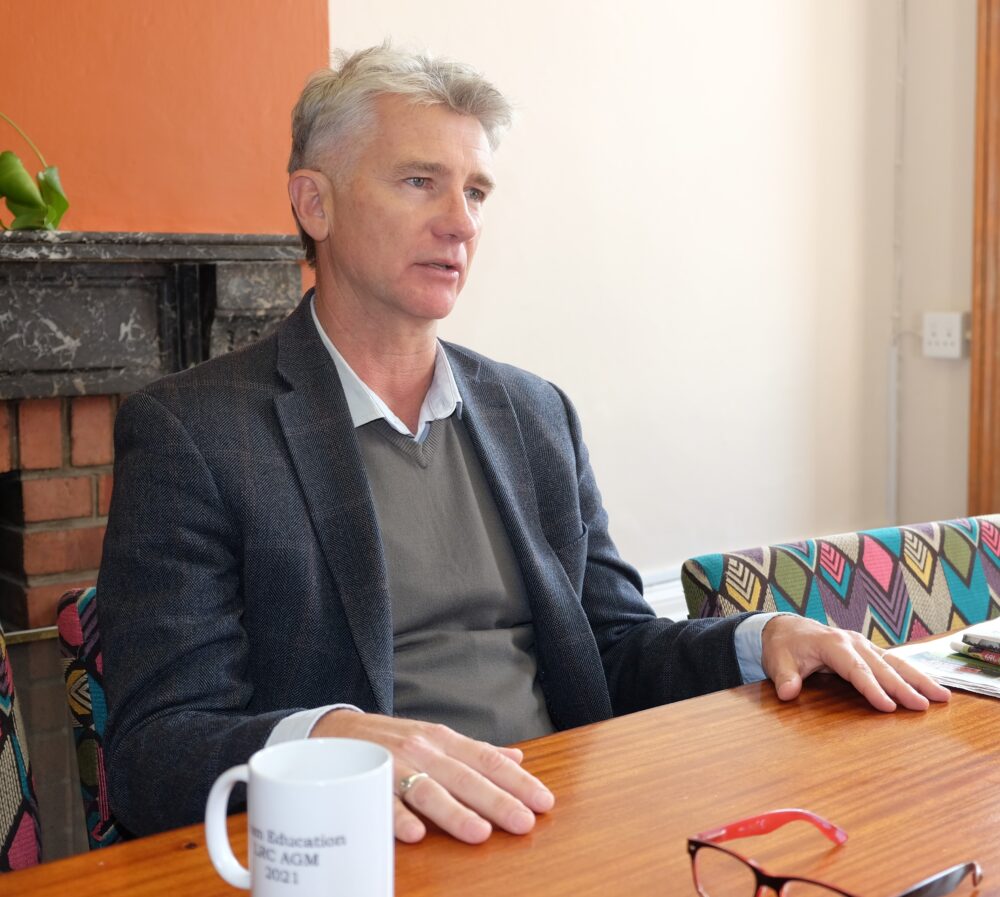 Cameron McConnachie, head of the Legal Resources Centre’s (LRC) Education Programme
Cameron McConnachie from the LRC in Makhanda articulates the problem: “South Africa has had lots of plans, policies, guidelines and strategies over the last 20 to 30 years and a lot of them are really good. However, they are just policies. They’re not funded. Often they’re not consistent; they come and they go.”
The National Reading Plan, which aimed to support provincial education efforts between 2019/20 and 2023/24, exemplified this pattern. It encompassed classroom libraries, teacher training, and other activities, yet offered scant detail on implementation, funding or accountability. Subsequent reporting found limited planning, uncoordinated reading initiatives across provinces and haphazard monitoring.
The Right to Read coalition is demanding binding literacy regulations within 24 months. The proposed “4Ts” framework would mandate specific instruction hours (time), minimum classroom materials (texts), accredited teacher support (training) and quarterly assessments against benchmarks (tests).
The FUNS data shows that teachers require in-class coaching and structured materials. Coaching is expensive — R730 to R2 500 per learner annually — and millions of graded readers must be developed for African languages.
However, the campaign’s cost analyses demonstrate that binding regulations would require redirecting funds, rather than making massive new investments. As McConnachie puts it: “We’re not asking for that much more money.”
If the government refuses, litigation will follow. The constitutional argument is straightforward: Section 29 guarantees the right to basic education and reading for meaning is fundamental to that right.
When the state is both essential and broken
The legal strategy makes sense in contexts like the Eastern Cape, where governance researchers such as Brian Levy describe a bureaucracy characterised by divergent regional interests, patronage ties and competing factions that consistently defy centralised control. Leadership instability has contributed to chronic weaknesses in financial and personnel management.
The evidence of mismanagement is stark. Since 2020, the Eastern Cape Department of Education has withheld about R5 billion intended for no-fee schools, retaining it for “centralised procurement” with no clear breakdown of how funds were used.
In KwaZulu-Natal, the situation is worse — an estimated R9.2bn has been held back since 2015. A recent audit revealed thousands of “ghost employees” drawing salaries. KZN MEC for Finance Francois Rodgers says R1bn annually could be recovered from this source alone.
When pressed for meaningful action to improve literacy, national and provincial education departments often cite budget constraints. But money is hiding in plain sight. The withheld funds could have been used to target graded African language readers, provide structured teaching materials, establish classroom libraries, and offer substantial literacy coaching.
There is some hope. The Eastern Cape Department of Education faces a court challenge in March 2026. Following the revelation of the ghost teachers, a nationwide audit is being coordinated by the National Treasury and the Education Labour Relations Council.
At national level, Minister of Education Siviwe Gwarube has signalled a shift in emphasis. In August 2025, she operationalised the long-dormant National Education and Training Council (NETC). Among its first four priorities: “expanding access to quality foundational learning by determining a minimum integrated package of support for schools offering Grades R-3 in all provinces”. However, the NETC is advisory, not decision-making — whether this represents genuine reform momentum or another layer of planning remains to be seen.
A political choice
The three models are not competing ideologies. They are responses to different governance conditions. Where the state is capable and reform-minded, as in Sobral, the government can drive transformation through political will and transparency.
FUNS provides the accountability infrastructure South Africa has lacked – benchmarks, baseline data, and the commitment to measure progress in 2029 and beyond. The question is whether political leaders like Gwarube will get support to operationalise it at scale.
Where the bureaucracy is professional but change requires external expertise, as in the Western Cape, civil society and government should partner. Where the bureaucracy is captured by patronage, as in the Eastern Cape, legal pressure through the Right to Read campaign will be a key lever of change.
McConnachie frames it: “South Africa is at a crossroads. We can continue with fragmented, underfunded efforts that go nowhere, or we can choose a different path — one where every child has the right to read, and therefore, the right to learn.”
In Sobral, school posters track each child’s journey. Every teacher, parent, and community member can see whether the system is working. That transparency transformed a poor Brazilian municipality into a model for the world.
South Africa now has the data to do the same. Civil society can help, but only the state has the reach and resources to drive significant change at a national scale.
The evidence is in and the path forward is clear. What remains is the hardest part: the politics.
This feature was made possible by the Henry Nxumalo Foundation which funded the Between the Lines series