African Reclaimers Organisation members stand in front of the trucks they use to collect waste from communities and industrial sites.
When Johannesburg’s Marie Louise landfill closed in September last year, the city’s waste management problem collided with a livelihood crisis.
About 140 waste reclaimers, who had spent years and some even decades recovering recyclables from the site, were given just one day’s notice.
The closure exposed a critical gap in South Africa’s just transition planning, where the informal workers who form the backbone of its recycling system are being left behind.
“There are young mothers and old women who are barely surviving and who are depending on this line of work. Taking this away from them is going to impact their ability to support three to five people in a household,” said Luyanda Hlatshwayo, the leader of the African Reclaimers Organisation (ARO).
On 1 September 2025, Johannesburg waste management company Pikitup shut the Marie Louise landfill site, adding to the closure of four others in the city.
According to Pikitup’s 2023/24 annual report, the site received 23% of the city’s waste. The report warns that the company will run out of space within the next few years, creating a waste disposal crisis.
Hlatshwayo highlighted the devastating impact the closure has had on female waste reclaimers whose livelihoods depend on recyclables. The ARO had absorbed four women and hoped to take in more, he added.
“It’s a shame because if we had collaborated with the municipality, we would have absorbed all of them.”
Forty-five-year-old Lilian Thamae from Braamfischerville, who has combed through trash at the Marie Louise site for 25 years, hoping to find something valuable, recalls the morning she woke up to a WhatsApp message notifying reclaimers of the closure.
Before the shutdown, Thamae recovered a variety of materials, ranging from plastics and cardboard to bottles and wood, before they were flattened by landfill machinery.
The mother of three boys and a girl made R2 500 a week from the waste material she sold to Waste World.
“My children asked me how we were going to survive after the closure of the place that fed us and sent them to school. I assured them a plan would come,” Thamae said.
“After that, I went outside the house and cried because at that time I had no means of putting food on the table.”
Thamae was fortunate to secure a job at the ARO, but added: “It’s no longer the same as working independently at Marie Louise and my future at ARO is uncertain as I have not signed any contract with them.”
She and other reclaimers are at the frontline of Johannesburg’s recycling system, yet they say they have been excluded from Pikitup’s planning.
Failing to integrate reclaimers into the formal system as landfills closed meant that thousands risked losing their only source of income, further destabilising communities, the
ARO said.
The organisation represents thousands of waste reclaimers who earn a living by diverting waste to recycling facilities on Johannesburg’s landfills and streets.
The sector had always been aware that the landfills would eventually close and prepared for that by developing several waste reclaiming pilot programmes, Hlatshwayo said.
“One successful programme has employed about 70 people from the landfill and is supporting more than 400 people indirectly,” he said.
For the past four years, the ARO, which has trucks that collect waste from industrial sites and communities, has undertaken a research-driven project called Source Separation, with support from the Coca-Cola Foundation and the Alliance to End Plastic Waste. It is aimed at addressing life after landfill closure.
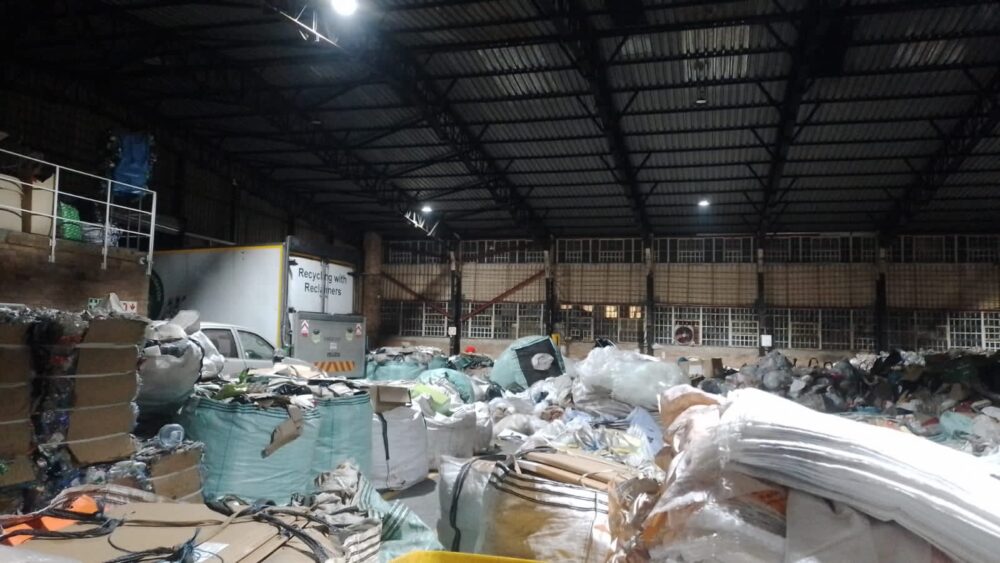 African Reclaimers Organisation (ARO) recycling facility in Johannesburg where waste is separated
“Women, particularly older mothers, are not able to move as quickly as younger people, so they do the separation at the ARO warehouse. We provide them with proper working space, medical facilities, proper infrastructure and sanitation,” Hlatshwayo said.
All in all, the closure of landfill sites in Johannesburg has left more than
5 000 informal workers without work. Reclaimers say policymakers are making decisions that negatively affect their industry without consulting them.
According to the Council for Scientific and Industrial Research, the informal sector is active in recovering valuable post-consumer recyclables from the waste stream in South Africa. An estimated 80% to 90% by weight of paper and packaging is recovered by informal waste pickers.
Pikitup had temporarily suspended operations to “assess capacity”, after which a decision would be made on how to continue, spokesperson Muzi Mkhwanazi said, adding that the suspension would allow the waste management utility to take measures to comply with its permit conditions.
In 2024, the Mail & Guardian reported that the city had plans to buy land in Ennerdale to develop a new landfill and expand current sites. At the time, Mkhwanazi said Pikitup “is awaiting the finalisation of the transfer of land to Pikitup and this additional land is expected to add an additional 10 years of airspace to the Ennerdale landfill site”.
Thamae and other waste reclaimers are calling on the City of Johannesburg and Pikitup management to create and implement alternative plans for diverting and minimising waste while ensuring people can continue to feed their families.