Power grip: Ugandan President Yoweri Museveni, 81, was declared the winner of the 2026 presidential race for a seventh elective term, taking his
tally from 40 to 45 years in power. Photo: Government of the Republic of Uganda
In a country that has never witnessed a peaceful transfer of power since independence in 1962, Ugandans braved an internet shutdown, fear, anxiety and heavily armed security deployment to cast votes for the president and parliamentary seats on 15 January 2026.
Article 1 of the 1995 Uganda Constitution (power belongs to the people) guides citizens to choose their own leaders, from the president to local councils, every five years. Out of an estimated population of 49 million, the Uganda Electoral Commission registered 21 649 068 voters, among whom 11 366 201 votes were cast, with 11 090 848 valid and 275 353 invalid, at 50 739 polling stations, projecting a 52% voter turnout.
The same commission electoral-engineered 7 946 772 votes, projecting 71.65%, allocated to Yoweri Museveni in first place and Robert Kyagulanyi Ssentamu (aka Bobi Wine) with 2 741 238 votes, projecting 24.72%, in second place.
Other participants, such as Nandala Mafabi with 209 039 votes and 1.88%, Mugisha Muntu with 59 276 votes and 0.53%, Bulira Frank with 45 959 votes and 0.41%, Robert Kasibante with 33 440 votes and 0.30%, Munyagwa Mubarak with 31 666 votes and 0.29% and Mabirizi Joseph with 23 458 votes and 0.21%, were reported as official figures, respectively.
As guided by Article 103, Section 7 of the 1995 Constitution, the electoral commission chairperson, Justice Simon Byabakama, declared the incumbent, 81-year-old Museveni, as the winner of the 2026 presidential race for a seventh elective term, taking his tally from 40 to 45 years in power.
Amid the electoral commission declaring Museveni the winner, the first runner-up and Uganda’s main opposition leader, Bobi Wine, of the National Unity Platform, rejected the results as fabricated and fake, categorically stating that the electoral commission results do not reflect the will of the people of Uganda.
One of the obvious cases backing Bobi Wine’s statements was the glaring lack of transparency in vote tallying and the final results reporting at the national tallying centre and, most importantly, the malpractices that transpired throughout the entire election cycle.
Bobi Wine’s point of view resonates with millions of Ugandans across the spectrum, international observers and media powerhouses.
An election must seem transparent, free and fair to all contenders, citizens and observers, otherwise, it ceases to be credible, thereby subjecting it to rejection, legal gymnastics and civil unrest.
Former Nigerian president Goodluck Jonathan, who led the delegation of observers from the African Union, in his report, raised similar shortcomings in Uganda’s 2026 elections and the uphills of democracy in Africa.
A credible, free and fair election is one of the tenets of democracy.
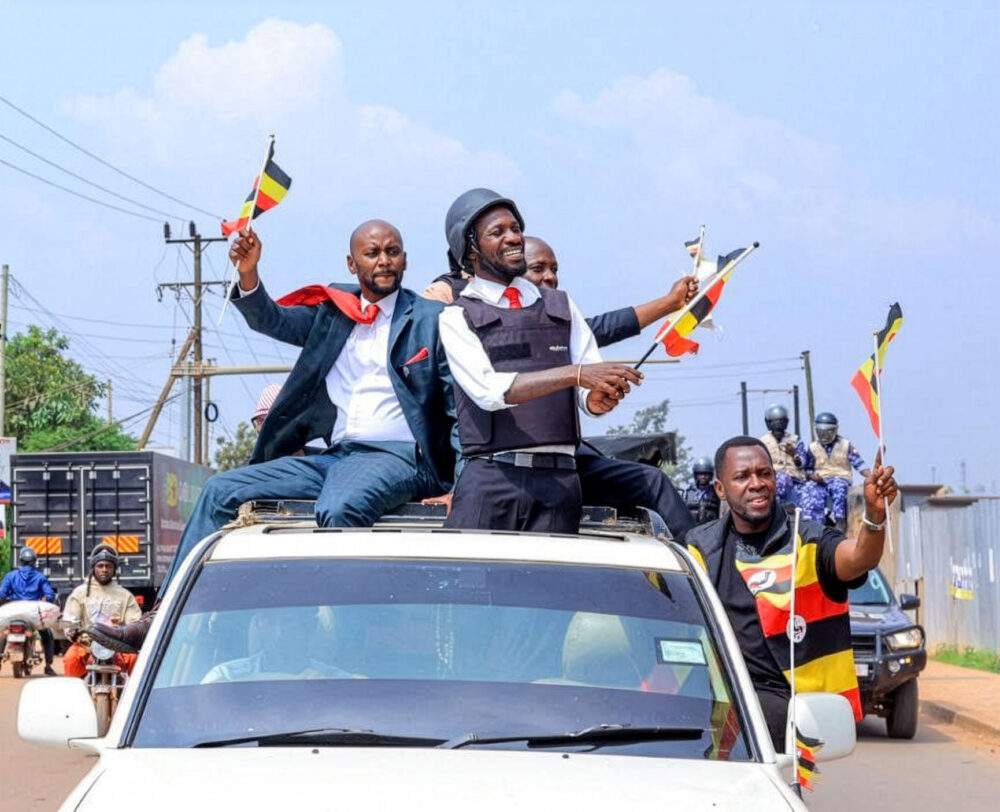 Hopeful candidate: Main opposition leader Bobi Wine appearing at an
election rally in Uganda before the January elections. Photo: Facebook
Hopeful candidate: Main opposition leader Bobi Wine appearing at an
election rally in Uganda before the January elections. Photo: Facebook
However, without fear of contradiction, Uganda’s 2026 elections were marred by glaring electoral irregularities and malpractices, use of disproportionate force, voter suppression and human rights violations from the beginning of the exercise to the end.
During the campaign period, some of the recorded irregularities ranged from blocking candidate
Bobi Wine from freely addressing the electorate in some parts of eastern, central, western and northern Uganda, to excessive deployment of heavily armed, overzealous uniformed men and militias with ammunition, buttons and tear gas, who ended up beating journalists, shooting live bullets and abducting some dissenting voices participating in a national exercise.
For instance, by the end of the elections, more than 1 000 opposition supporters and administrators were missing and others were incarcerated, while Leon Joshua Otim, among others, was murdered by security forces.
Overwhelming monetisation of politics turned elections into auctions at all levels, contributing to record-breaking voter bribery and election fraud.
Hiring mobile goons, as was the case in Gulu and Kampala, to terrorise peaceful assemblies deprived citizens of the freedom of assembly and participation, a cardinal principle of democracy.
Abuse of power and manipulating public institutions into partisan political mobilisation and denigrating opposition candidates are all atrocities that erode electoral integrity.
Bold media entities were denied access to cover a single presidential candidate, an act besieging press freedoms and independent media, another key tenet of democracy.
The arrest of civil society player Sarah Bireete and the indefinite suspension of Charter IV operations, among other civil society organisations, left a vacuum in election scrutiny, accountability, transparency and human rights observation.
Before the polls, the internet was switched off, an act that violated citizens’ participation, civic engagement and the freedom of expression, as well as the right to information.
Failure of biometric voter verification machines to operate culminated in a lack of transparency, accuracy, efficiency and electoral integrity.
Ballot stuffing, result changing and abducting opposition polling agents with declaration forms all contributed to electoral fraud and completely degraded democracy.
In Uganda’s 2026 elections, one of the criminally underrated issues is the rate of voter apathy.
Imagine: out of 21 649 068 registered voters, only 11 366 201 turned up, projecting 52%, indicating an absence of 10 282 867 — another red flag, perhaps arising from lack of voter education, shrinking civic spaces and mistrust
in elections.
Despite all the unthinkable shortcomings in Uganda’s 2026 elections, there are some scores for democracy to reckon with, among them holding regular elections and woman and, overwhelming, youth participation in political spaces.
Following what has transpired throughout the election cycle in Uganda’s 2026 elections and in Tanzania recently, the status of democracy in Africa is deteriorating from a precarious authoritarian state to totalitarianism.
Lest we forget: bad elections in 1980 forced a young Yoweri Museveni to start an armed five-year rebellion against the Obote regime, which similarly abused all tenets
of democracy.
Sadly, we have learnt nothing and forgotten nothing of these historical facts.
Fortunately, Uganda can leverage the 2016 Amama Mbabazi versus Museveni ruling, guiding the country to have electoral reforms that could perhaps end the underlying election malpractices and give democracy a chance to thrive.
My futuristic clarion call goes to the Ugandan regime, Tanzania and Africa at large: if nations continue with the trend of election malpractices, it is only a matter of time before Uganda or any other country faces the same fate as Libya and Sudan.
Robert Kigongo is a sustainable development analyst and political pundit.