


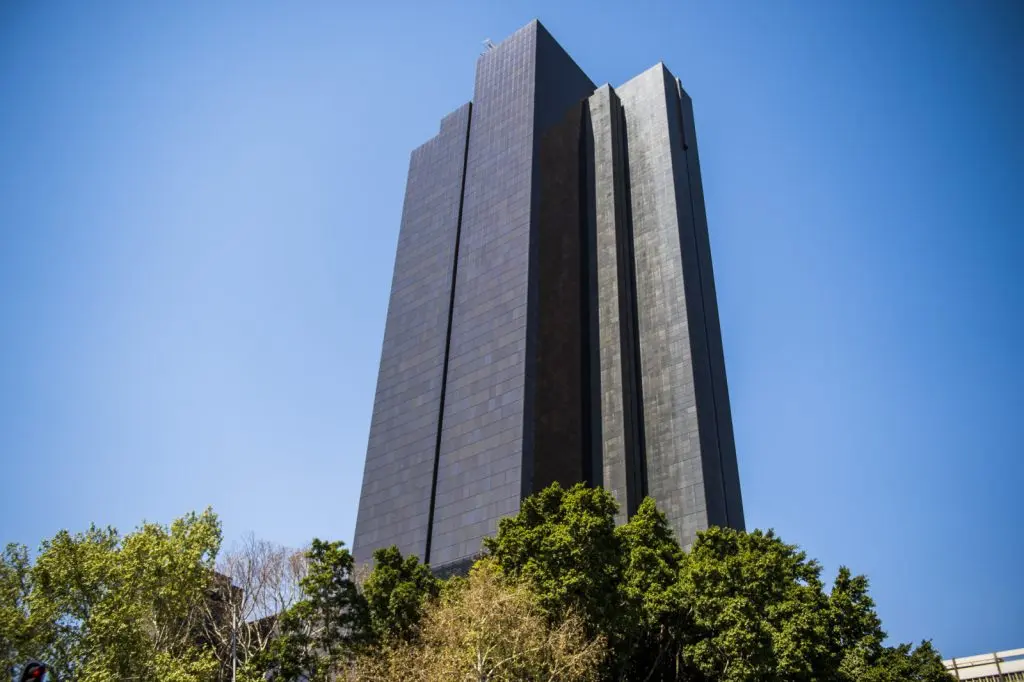
The South African Reserve Bank left interest rates unchanged on Thursday, opting to hold the repo rate at 7% as policymakers weighed persistent inflation risks against growing concerns over the country's sluggish economic growth.
The Monetary Policy Committee (MPC) left the repo rate unchanged at 7%, with the prime lending rate remaining at 10.5%, following a 25-basis-point increase in May.
The decision comes as policymakers continue to weigh inflationary pressures, geopolitical tensions and subdued domestic economic growth.
The MPC voted four to two in favour of keeping rates unchanged.
Dr Elna Moolman, Standard Bank Group's head of South Africa macroeconomic research, said the decision reflected the Reserve Bank's careful balancing of lingering inflation risks against the broader economic outlook.
“This comes despite the Reserve Bank’s concern about some of the lingering inflation risks,” she said, adding that policymakers remained particularly concerned about services inflation, which tends to be more persistent.
Moolman said it was not impossible that interest rates could rise later this year if inflation risks intensified. However, the Reserve Bank currently regarded the existing policy stance as appropriate, while its forecasting model continued to indicate there could be scope for interest rate cuts should inflationary pressures ease.
Johann Els, chief economist at PSG Financial Services, described the MPC statement as “far less hawkish” than he had expected.
He said the Reserve Bank appeared to be taking a forward-looking approach, focusing on where inflation was heading rather than reacting to June's inflation rate of 5%.
“They recognise the risks, but policy is based on where inflation is going, not where it is today,” Els said.
According to Els, the central bank acknowledged risks posed by the conflict in the Middle East, higher oil prices and the potential impact of El Niño on food prices, but treated these as risk scenarios rather than incorporating them into its central inflation forecast.
He said the Reserve Bank also appeared increasingly concerned about weaker economic growth, citing subdued household confidence, disappointing recent activity data and soft export commodity prices.
Standard Bank’s head of agribusiness for business and commercial banking, Brendan Jacobs, said the decision would provide welcome relief for agribusinesses already under pressure from rising input, transport and financing costs.
He said a further rate increase would have added to borrowing costs for businesses carrying debt, although risks linked to the conflict in the Middle East, particularly higher fertiliser and diesel costs, remained a concern.
The property sector also welcomed the decision.
Standard Bank head of home services Toni Anderson said leaving the repo rate at 7% and the prime lending rate at 10.5% would give consumers greater certainty as many households continued to grapple with cost-of-living pressures.
“A hold provides welcome relief for homeowners and aspiring buyers. It means monthly home loan repayments remain unchanged and gives those looking to buy new homes more confidence in their planning,” Anderson said.
She said affordability remained one of the key drivers of activity in the residential property market and that stable borrowing costs should continue to support demand, particularly among affordable and first-time buyers.
Mortgage originator ooba Group also welcomed the decision, saying South Africa's housing market had remained resilient despite global economic uncertainty.
Rhys Dyer, chief executive of the ooba Group, said holding rates would help sustain confidence in the residential property market by giving consumers greater certainty over borrowing costs.
Despite economic uncertainty, first-time buyers accounted for 48% of home loan applications during the first six months of the year, according to ooba. However, the average age of first-time buyers has risen to 36, suggesting affordability pressures are delaying entry into the housing market.
Dyer said demand had also been supported by banks continuing to offer high loan-to-value mortgages, with zero-deposit loans accounting for 56.9% of applications and cost-inclusive loans making up 6.1%.
He said geopolitical tensions and broader economic uncertainty would continue to weigh on the outlook, but stable interest rates and continued lender support should help underpin the housing market.