


South Africa could gain as global investors reassess their heavy exposure to increasingly indebted developed markets.
Strong commodity prices, improved electricity supply and reforms to the freight network have strengthened the country’s position at a time of geopolitical and economic uncertainty. The opportunity now is to turn that advantage into investment, production and jobs.
Speaking at INVESTIVAL 26 by Old Mutual Wealth, a two-day investment conference held at Fancourt in George on 14 and 15 September, Ninety One portfolio manager Malcolm Charles said his firm’s conversations with Gulf sovereign wealth funds and large US institutional investors suggested that some were taking a closer look at emerging markets.
“They don’t want to get out of the US, but they want to trim it down,” he said.
Mounting US debt and uncertainty about the country’s international role were changing the way investors assessed risk, Charles argued. Emerging markets that had controlled their deficits could begin to look more attractive than developed economies carrying much larger debt burdens.
South Africa’s case rests partly on its efforts to stabilise public finances, restore electricity supply and bring private investment into infrastructure. These reforms remain incomplete, but they have improved the country’s prospects compared with several years ago.
Izak Odendaal, investment strategist at Symmetry, Old Mutual’s multi-manager investment business, said South Africa was trying to put its house in order despite a difficult international environment.
“It is absolutely necessary to go through this painful period to stabilise the finances,” he said. “The alternative is that the debt just runs away with you and, 10 years later, you are forced to go to the IMF.”
Financial markets have begun to recognise the improvement. The premium investors demand to hold South African government bonds rather than US debt has narrowed substantially, according to Odendaal’s latest Market Matters report.
But the same global changes creating an opening for South Africa are making it harder for developing countries to grow.
Odendaal said rising government debt, the fragmentation of global trade and the transition to new technologies and cleaner energy were reshaping the world economy. Countries were bringing supply chains closer to home and placing greater emphasis on security and self-sufficiency.
“The traditional avenue where poorer countries become richer is by globalising,” he said. “But the world is turning away from globalisation.”
This weakens the export-led route used by several East Asian economies to industrialise and move into higher-value production. South Africa must therefore take advantage of current investor interest while adapting to a less integrated world economy.
The immediate growth figures remain weak. Gross domestic product contracted by 0.2% in the second quarter of 2026 after six consecutive quarters of expansion. Mining output fell 3%, manufacturing contracted for a third consecutive quarter and gross fixed-capital formation declined again.
The official unemployment rate rose to 33.6%, leaving 8.5-million people actively looking for work.
The figures show why improved sentiment towards South African assets must translate into fixed investment and productive capacity.
Eskom and Transnet provide early evidence of progress.
Eskom reported a R30.3-billion profit for its latest financial year, while load-shedding fell to four days from 329 two years earlier. The improvement was helped by higher tariffs, and municipal arrears to the utility climbed to R111.6-billion, but the reduction in power cuts has removed one of the most immediate constraints on businesses and households.
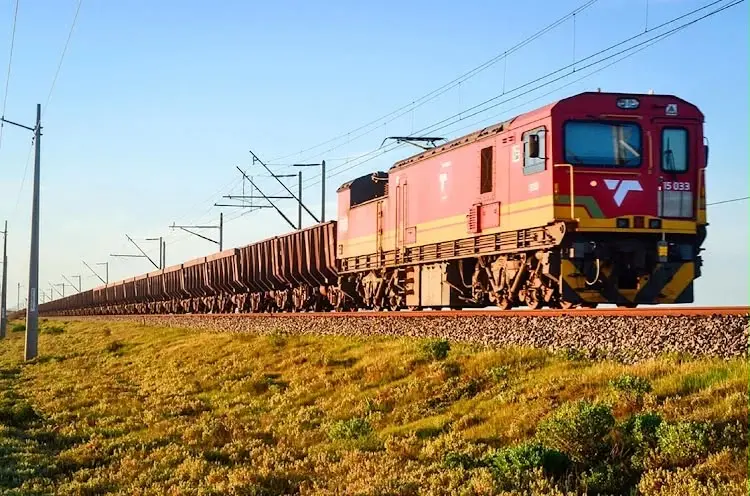
Transnet returned to profit and increased rail freight volumes by 4.9% to 167.9-million tonnes. Volumes remained below its 180-million-tonne target, and much of the profit resulted from a once-off gain linked to the Durban container terminal concession. Even so, the rise in volumes marks an improvement from the severe logistics failures of recent years.
The approval of 11 private train operators is a more fundamental change. They could eventually add as much as 24-million tonnes of annual freight capacity, with operations expected to begin from April 2027.
Charles described private participation in rail and ports as “a proper major structural shift”.
“It’s not a job done, any way you look at it,” he said. “It’s a freaking good start.”
The reforms will ultimately be judged by whether they raise production.
South Africa is benefiting from higher gold and platinum-group metal prices, which have supported export earnings, company profits and tax revenue. But mining output fell 7.5% year on year in July, with declines in platinum-group metals, coal and iron ore.
“We are benefiting from higher prices, but we’re not growing our volumes,” Odendaal said.
Mining companies need confidence that additional ore can be transported reliably to ports before committing to new shafts or extending existing operations. Greater rail capacity, faster licensing and improved security could allow South Africa to turn the commodity upswing into production and employment rather than a temporary revenue windfall.
The citrus industry shows what volume-led export growth can achieve.
Final industry figures showed that South Africa exported about 2.9-million tonnes of citrus in 2025, narrowly overtaking Spain to become the world’s largest citrus exporter by volume.
South Africa could gain as global investors reassess their heavy exposure to increasingly indebted developed markets.
Strong commodity prices, improved electricity supply and reforms to the freight network have strengthened the country’s position at a time of geopolitical and economic uncertainty. The opportunity now is to turn that advantage into investment, production and jobs.
Speaking at INVESTIVAL 26 by Old Mutual Wealth, a two-day investment conference held at Fancourt in George on 14 and 15 September, Ninety One portfolio manager Malcolm Charles said his firm’s conversations with Gulf sovereign wealth funds and large US institutional investors suggested that some were taking a closer look at emerging markets.
“They don’t want to get out of the US, but they want to trim it down,” he said.
Mounting US debt and uncertainty about the country’s international role were changing the way investors assessed risk, Charles argued. Emerging markets that had controlled their deficits could begin to look more attractive than developed economies carrying much larger debt burdens.
South Africa’s case rests partly on its efforts to stabilise public finances, restore electricity supply and bring private investment into infrastructure. These reforms remain incomplete, but they have improved the country’s prospects compared with several years ago.
Izak Odendaal, investment strategist at Symmetry, Old Mutual’s multi-manager investment business, said South Africa was trying to put its house in order despite a difficult international environment.
“It is absolutely necessary to go through this painful period to stabilise the finances,” he said. “The alternative is that the debt just runs away with you and, 10 years later, you are forced to go to the IMF.”
Financial markets have begun to recognise the improvement. The premium investors demand to hold South African government bonds rather than US debt has narrowed substantially, according to Odendaal’s latest Market Matters report.
But the same global changes creating an opening for South Africa are making it harder for developing countries to grow.
Odendaal said rising government debt, the fragmentation of global trade and the transition to new technologies and cleaner energy were reshaping the world economy. Countries were bringing supply chains closer to home and placing greater emphasis on security and self-sufficiency.
“The traditional avenue where poorer countries become richer is by globalising,” he said. “But the world is turning away from globalisation.”
This weakens the export-led route used by several East Asian economies to industrialise and move into higher-value production. South Africa must therefore take advantage of current investor interest while adapting to a less integrated world economy.
The immediate growth figures remain weak. Gross domestic product contracted by 0.2% in the second quarter of 2026 after six consecutive quarters of expansion. Mining output fell 3%, manufacturing contracted for a third consecutive quarter and gross fixed-capital formation declined again.
The official unemployment rate rose to 33.6%, leaving 8.5-million people actively looking for work.
The figures show why improved sentiment towards South African assets must translate into fixed investment and productive capacity.
Eskom and Transnet provide early evidence of progress.
Eskom reported a R30.3-billion profit for its latest financial year, while load-shedding fell to four days from 329 two years earlier. The improvement was helped by higher tariffs, and municipal arrears to the utility climbed to R111.6-billion, but the reduction in power cuts has removed one of the most immediate constraints on businesses and households.
Transnet returned to profit and increased rail freight volumes by 4.9% to 167.9-million tonnes. Volumes remained below its 180-million-tonne target, and much of the profit resulted from a once-off gain linked to the Durban container terminal concession. Even so, the rise in volumes marks an improvement from the severe logistics failures of recent years.
The approval of 11 private train operators is a more fundamental change. They could eventually add as much as 24-million tonnes of annual freight capacity, with operations expected to begin from April 2027.
Charles described private participation in rail and ports as “a proper major structural shift”.
“It’s not a job done, any way you look at it,” he said. “It’s a freaking good start.”
The reforms will ultimately be judged by whether they raise production.
South Africa is benefiting from higher gold and platinum-group metal prices, which have supported export earnings, company profits and tax revenue. But mining output fell 7.5% year on year in July, with declines in platinum-group metals, coal and iron ore.
“We are benefiting from higher prices, but we’re not growing our volumes,” Odendaal said.
Mining companies need confidence that additional ore can be transported reliably to ports before committing to new shafts or extending existing operations. Greater rail capacity, faster licensing and improved security could allow South Africa to turn the commodity upswing into production and employment rather than a temporary revenue windfall.
The citrus industry shows what volume-led export growth can achieve.
Final industry figures showed that South Africa exported about 2.9-million tonnes of citrus in 2025, narrowly overtaking Spain to become the world’s largest citrus exporter by volume.
Unlike a windfall driven mainly by higher prices, this reflects growth in the amount of produce South Africa sells internationally. Charles cited the industry as evidence that investment in productivity and access to global markets could deliver results.
Its success also reinforces the need for functioning roads, ports and cold-chain infrastructure. Farmers can expand production, but they cannot repair the national logistics system needed to reach foreign buyers.
The same principle applies across the economy. Private companies can invest in power generation, freight operations and other commercially viable infrastructure, but they cannot assume responsibility for policing, water networks, suburban roads or municipal administration.
Improving local government, particularly in Johannesburg, is therefore essential to the broader recovery.
Gauteng generates about a third of South Africa’s output, but water interruptions, power failures, damaged roads and administrative dysfunction are weakening the country’s commercial and industrial centre.
“Everyone says Eskom is working better, Transnet is working better and the mood is up. Why aren’t we getting jobs? Why aren’t we getting growth?” Charles said. “The answer is Gauteng.”
Odendaal said Johannesburg’s condition could no longer be treated solely as a local government problem.
“It’s not a local issue anymore. It is a macro issue if your biggest city is failing,” he said.
“Most of your big companies are based there. Your industrial sector is based there. You can’t afford for it to fall over.”
Municipal failure also deepens the unemployment crisis. Apartheid-era spatial planning still leaves many poor households far from economic opportunities, with transport absorbing a large share of workers’ earnings.
“We haven’t solved this problem of physically connecting people,” Odendaal said.
For him, one of the clearest signs of recovery would not be a stronger rand or better credit rating, but the return of reliable commuter trains.
From his office at Mutualpark in Cape Town, Odendaal can see the junction of three railway lines. Before the Covid-19 pandemic, trains crossed the tracks regularly. Services then largely disappeared and have returned only gradually.
Reliable rail would lower the cost of getting to work and connect more people to the formal economy. Other practical signs of progress would include rising mining output, stronger construction order books and the release of well-located state land for development.
South Africa has a window in which commodity prices, infrastructure reforms and improving investor sentiment could reinforce one another.
Whether that becomes a lasting recovery will be decided not only in financial markets but on the country’s railway lines, at its ports, in its cities and in the jobs it creates.