


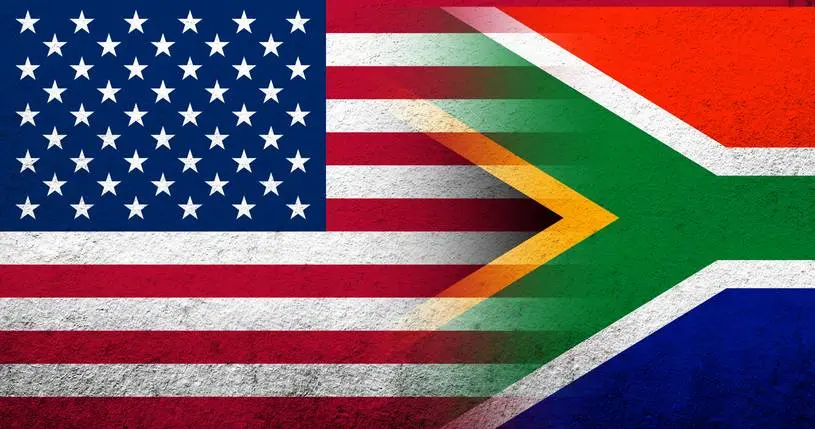
While labour has expressed concern about possible job losses, on Tuesday economists said the US government’s announcement to remove South Africa from the duty-free benefits of the African Growth and Opportunity Act (Agoa), did not spell doom and gloom.
The Office of the US Trade Representative (USTR) has announced the removal of the country from the list of eligible nations, along with Rwanda.
In announcing the termination of the two countries from the programme, effective from 1 January 2027, the USTR said the Trump Administration found the respective governments engaged in practices that were “inconsistent with Agoa’s eligibility criteria”.
US government concerns included barriers said to undermine American trade, investment and practices, which threatened US national security and foreign policy interests in the region.
Reflecting on South Africa, the Trump Administration said it was “deeply concerned by barriers to US trade and investment; corruption, threats to US national security and foreign policy interests”.
With Agoa enacted in 2000, South Africa has been the largest beneficiary of the programme over the past 25 years, accounting for 54% of all of the programme’s related exports to the US.
Leading economists Duma Gqubule, Donald MacKay, Wandile Sihlobo and Sam Koma told the Mail & Guardian that they were not surprised by the US’s move.
Gqubule criticised the South African government for “spending much time visiting the US, trying to appease the Trump administration, when we should be putting much emphasis on trade with Africa”.
“Trade with the US is very miniscule to worry about, instead of looking at other markets. We should be starting with Namibia in our backyard,” Gqubule said.
Echoing Gqubule’s sentiment, MacKay said that on average, Agoa “gave us a 3.5% over the rest of the world — something not material”.
“I don’t think it is all doom and gloom being out of Agoa because the benefit under Agoa was always very small. Trump has already inflicted the worst pain in terms of Section 232 duties on cars, steel and aluminium.
“If you take cars, it was duty-free under Agoa, while everyone else paid 2.5% and we got hit by 25% national security duties. Now that we have lost Agoa, it now takes a car tariff to 27.5%.
“The same goes for steel and aluminium, among the biggest exports by country mile under Agoa. Those have already taken the heat —nothing to do with Agoa,” MacKay said.
He predicted “some pain in the agricultural sector and individual businesses, which will suffer”. “But I don’t think the overall agricultural sector is at any material risk. New markets absolutely have to be explored.”
MacKay described the US as “the most unreliable trading partner”. “We would be stupid if we did not try to find other countries to trade with, the same pattern being followed by everyone else that has been victimised by the US. South Africa is no exception.”
Sihlobo said: “All this is not outside of the expectations. While we are now in a different political climate, it’s important to remember that aside from the issues the US raised about South Africa’s eligibility to be part of Agoa, there have been some conversations for some time.
“Back in 2014, the focus was on the reality that South Africa is an upper-middle-income country and should have graduated from Agoa to a full bilateral trade agreement with America.
“We had our own complications, both because of the Southern African Customs Union, which we can’t sign bilateral trade agreements without and because we lobbied to keep benefiting from this unilateral approach to Agoa.
“Looking back, if we had found a way to graduate out of Agoa, as we were pressured to do then, and started conversations about a trade agreement — we would be in a different climate than what we are seeing now.”
Sihlobo said countries with trade agreements were not spared from drastic changes in US trade policy.
“We see those changes affecting countries like Canada. Others frame it as a complete ban from the US market, which is not the case. Simply put, as South Africa transitions out of Agoa, the country would face an additional Most Favoured Nation tariff of around 3.4% on top of the existing tariffs the current US Administration added to various countries.
“Currently, some South African products enter the US market at 12.5% tariffs (Liberation Day tariff). Without Agoa, these tariffs would rise to 15.9%, slightly reducing the competitiveness of some South African products in the US market,” he said.
The South African trading environment would not “necessarily be as catastrophic, as we have faced in the past”.
“We have faced much higher US tariffs and still managed to compete. In 2025, the South African farming sector faced tariffs of around 30%. But agricultural exports to the US remained strong. South Africa’s agricultural exports to the US in 2025 totalled $504 million, down 3% from the previous year.
“During the higher ‘Liberation Day Tariffs’, some South African agricultural exporters took advantage of the 90-day pause in the second quarter of 2025 and exported more volume than usual. After this pause, exports cooled in the third and fourth quarters of 2025,” said Sihlobo.
Koma said the US taking SA off the list of Agoa for purposes of being exempted for duty-free trade regime, “has been in the offing for a considerable time — in part owing to the description of SA as an upper income country”.
“Indeed, this is a serious economic setback. However, this equally calls into question whether a proactive economic strategy to cushion the effects of this decision was thought through before and will now be executed by the Department of Trade, Industry and Competition,” he said.
“In the immediate, this decision has implications on the cash flow position of companies operating in these key economic sectors, in terms of now paying for import duties and tariffs for a whole range of commodities, machinery and vehicles.
“We hope that this policy decision will not result in job losses in the main,” he added.
The US decision called on the SA government to facilitate its bilateral trade relations with the US, “including leveraging the African Continental Free Trade Area, the BRICS bloc and the G20”.
“This is primarily more about the re-grading of SA as an upper income country, long before the current diplomatic tensions with the US were largely heightened by the Trump administration.”
Concerned about the impact on jobs, labour federation Cosatu said South Africa had experienced several jobs lost at factories and companies in Cape Town, Atlantis, Malmesbury and Tulbagh.
“We have seen the devastation it threatens to these workers and farmers’ abilities to take care of their families.
“Given South Africa’s already dangerously high 43.8% unemployment rate and weak economic growth, it is important that South Africa’s government utilise the next 60 days before this exit comes into effect.
“Government should negotiate a favourable set of solutions to avert this potential blow to the economy and jobs,” Cosatu national spokesperson Matthew Parks said.
He said the engagements should be “based on facts, not fiction”. “They must be anchored upon mutual respect, including the recognition and appreciation of South Africa as a constitutional democracy and a sovereign member of the international community.
“Negotiations for South Africa’s continued membership of Agoa and a reset of bilateral relations with the US too must be based upon what is in the interests of South Africa’s people and a respect for its own transformation journey.
“It is critical that the DTIC (Department of Trade, Industry and Competition), labour, National Treasury and agriculture, put in place an urgent package of support for at-risk workers, companies, industries and communities.”
The Federation of Unions of South Africa (Fedusa) also expressed concern about the possible impact of the US decision on the country.
“Workers must not bear the cost of international trade and diplomatic tensions. Although Agoa-related exports accounted for approximately $1.7 billion in 2025, representing around 1% of South Africa’s total global exports, the potential impact on particular industries and their employees should not be underestimated,” Fedusa general secretary Riefdah Ajam said.
“Automotive manufacturing and retail, agricultural processing, food processing, textiles, clothing, footwear, leather, associated logistics and supply chains, could experience increased pressure on production, investment and employment.
“Workers, particularly seasonal agricultural workers and those employed in export-dependent industries, may face reduced working hours, income insecurity and potential retrenchments.”