


Every year on June 16, South Africa pauses to remember the students who marched through the streets of Soweto in 1976 and challenged an education system designed to limit their futures.
We remember the photographs that travelled around the world, the names that became synonymous with youth resistance and the courage of a generation that refused to accept the role apartheid had assigned to them.
Yet this year, June 16 made me think less about the images that have become part of our national memory and more about a small booklet I found in a family drawer.
Like many families, we have a drawer that nobody really touches. It has survived house moves, spring cleans and countless attempts to sort through old papers.
Inside are birth certificates, funeral programmes, letters, identity documents and photographs whose stories have become increasingly difficult to trace.
Over the years, without anyone consciously deciding it should, the drawer became a family archive.
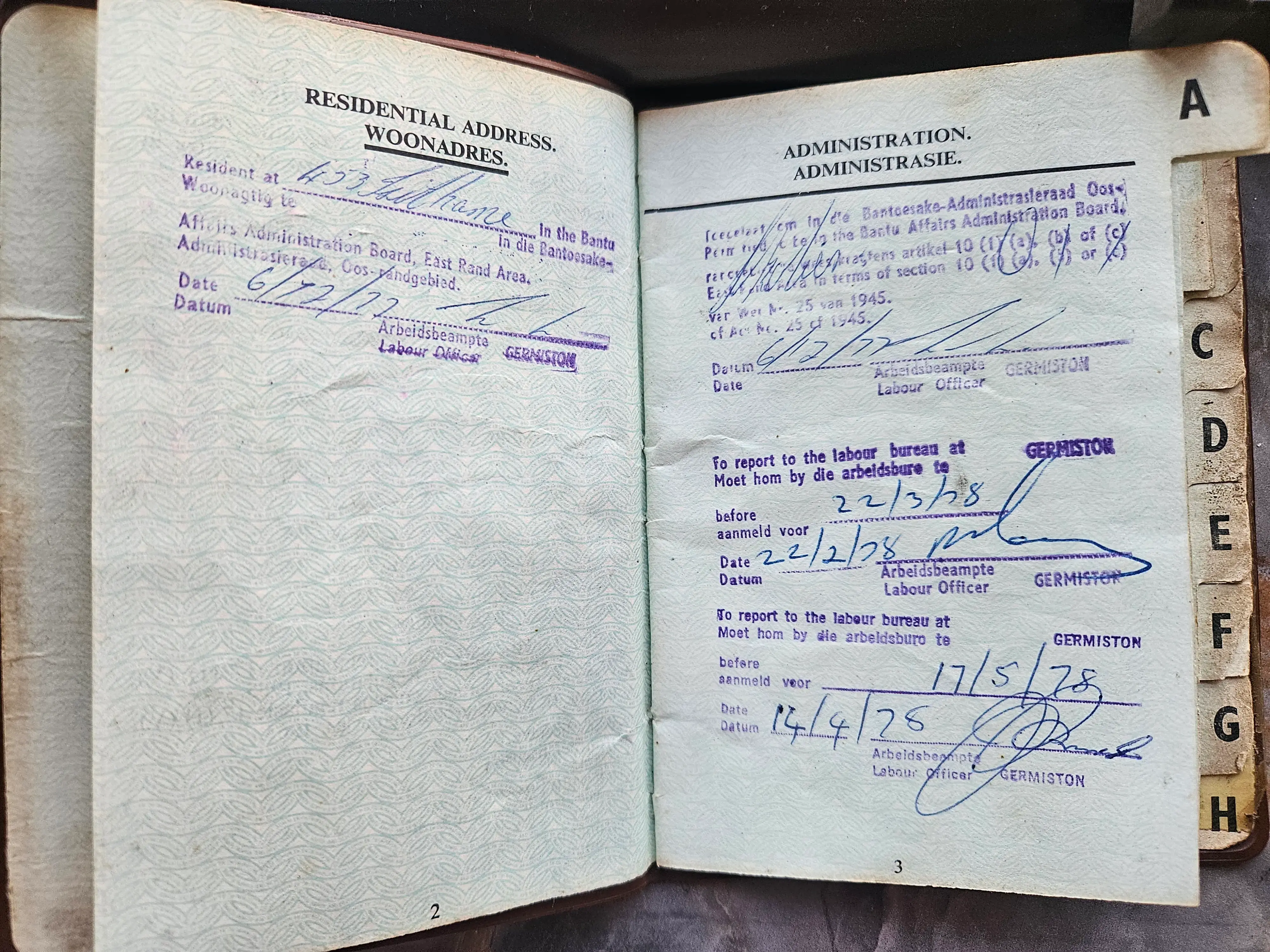
A few weeks ago, while searching through its contents, we found a worn booklet with the words “Reference Book” printed on the cover. The apartheid government called it a Reference Book because the name sounded administrative and harmless.
Black South Africans knew it by another name entirely.
The dompas.
The booklet belonged to my uncle, Vusimuzi Obisi.
He was born on 1 January 1959 and died on 15 August 1984 in a fire at his home in Isithama, Tembisa alongside his brother Michael Obisi and cousin Elias Thabang Obisi. He was only twenty-five years old.

I never met him.
Before finding the dompas, I knew very little about him beyond the fragments that occasionally surfaced during family conversations. He existed as a photograph, a name and a loss that belonged to an older generation. Like many relatives who die before we are born, he felt both familiar and distant at the same time.
Holding the dompas in my hands, I thought perhaps the document might tell me something about him.
Instead, it revealed very little.
The pages contain employment records, official stamps, signatures and administrative information. One entry from December 1977 is recorded at Marhulana Community School. There is evidence of where he was permitted to be.
What the document does not contain is any indication of who he was.
The more I looked through the booklet, the more I realised that this absence was not accidental.
The dompas was never designed to record humanity.
For decades, Black South Africans were required to carry passbooks wherever they went.
The documents regulated movement, employment and residence. They determined who could enter urban areas, who could remain there and who could be arrested for being in the wrong place at the wrong time. The system treated Black people as units of labour to be monitored and controlled.
So I began looking.
The answers I was searching for were not in the booklet. They were in the memories of the people who loved him.
My mother remembers him but her memory is fragmented.
She was only eleven years old the last time she saw her brother.
At the time, she was living in a transition house in Matola, Mozambique. Many South African families connected to the liberation struggle had been separated by exile, politics and circumstance.
Children were sent across borders. Parents disappeared into political work. Families lived with uncertainty, often not knowing when they would see one another again.
Before my mother left, Vusimuzi came to visit her.
More than forty years later, she still remembers that day clearly.
He brought her a jersey, a pair of school shoes and a pink polka-dot dress.
The memory has survived when so many others have faded.
Perhaps because those things he brought her represented something much bigger than the items themselves.
For an eleven-year-old girl living through uncertainty, they were a reminder that someone was thinking about her. They were a gesture of care from an older brother who understood that even small acts of kindness could provide comfort during difficult times.
My mother remembers him hugging her before he left and him telling her to take care of herself. She remembers watching him walk away.
What she did not know at the time was that it would be the last time she would ever see him.
When she tells the story today, it becomes clear that the memory is not really about the jersey, the shoes or the dress.
It is about love and about being remembered. It is about the final moments she shared with a brother whose life would end long before South Africa became free.
Listening to her tell that story changed the way I thought about the dompas.
The booklet and my mother’s memory were documenting two completely different versions of the same person.
The dompas recorded employment.
My mother remembered care.
The dompas recorded movement.
My mother remembered presence.
The dompas recorded compliance with a system.
My mother remembered humanity.
One version reduced him to a series of official entries and the other preserved the things that mattered.
The more I learned about my uncle, the more I realised how many similar stories must exist across the country.
How many dompasses still sit in family drawers.
How many lives have been reduced to documents that record everything except what mattered most.
How many people survive only through the memories of siblings, children and neighbours.
Finding the dompas became important not because of what it revealed but because of what it forced us to remember.
The document prompted conversations that might otherwise never have happened. It encouraged my mother to revisit memories she had carried quietly for decades. It transformed my uncle from a name attached to a tragic story into a person whose life contained care, responsibility and love.
There are still many things I do not know about him.
There are gaps that will probably never be filled.
But there is now more than a photograph and a date of death.

There is the image of a young man buying a jersey, a pair of school shoes and a pink polka-dot dress for his little sister.
There is a goodbye.
There is a hug.
There is a final act of kindness.
This June 16, while South Africa remembers the young people who changed the course of history, I find myself thinking about the countless others whose names never became part of the national narrative.
People like Vusimuzi Obisi.
Young Black South Africans whose lives were shaped by the same system, whose futures were constrained by the same laws and whose stories were never recorded beyond the documents that monitored them.
Because behind every dompas was a human being whose life contained far more than permits, signatures and official stamps.
And sometimes the most important archive is not the document left behind.
It is the memory carried by the people who remain.