


Three days after schoolchildren took to the streets of Soweto and altered the course of South African history, another act of resistance quietly opened its doors in Johannesburg.
On 16 June 1976, between 3 000 and 10 000 students marched against the apartheid government’s insistence that Afrikaans be used as a medium of instruction in black schools.
The roots of the anger stretched from the Bantu Education Act of 1953, which formalised an education system designed to limit the aspirations and opportunities of black South Africans.
What began as a peaceful demonstration ended in bloodshed in what would later be known as the Soweto Uprisings. Police fired teargas. Then they fired live ammunition. Images of children fleeing bullets and carrying the lifeless body of Hector Pieterson travelled across the world, exposing the brutality of apartheid in ways the government could no longer contain.
Three days later, while communities were mourning and the country was trying to comprehend what had happened, the Market Theatre opened its doors with a production of Anton Chekhov’s The Seagull.
Nearly 50 years later, the timing still feels extraordinary.
The first thing that strikes me about the Market Theatre is that it does not feel like a monument.
One might expect an institution carrying almost five decades of cultural significance to resemble a museum, frozen in time and carefully preserving its past. Instead, it feels remarkably alive.
Photographs line the walls and staircases, documenting generations of actors, playwrights and productions. Posters from landmark performances sit alongside newer works. Faces from productions long gone stare back from corridors like fragments of a collective memory.
Yet the building itself is anything but nostalgic.

Technicians move through passages balancing lighting equipment and cables. Somewhere, a burst of laughter escapes from behind a closed door before dissolving into the constant hum of activity.
There is a sense that things are still being made here. Stories are still being argued over. Futures are still being imagined.
Nothing about the Market Theatre suggests an institution content with living off its legacy. Instead, it feels like a place busy becoming itself.
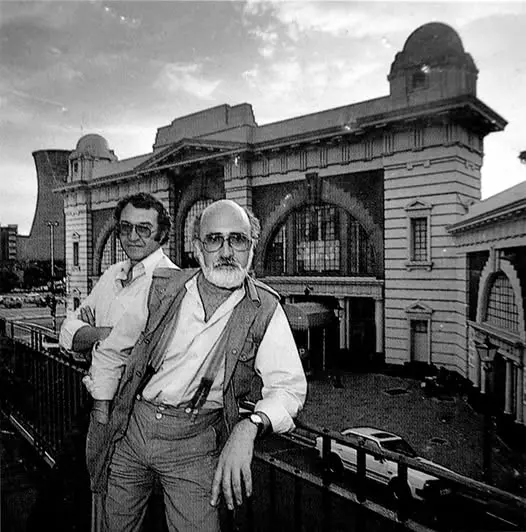
Waiting for me are playwright, actor and former artistic director Malcolm Purkey and artistic director Greg Homann. What begins as a conversation about the Market Theatre’s approaching 50th anniversary quickly becomes something much larger.
Every answer leads to another story. Every story leads to another production. Every production reveals something about the country that produced it.
“The connection to the politics of the country and the social fabric of the country is there from inception,” Homann says. “We opened this venue with The Seagull on the 19th of June 1976, three days after the uprising began.”
The choice of The Seagull remains one of the more curious details in the institution’s history. It was hardly the revolutionary production one might expect from a theatre that would later become synonymous with resistance, censorship battles and anti-apartheid storytelling.
Yet the decision says something important about founders Barney Simon and Mannie Manim. They understood that political theatre begins with artistic excellence. The politics would come but they would emerge through stories, characters and craft.
For Purkey, who witnessed much of the history unfold first-hand, the atmosphere of South Africa during those years is impossible to separate from the theatre’s emergence.
“Apartheid was truly ugly because, beyond the obvious violence, the shootings, the detentions and the people being hauled away, it damaged everybody,” he says. “Black South Africans carried the daily burden of oppression while white South Africans lived inside a system that distorted how they understood themselves and the people around them. It was a horrible time. We couldn’t live with the madness of the streets every day and simply pretend it wasn’t happening. We were desperate for places to tell stories.”
The Market Theatre became one of those places.

Founded by Simon and Manim in an old fruit and vegetable market in Newtown, the institution emerged as a non-racial space during one of the most aggressively segregated periods in South African history. At a time when apartheid attempted to regulate every aspect of public life — from where people lived to where they socialised and whose stories could be told — the theatre offered a radically different vision of the country.
“The point is there was a wilful opening of the space,” Purkey says. “It was a committed anti-racist space. It would do anything it wanted to do that told our stories to ourselves.”
To understand why that mattered, one has to understand what South Africa felt like in the years after 1976.
The Soweto Uprising did not emerge from nowhere. Purkey speaks passionately about the role of Black Consciousness in shaping a generation of young people who would eventually challenge apartheid head-on.
“You can’t have an uprising in June 1976 without recognising what happened beforehand,” he says. “From 1969 to 1976 there was a training going on, driven by Black Consciousness, by Steve Biko and others. Through poetry, song, church halls and classrooms, young people were hearing new ideas about themselves and their place in the world.”
When the uprising came, South Africans desperately needed places where the events could be processed and understood. Purkey remembers working on The Fantastical History of a Useless Man during that turbulent period.
“We thought to ourselves: ‘Do we have a right to make a play in times like these? What’s the point of theatre?’ We decided we would continue making the play and history would be the judge.”
The answer arrived almost immediately.
“For three months after June 1976, audiences were suddenly shocked by what was going on,” Purkey recalls. “They thought we’d better find out what’s happening here. We played to full houses because people were looking for ways to understand the crisis unfolding around them.”
As censorship intensified throughout the 1980s, that role became even more significant.
“The space was under censorship,” Homann says. “The censorship board had offices nearby and would come and watch the first performances. There was even a period when they would step onto the stage afterwards to conduct the censorship process in front of audiences.”
Yet despite the restrictions, stories continued to find their way onto the stage. This is why Barney Simon famously described the Market Theatre as “the newspaper of the day”. During the height of the State of Emergency, when newspapers were restricted and information tightly controlled, theatre became one of the few places where South Africans could encounter stories about their own reality.
“The Market Theatre became the newspaper of the day,” Homann says. “Stories could be made into plays within weeks and audiences could engage with them before authorities had time to shut them down.”
That determination produced some of the most influential works in South African theatre history.
Woza Albert!
Sarafina!
Have You Seen Zandile?
Sophiatown.
The names alone form part of South Africa’s cultural canon.
The productions did more than entertain audiences. They helped create a distinctly South African theatrical language rooted in local realities while speaking to international audiences. Productions developed at the Market Theatre travelled the world and introduced international audiences to stories that apartheid had attempted to suppress.
“It’s the home of South African theatre,” Homann says. “A genuine identity rooted in South African storytelling emerged through this space.”
Yet the institution’s influence cannot be measured only by the productions it staged or the actors who became household names. It can also be measured by the generations of theatre practitioners whose careers began within its walls.
Few stories capture the legacy better than that of Nomvula Mguni Molepo, today the head of stage and technical services at the Market Theatre Foundation.
Her journey into theatre began far from the professional stages of Newtown. Born in Soweto and raised partly in a rural village before moving to Alexandra, she discovered theatre through a community theatre group.
Like many young people in township communities, theatre became a constructive space where creativity and social engagement intersected.
The group performed dramas, took part in festivals and tackled issues affecting their communities. One production in particular would alter the course of her life.
An HIV/Aids awareness play called The Virus was selected to perform at a festival hosted by the Market Theatre Laboratory.
For many young performers, the excitement would have centred on being on stage. For Molepo, the revelation happened backstage.
“I became fascinated by what was happening behind the scenes,” she recalls. “I saw stage managers, lighting technicians, sound operators and technical crews working together to make the production happen.”
She found herself asking questions that most audience members never consider. How do the lights work? Who controls them? How does a production come together?

A stage manager took the time to answer her questions and introduced her to the world of technical theatre. The conversation changed everything. She entered the Market Theatre through a training programme and started at the bottom.
“We were expected to do everything,” she says. “Setting up venues, moving scenery, assisting backstage and supporting productions in any way that was needed.”
The work was physically demanding and often invisible but it provided an education that no classroom could replicate. Over time she developed a fascination with lighting.
“Lighting is a powerful storytelling tool,” she says. “It can change the mood of a scene instantly. It can focus an audience’s attention, create emotion and transform a stage.”
She worked as a lighting technician, learning how to hang lights, focus fixtures, patch equipment and interpret lighting plans. More importantly, she learnt by observing experienced designers.
Every production became a lesson. Every designer became a mentor. Every challenge became an opportunity to grow.
Years later, the curious young performer who once wandered backstage asking questions now leads the department responsible for ensuring productions run smoothly across the institution.
Her story is, in many ways, the story of the Market Theatre itself. It is a story about opportunity. It is a story about mentorship. It is a story about how curiosity can become a profession when institutions are willing to invest in people.
“I benefited from mentors who shared their knowledge with me,” Molepo says. “I feel a responsibility to do the same for others.”
That commitment to nurturing talent remains one of the theatre’s most important functions.
While audiences often celebrate actors, directors and playwrights, theatres survive because of an entire ecosystem of stage managers, lighting designers, sound engineers, technicians, builders and production specialists working behind the scenes.
The Market Theatre has quietly produced generations of them. It is perhaps one of the institution’s greatest but least visible achievements.

Yet perhaps the most surprising part of the Market Theatre’s story is how fragile it remains.
From the outside there is a tendency to imagine the institution as a well-funded cultural giant, sustained by its reputation and historical significance. The reality is considerably more complicated.
“The perception from the exterior is that we’re this important lush space that has lots of money to do all kinds of things,” Homann says.
“The reality is that we’re quite a lean base with a big history.”
He explains that the theatre begins each year with roughly R4 million available for productions.
“We have three venues and try to keep them busy for 46 weeks of the year. One production can cost between R700 000 and R1.2m.”
The contrast with earlier years is striking.
Purkey remembers a period when funding from foundations, lotteries and international partnerships created far greater possibilities.
“In 2006 there was around R15m available before inflation is even taken into account,” he says. “Twenty years later we’re operating in a completely different environment.”
The challenge is not unique to the Market Theatre.
Across South Africa, arts institutions continue to grapple with shrinking resources, inconsistent funding and changing audience habits. Yet the stakes feel particularly high here because of what the institution represents.
The South Africa that produced the Market Theatre in 1976 is not the South Africa of 2026.
The censorship board no longer waits in the wings. Apartheid legislation is gone. The questions facing the country have changed. But the need for storytelling remains.
“I don’t think the mission has changed,” Homann says. “We’re trying to tell the story of the challenge of our new democracy. We’re trying to tell the story of what it means to live in our country today.”
The tension around race, identity, class, language, memory and generational experience continues to produce powerful theatre. An example is Rise 76, a production revisiting the Soweto Uprising through the perspective of a younger generation.
For Homann, it embodies exactly what the institution should be doing.
“We’re birthing, as we speak, a play about 16 June 1976,” he says. “I know it’s going to have a very, very long life.”
As our conversation comes to an end, we walk through hallways lined with photographs documenting nearly five decades of South African theatre. Some productions are instantly recognisable. Others belong to stories that have faded from public memory. Together they form an archive of South African imagination.
Looking around, it becomes increasingly difficult to separate the story of the Market Theatre from the story of South Africa. It has functioned as a witness. A classroom. A meeting place. A newsroom. A memory bank. A mirror.
The schoolchildren who marched on 16 June 1976 understood that changing a country required more than legislation.
It required imagination. It required the ability to envision a different future and convince others that such a future was possible.
Nearly 50 years later, inside a former fruit and vegetable market in Newtown, artists are engaged in the same work. They are still asking difficult questions. They are still interrogating power. They are still holding up a mirror to the country.
And they are still telling South Africans stories about themselves.
“Everybody wants to be here,” Purkey says. “The Market Theatre remains one of the few places in the country where artists know they can find an audience that understands theatre and wants to engage with it seriously. We wish to God there were another three Market Theatres.”
Nearly five decades after opening its doors, the Market Theatre stands not as a monument to the past but as proof that culture matters, that storytelling matters and that even in the most difficult moments there remains immense power in gathering strangers together in a room and asking them to pay attention.
The stage, after all these years, still refuses to be silent.