


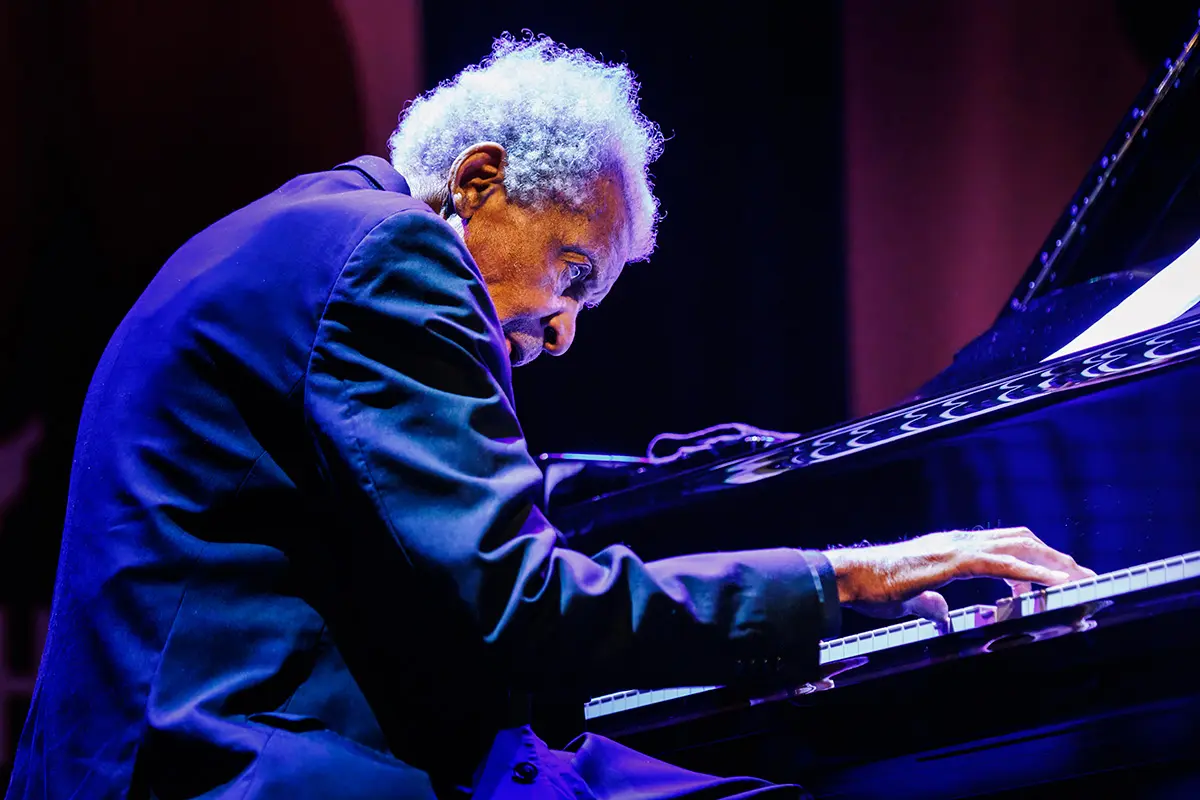
The first time I met Abdullah Ibrahim, he growled at me. It was sometime around 2003. A rainy Cape Town afternoon on Plein Street, not far from Parliament. He was walking alone towards the mountain, collar turned up against the weather and hat pulled low over his face.
For a moment, he looked anonymous, which is perhaps the closest a man of his stature could ever come to anonymity in his own city. I recognised him immediately and offered what I thought was a polite greeting.
“Hello, Mister Ibrahim.”
He looked at me, emitted something between a grunt and a growl and kept walking. At the time, I assumed I had caught him on a bad day. Over the years, I learned that what I had experienced was simply Abdullah Ibrahim being Abdullah Ibrahim. He was difficult.
Now that he is gone, I hope we can resist the temptation to pretend otherwise. Death tends to sand down people’s rough edges. We elevate them into symbols, remove the contradictions and quietly edit out the parts that make us uncomfortable. We prefer uncomplicated heroes.
We prefer legends who are grateful, accessible and endlessly generous with their time and patience.
Abdullah Ibrahim was very little of those things.He could be suspicious, abrupt, cryptic and infuriating. Conversations rarely travelled in a straight line.
Ask him about a concert and you could find yourself listening to a story about a monkey and a shark. Ask him about South Africa and he might start discussing Einstein’s theory of the curvature of time and space.
Ask him a direct question and he often appeared to answer something entirely different.
Three days later you would realise he had answered your question after all.
Over the last decade I interviewed him numerous times. During Covid, when I hosted a nightly talk show, he would occasionally call from Munich. Sometimes a text message would arrive signed: “AI, Munich.” On Sunday mornings another message would appear.
“Come Sunday. Mahalia Jackson.”
He would later detail how Mahalia Jackson’s recording of Come Sunday remained deeply important to him, tied to memories of Duke Ellington’s Sacred Concerts and the spiritual tradition that sat at the centre of his musical worldview. Ibrahim also had a small organising role for the concerts as he was in Ellington’s larger orbit.
It is the Duke who elevated both Abdullah (then recording under the name Dollar Brand) and his wife Sathima Bea Benjamin’s international careers.
Our relationship was never particularly close. It was respectful, private and always maintained at arm’s length. Yet over the years, we spoke about many things. Rumi. The Green Kalahari. Credo Mutwa. Cape Town. Memory. History. Music. His farm in the Northern Cape.
Strangely, for all those conversations, we never spoke about family. We never discussed the complicated personal relationships that shaped him or the hurt that existed alongside the brilliance.
Those stories belong to the people who lived them.
Musical genius does not automatically translate into successful relationships, attentive fatherhood or uncomplicated love. Like many men of his generation and particularly men shaped by exile, obsession and lifelong artistic pursuit, Abdullah Ibrahim left behind both admiration and hurt. We do him no service by pretending otherwise.
What became increasingly clear to me, however, was that beneath every conversation sat the same unresolved question: identity.
Nobody seemed more preoccupied by the question of who he was than Abdullah Ibrahim. During an interview in 2024, I asked him why so many of his compositions carried women’s names. Nisa. Joan. Moniebah. Song for Sathima. His answer drifted towards grandmothers, whom he described as the keepers of memory. Then, unexpectedly, he became personal.
“My name is on my ID card. It says Adolph Johannes Brand. It’s not me. My name is Sentso. My father is Mosotho.” His father had died when he was four years old. The story he told me next stayed with me long after the interview ended. His grandmother, he explained, had given him another identity, another way of moving through the world. “She gave me this identity so I could have an easier passage.”
Easier passage in apartheid South Africa, where being coloured afforded slightly more privilege than being a black African. That single sentence seemed to explain an extraordinary amount about Abdullah Ibrahim.
How much of his life had been spent negotiating identities assigned by other people?
How much of his music represented an attempt to recover something older, deeper and more authentic than the categories apartheid and colonialism imposed upon him?
Perhaps that is why he became increasingly irritated by Mannenberg.
The irony is that South Africans loved the composition precisely because it represented so much of what made him great. Yet the older Abdullah became, the more resistant he seemed to being defined by it. Every time he returned home, somebody wanted Mannenberg. Promoters wanted it. The audience wanted it. Journalists wanted it. Award ceremonies wanted it. The song had become larger than the man who created it.
He complained about this repeatedly.
“Every time I play in South Africa, they tell me what I must play.”
What irritated him was not the composition itself. Quite the opposite. He spoke warmly about its creation. He recalled being in a studio in Bloem Street while the country was burning and young people were protesting. During a break in the recording session, he saw an upright piano standing in the corner. As was his custom, he approached the instrument as though it possessed its own intelligence.
“What have you got for me?” he asked.
The answer became Mannenberg.
“We played for seventeen minutes,” he told me. “Something happened here. Finally, we can play our music.”
That final sentence is the key to understanding why Mannenberg became the unofficial anthem of the anti-apartheid movement.
The song was never simply about a place on the Cape Flats. It was about recognition. It was about hearing oneself reflected in music after generations of being told that your culture, your language and your traditions were somehow secondary. It carried echoes of ghoema, marabi, church music and township jazz. It sounded unmistakably South African without asking permission to do so.
Unlike many protest songs, Mannenberg never preached. It never instructed listeners what to think. Instead, it created a feeling. A possibility. It sounded like freedom before freedom arrived. It sounded like people discovering their own voice.
The outro lyrics in Afrikaans –“Julle kan ma New York toe gaan, ek bly in die Mannenberg” [You can go to New York, I live in Mannenberg] – are perhaps a hint to the fight for liberation in South Africa and a tacit message to exiles.
For a generation of South Africans living under apartheid, that mattered enormously.
Yet the deeper irony remains that while the movement heard an anthem, Abdullah Ibrahim heard something else. He heard a moment. A breakthrough. One chapter in a much longer story. The rest of us wanted to return to that chapter again and again. He wanted to keep moving forward.
Perhaps that is why he never seemed particularly interested in awards, ceremonies or the endless celebration of his own legacy. Every return to South Africa brought another honour, another recognition, another attempt to turn him into a national treasure. Yet he often appeared uncomfortable with the process.
Hero worship held little appeal for someone who spent his entire life resisting labels. In 2024, on his return home for a concert around his 90th birthday, Ibrahim appeared uninterested in the fawning of ministers, VIPs and hangers-on who all wanted to celebrate him.
The truth is that Abdullah Ibrahim was too complicated to become a monument. He remained, until the very end, a searching man. A Cape Town boy trying to understand Africa. An exile trying to understand home. A musician trying to understand identity. A difficult man trying to understand himself.
The greatness is not diminished by those contradictions. If anything, it becomes more remarkable.
Because in the end, for all the conversations about exile, memory, belonging and identity, Abdullah Ibrahim always arrived at the same place.
The music.
He could spend an hour discussing cosmology, homelessness, ancestry and the nature of time itself. Then he would sit down at a piano and tell you exactly what he meant.
“Inna lillahi wa inna ilayhi raji’un,” he told me during one of our final telephone conversations.
From God we come. And to Him we shall return. “That’s it,” he said.