


The title arrived after the music. Shane Cooper had already written the composition when he stumbled across a line in a poem by the 13th-century Persian poet Rumi. The poem was called Cry Out in Your Weakness. The line that stopped him in his tracks was simple yet surprising: "Let the sky open under your feet." "It had a resonance with the emotion of the song," Cooper tells me.
The piece itself was built around a contrast. The verse felt rooted to the earth; the chorus felt weightless, suspended somewhere above it. "The verse section is very grounded and very rooted in the earth," he explains. "And the chorus has a feeling of floating, a feeling of being lifted into the air." The title seemed to contain both ideas at once: the ground beneath your feet, and the sky opening below it—stability and possibility occupying the same space.
Months later, when the members of Skyjack gathered to discuss what to call their fourth album, the title emerged again. "It was unanimously decided to be a good feeling that embodied the whole album," Cooper says. Listening to Let The Sky Open Under Your Feet, due for release on July 3, it's hard not to hear why.
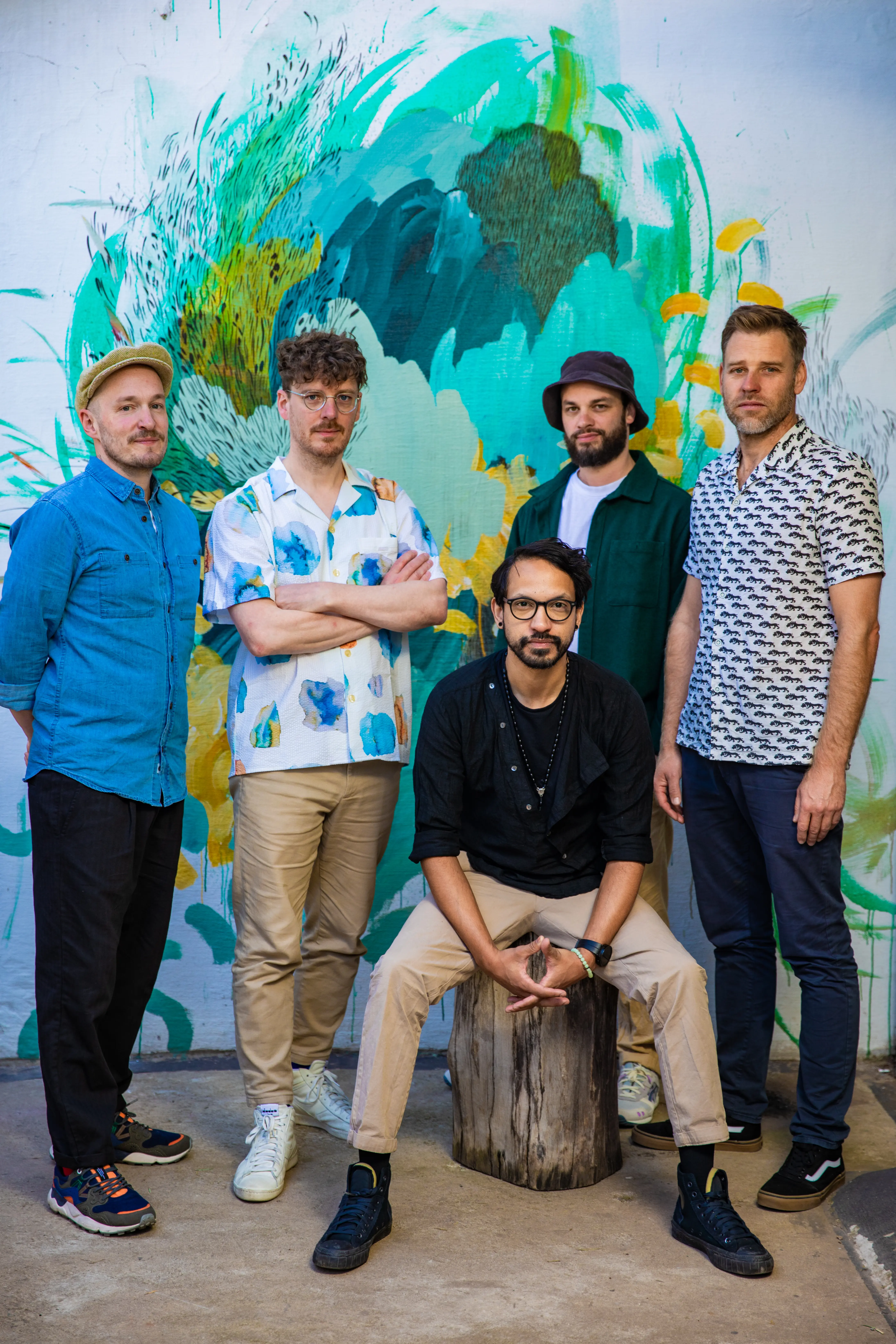
The album arrives more than a decade into the life of a band that has become one of the most unusual collaborations in contemporary jazz: three South Africans and two Swiss musicians spread across continents but bound together by a musical relationship that seems to deepen every time they reunite. The quintet consists of Cooper on bass, pianist Kyle Shepherd and drummer Jonno Sweetman from South Africa, alongside Swiss tenor saxophonist Marc Olivier Stucki and trombonist Andreas Tschopp. Together they have spent the last 13 years building a body of work that now stretches across four albums: Skyjack (2015), The Hunter (2019), Light Cycle (2024) and now Let The Sky Open Under Your Feet.
What makes their longevity remarkable is the fact that the band appears to be growing more adventurous rather than more predictable. "The nice thing is that we're still really a musical unit," says Tschopp. "Every time feels like we are having more and more resources as a group of people and also as a unit of musicians. To me, it feels like it hasn't reached a plateau yet."
For a band entering its second decade, that's not a small claim. Many ensembles spend years developing a shared language only to become trapped by it. Familiarity can harden into routine, and the surprise disappears. Skyjack seems determined to resist that fate. "We still actually do end up surprising each other with things that happen musically," Sweetman says.
"We're really diving into improvisation," he continues. "There are moments where each one of us brings something completely fresh and new. It can happen at a gig. It can be something that keeps it exciting. That flow state where we're all together and just hearing and feeling the same thing at the same time." The comment speaks to something that comes up repeatedly when talking to the band. They rarely describe Skyjack in terms of technical skill, even though each member is a highly accomplished musician. Instead, they talk about trust, listening and chemistry.
For Cooper, that chemistry begins with the rhythm section. Before Sweetman joined Skyjack in 2022, replacing drummer Kesivan Naidoo, he had already spent years playing alongside Cooper and Shepherd in various projects, including the Kyle Shepherd Trio. "Kyle, Jonno and I have been playing together for almost 20 years," Cooper says. "There's a certain unspoken level of ESP, if you will, that we have just through time together."
The same could be said of the band's European contingent. Tschopp and Stucki also bring nearly two decades of shared musical history to the ensemble. The result is a group built upon two long-standing friendships that eventually converged into a third. "We're like a really close family at this point," Cooper says.
That family dynamic becomes particularly important because Skyjack's members spend much of the year apart. The South Africans are based at home, while the Swiss musicians remain in Europe. In many years they only see each other once or twice. Yet when they reunite, the distance seems to evaporate. "We only see each other once or twice a year," Tschopp says. "So lots of things happen in between. But every time it feels fresh to meet the friends again." It's a statement that feels deceptively simple.

Behind it lies one of the central mysteries of the band: How does a group spread across continents maintain such cohesion? Tschopp believes the answer is that Skyjack has gradually become something larger than the national traditions from which it emerged. Asked whether Swiss and South African jazz identities still feel distinct within the band or if it feels like the band has formed its own nationality at this point, he giggles a bit before responding: "Yes, its own nationality. That was a nice way to put it."
It's difficult to imagine a better description. Certainly, the music draws heavily from South African jazz traditions. Shepherd himself points to the influence of figures like Abdullah Ibrahim, Bheki Mseleku and Zim Ngqawana on the generation of musicians that emerged during the mid-2000s. But Skyjack's sound no longer belongs entirely to either country. "We are all thinking of the other members of the group when we write," Tschopp explains. "I'm writing specifically for Kyle and Jonno and Shane and Marc and myself. So it has developed its own language."
That language is built through conversation. Cooper repeatedly describes the band's approach to improvisation in social terms. "The way we work is really about listening," he says. "No one begins and speaks on top of others, so to speak, to use the analogy of conversation and dialogue."
The comparison feels appropriate. When I ask what freedom Skyjack offers him that his own projects don't, Shepherd laughs. "It's kind of known among jazz musicians that the band leader has the least amount of fun at the gig." In his own groups, there are logistics to manage, venues to deal with and responsibilities to shoulder. Skyjack offers something different. "We are all sidemen and we are all leaders at the same time," he says.
The structure extends into the writing process. For the band's last two albums, each member has been expected to arrive with two compositions. The framework is simple but effective: everyone contributes, and everyone takes ownership. "There's nothing like a good deadline to get a composer working," Shepherd jokes.
Tschopp remembers the flurry of activity that precedes each reunion. "A week before we would actually meet, everybody was starting to send first sketches or little pre-productions and charts around," he says. "It was a really nice vibe to get into the Skyjack feeling."
That feeling carried into the making of Let The Sky Open Under Your Feet. Returning to Sunset Recording Studios and working again with the same production team that shaped Light Cycle, the band found itself operating from a position of confidence. "We were super comfortable this time," Sweetman says. "I can hear the progression in the two albums. I love the previous album but this one, there is a progression. There's a little bit more of a glue that's knitted the songs together."
For listeners approaching Skyjack for the first time, several members point toward the title track as the clearest entry point. Sweetman names it among the songs that best capture the band's essence. Shepherd goes further. "It feels to me like a real quintessential Skyjack tune of where we are now," he says.
What he hears in the piece is something deeply rooted in South African musical traditions while remaining open to contemporary influences and possibilities. Much like the band itself, the title track points backward and forward simultaneously. It acknowledges the years of history that brought these musicians together while suggesting there is still somewhere new to go.
That may ultimately be the achievement of Skyjack. After thirteen years, they still sound curious, still surprise each other and still find new things to say. And perhaps most remarkably, they still seem slightly amazed that this unlikely partnership between five musicians from different countries, backgrounds and life experiences works as effortlessly as it does.
"Oftentimes we get questions about Europe versus South Africa," Tschopp says near the end of our conversation. "But the actual interesting stuff for me is that it feels almost effortless to get together and play and create music together." "That's kind of remarkable."
It is. Like the title of their new album, Skyjack's story lives in the space between being grounded and being lifted. Between familiarity and discovery. Between continents and cultures. Somewhere in that unlikely space, over thirteen years and four albums, they have built a nationality all their own.