


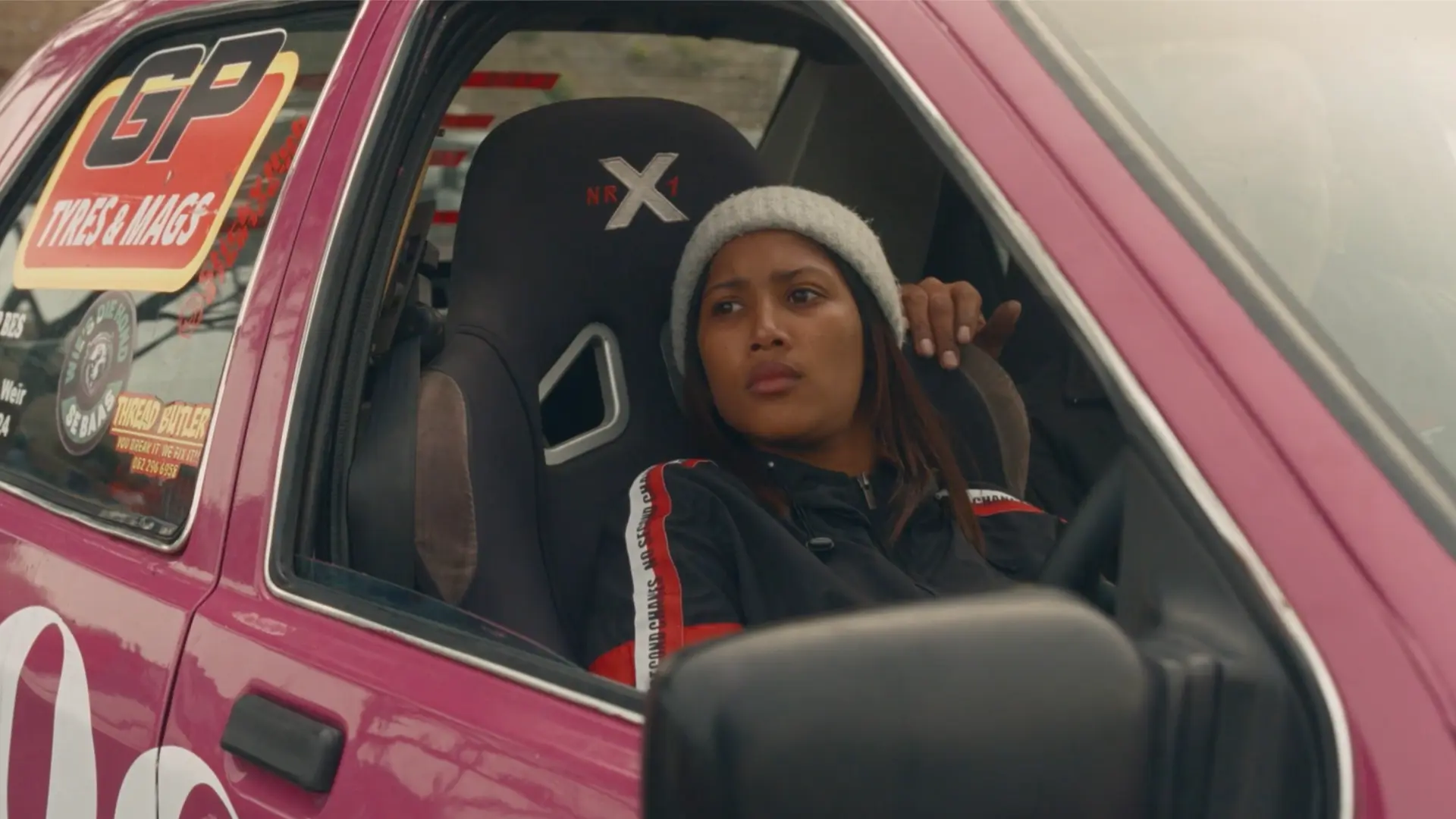
Julia Jansch’s documentary From Dust We Spin is as much about the distinctly South African motorsport of car spinning as it is about a girl learning to take up space in her own life.
The film just made its SA debut at the Durban International Film Festival where it picked up the award for Best South African Documentary, making it eligible for Oscar consideration.
It’s a visceral and intimate exploration of the word of spinning, specifically in the coloured community of the Cape Flats where it has a long history, stretching from the 1980s during apartheid.
The film follows teenager Logan Maart, who despite her quiet de-meanour has developed a passion for spinning and her teacher, Mark Linden, who’s ready to confront any obstacle to pursue his love for spinning, even the law.
Logan is far from the first face that would usually come to mind when people think of spinning but through the film we come to understand how it has been a lifeline for her through a particularly difficult period. We learn that she attempted suicide and was unsuccessful only because her parents found her and intervened before it was too late.
“It feels like I’m losing hope,” she says at one point in the documentary. “That’s how my zero feels.”
She finds relief behind the steering wheel of a car: “When I touch the steering wheel, house problems, school worries … they just go away.”
In one especially compelling scene, Logan and Mark discuss the sign for infinity, the figure eight. This is an important aspect of spinning because once a driver is able to consistently spin in the shape of the figure eight, they’re able to master all manner of tricks and manoeuvres.
“What do you think is infinity?” Mark asks Logan.
“I think infinity is forever. It symbolises forever with the figure of eight … So constantly flowing,” she responds.
The scene of teacher and pupil talking is intercut with a scene of Logan in class creating the figure eight with a pencil in her notebook and repeatedly going over it, almost as if she’s in a trance. It’s one of many methods Julia uses to communicate the interiority of her taciturn protagonist.
Later in the film when we see an overhead drone shot of Logan successfully creating a figure eight with the exhaust fumes of her car, it’s a moment of achievement the narrative has prepared us to celebrate. Logan has gone from zero to infinity.
Jansch didn’t set out to make a film about spinning. She met Mark years earlier, while he was working as a driver on her documentary The Academy, about a young sailor from the Cape Flats.
“He was telling me about spinning in the Cape Flats and how spinning is helping people have an interest in something other than the drugs and the gangs,” she says. “I didn’t know what he meant by spinning. I thought it was like what they do in the gym.”
Then he showed her YouTube videos. “It blew my mind, really, because I’m a very nervous person. You know, I’m scared of flying, I don’t do roller-coasters. And I was like: ‘This is crazy! They’re not wearing helmets, they’re not wearing seatbelts and they’re jumping out of cars.’”
Her first instinct, she admits, was that this was a story for a male director to tell. Then her long-time collaborator, director of photography Jacques Naudé, saw the footage and lit up. “In that moment I realised audiences would go all googly-eyed over these cars. I still had to go on a long journey to discover Logan, the spirit, the wound and the transcendence in the story.
“But it was the cars that made me think: ‘Okay, this is cool.’”
The instinct to look for the teacher-student relationship at the heart of a subject runs through Jansch’s other films My Father the Mover and The Academy.
“I love a story about a mentor and someone who’s got something to learn. Not just physically or intellectually but spiritually,” she says.
When Mark told her about Slip and Slide, the informal school he runs for young spinners, she asked him: Did he have any female students? “I thought: ‘It’s a very male world, this is a very male sport and how amazing would it be if he was teaching a woman how to spin.’” He’d just started teaching Logan, the daughter of his best friend, Llewelyn.
The film gives us more insight into the teacher. We see Mark struggling with grief over the loss of his mother, whose ashes he is holding onto. Nicknamed “Bull” for his
quick temper, Mark has been to jail and now tries to keep himself and young people in the Cape Flats away from the troubles of gang life through car spinning.
The camera work used to capture the scenes of cars spinning is immersive and cinematic, taking you everywhere from inside the car with the intrepid driver to the outskirts of the performance area where onlookers stand dangerously close to the action.
“You gotta get the car candy,” Jansch remembers being told by her director of photography. Getting it meant rigging cameras to the cars, running a phantom camera to slow the chaos down and sending drones up to trace the figure eights from above. Naudé insisted Jansch experience it herself before she could direct it properly. “He said: ‘You cannot make this film as the director until you’ve spun in one of these cars. It’s a spiritual experience.’”
She got in, reluctantly, with veteran spinner Eddie Rasta behind the wheel. “It was honestly incredible.”

Julia shot the film over 18 months and it shows in the intimacy of some of the moments she’s able to capture in Logan and Mark’s lives. It’s evident from the film that she took the time to build a level of trust with her two documentary subjects that allowed them to be completely comfortable with her.
“He wears his anger on his sleeve; he wears his heart on his sleeve,”Julia says about Mark. “You can easily get him there.” Logan was the opposite. “She is still waters run deep. It took 18 months to get her to open up.”
She tells me that one time she found Logan lying in bed unable to get up, which happened a few times. At that point a 40-minute cut of the film had been completed. It was originally intended to be a short film. Julia says she left Logan alone in the dark of her curtained room with her cellphone long enough for her to watch the whole film.
“She came out 40 minutes later, she had showered and she had dressed. It was crazy. She’d seen herself in this new light that was always there within her. Sometimes when other people see it in you, you start to believe it.”
This whole experience has been a boon for Logan who had been struggling with depression and falling back in school when Julia first met her. She has since completed matric.
When I spoke to Julia she mentioned that Logan was scheduled
to take part in a discussion in a panel at Cape Talk as part of some Women’s Day commemorations and that she was excited to see the Cape Talk offices.
Framing the film around Logan and Mark, their personal struggles, their relationship to spinning and their relationship to each other as teacher and pupil is the best aspect of the documentary.
There are hints of the wider conversation around spinning including its formalisation as a sport and Gayton McKenzie, the minister of sports, arts and culture, appears in the documentary a few times seemingly to be in support of it.
“This isn’t an investigative journalism piece on whether Gayton’s delivering on promises,” she says. “It’s Mark’s point of view I’m showing because it’s about Mark and Logan.”
She has, by her own admission, a whole alternate cut sitting somewhere that leans harder into the politics — the safety disputes, the informal spinning economy, the tension between grassroots organisers and the officials trying to formalise the sport.
“It’s a fascinating case study from an academic point of view. But that’s not the film we’re making this time.”
What Julia has made, in the end, is a character study. A beautiful one. Mark is the Mr Miyagi to Logan’s Daniel LaRusso and the figure eight is their “wax on, wax off”.
From Dust We Spin starts you at zero and leaves you convinced that with the right car, the right open space and a driver just crazy and skilled enough to stand on top of it mid-spin, infinity isn’t just a shape. It’s reachable.