


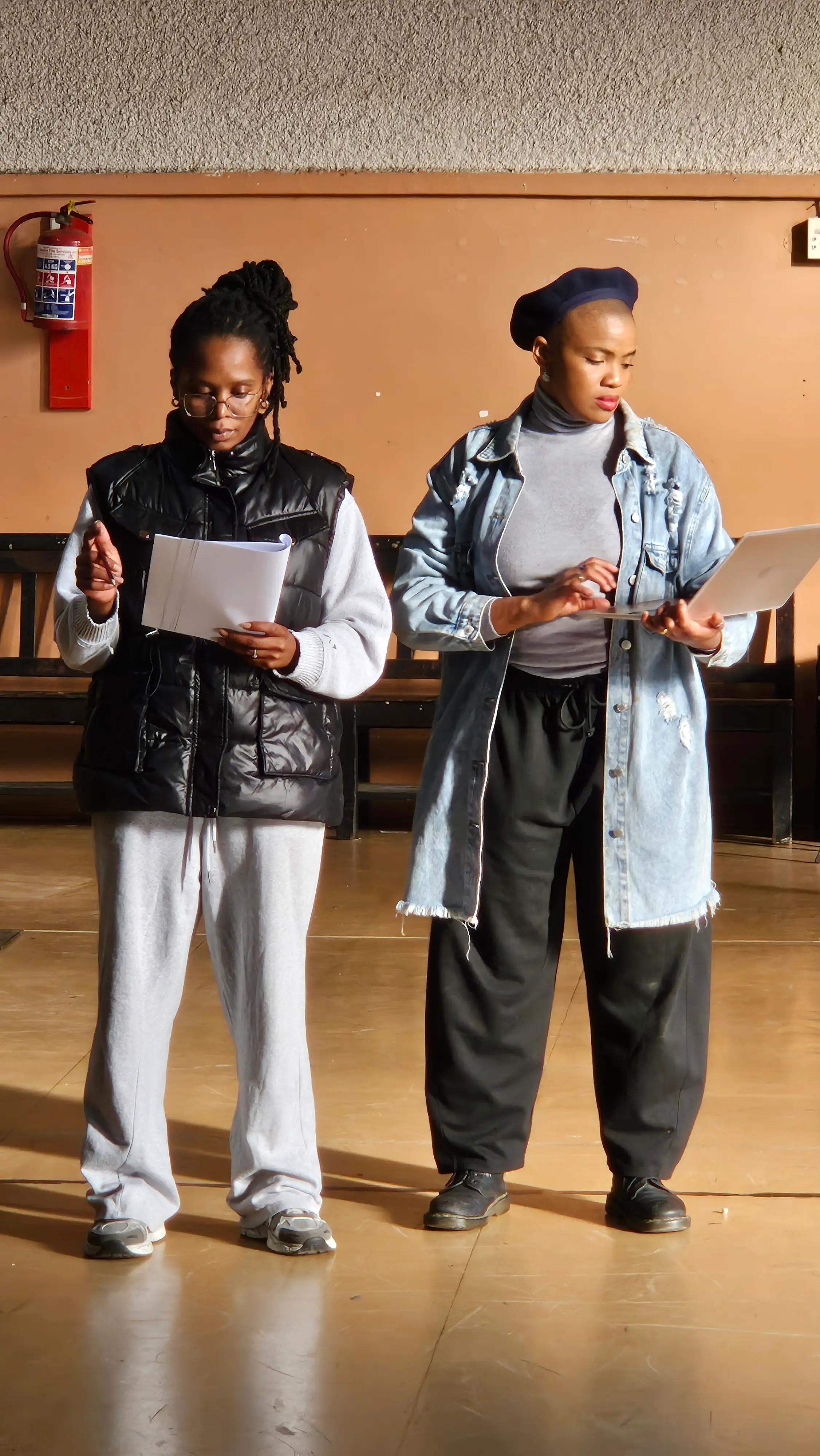
In a rehearsal room in Braamfontein, 30 teenagers spend their July school holidays singing, dancing and acting six days a week.
They’re building a musical about what it takes to make it in the world of performing arts. And the two women guiding them through it know exactly what that costs — because they’ve lived it.
On The List: Broadway the NSA Way opens this week for a four-day run at The Lesedi, Joburg Theatre, bringing together on one stage every discipline the National School of the Arts (NSA) teaches: art, dance, drama and music.
Co-directing are Khaya Ndlovu Mpehle and Kensiwe Tshabalala, two women whose journeys through South African theatre have often followed unexpected paths.
The production is a full circle moment for Ndlovu Mpehle, who graduated from the NSA in 2009 as a dance major. Her name is on the school’s wall of top achievers.
From there she went to the Tshwane University of Technology, then turned down a spot in The
Lion King on London’s West End at 17 to instead join Dada Masilo’s company, touring internationally with her for six years. Just before Covid hit, she left to start her own company, K-Movement. Along the way she’s worked with Sylvia Glasser, Mamela Nyamza, James Ngcobo and Janice Honeyman and now choreographs the annual pantomime at Joburg Theatre.
Tshabalala’s route ran through the same TUT hallways. She and Ndlovu Mpehle met there and Tshabalala taught her tap the next year. “That was a baptism of fire,” she laughs.
After graduating in 2010 she moved into children’s theatre, earned a supporting actress nomination, then left to study acting for film in the US, splitting six years between New York and Los Angeles before Covid brought her home.
Back in South Africa, she landed a role in an original musical choreographed by Ndlovu Mpehle and directed by Honeyman. Their reunion, unplanned, happened through an audition. Since then Tshabalala has worked across musicals and pantomimes. She recently performed at the Market Theatre in Under the Shade of a Tree I Sat and Wept, about the Truth and Reconciliation Commission.
“These are the types of stories I like to make,” she says, “stories that are about South African history, about South Africa’s humanity and the integrity we have as a people.”
On The List began when NSA’s artistic director Brenda Sakellarides, who had worked with Ndlovu Mpehle before, brought K-Movement in with a simple brief: create a Broadway musical, the NSA way, with grit that speaks to a South African audience.
What followed was an open audition process running from February through to now, drawing more than 100 pupils from grade 8 to matric across all four NSA disciplines. Ndlovu Mpehle says she wasn’t just watching for talent.
“Can these kids be authentic to themselves? Can they take up and own space?” She says that was the real question because the show they were building was “a play within a play where we show real people auditioning and putting themselves out there to be on the list”.
That audition process became the story. Tshabalala says reuniting with Ndlovu Mpehle during an audition sparked the realisation that performing artists have to show up in person and prove themselves.
“I know what it is to be hungry, to get into the room and to show the world what you’ve got,” she says of her own off-Broadway experience in New York.
From there the two began shaping their own distinctly South African version of A Chorus Line.
“We wanted the story to be a love letter to our country,” Tshabalala says, “a people who dream big.”
In the musical, “on the list” becomes shorthand for making it, for reaching whatever a person’s own definition of success looks like.
The central figure in the musical is a young, acclaimed female director searching for the country’s next great musical, a choice that came from the two women’s experience in the industry.
“The musical theatre industry in South Africa is not really reflecting the South African experience,” Tshabalala says. “We don’t see a lot of women in leadership … and so our own personal journey, forging a path as theatre-makers in South Africa, became the inspiration for our protagonist.”
She describes the pressure of being “lonely at the top”, of being expected to be likeable in a job nobody would ask a man to be likeable in. Ndlovu Mpehle adds that the show also pulls back a curtain rarely lifted for audiences: the hierarchy that sits above even the director.
“Why do shows close down? Why do castings change? Why is this creative director a certain way emotionally in the space and a certain way when investors are there?” Directing, she says, comes with a cost. The pull between artistic integrity and the funders who might or might not support it is always present.
Co-directing meant negotiating all that together. Both women say it started with setting ego aside. “It wasn’t about that,” Ndlovu Mpehle says. “Our vision was, at the end of the day, to change these kids’ lives … What does the production need?”

Tshabalala calls it “divide, conquer and remembering that we are in service of the story”, adding that the pupils have watched the two of them model compromise and honesty in real time.
Managing a cast of 30 teenagers, rehearsing through their school holiday, brought its own lessons. Tshabalala says the audition process looked for “triple threats” willing to work in their areas of discomfort.
Determination mattered more than polish. Ndlovu Mpehle describes balancing the push with patience, giving the pupils room to feel validated rather than simply instructed.
“Don’t make final decisions based on your emotions,” she tells them. “But also, don’t forget that this is a family.” She and Tshabalala, women of faith, pray with the cast before rehearsals.
“We also can’t carry so many emotions on our shoulders. We leave it to God.”
For Ndlovu Mpehle, returning to her old school carries its own weight.
“It feels so surreal,” she says. “For many years I never understood why the NSA never called me … but God knows His timing.”
Watching this generation, she wants them to learn something she didn’t have language for at their age: self-preservation. “Not every opportunity is your opportunity,” she tells them. “Enjoy the fact that you can do your homework.”
Tshabalala points to a pressure this generation carries that her own didn’t: comparing themselves not just to the most talented kid in the room but to everyone online. “There’s this pressure of ‘I also have to make it big immediately’, because of being able to see what’s happening online,” she says. The theme runs straight into the show, alongside questions of influencer culture and what it means to be seen.
Asked what she hopes audiences take from the show, Ndlovu Mpehle resists the idea of a single message.
“Once the art is out there, it’s for their interpretation,” she says. What she does want is a return to valuing artists, a lesson she says Covid taught, briefly, before it was forgotten. “Your constant support keeps the art going for these kids.”
Tshabalala’s answer lands on the thing no screen can replicate. “There is no technology that can replace the beauty of seeing any human being pour their heart and soul out in front of you,” she says. “That’s going to be the biggest gift for everybody.”
On The List: Broadway the NSA Way runs from 6 to 9 August at The Lesedi, Joburg Theatre, in Braamfontein. Tickets are available via webtickets.co.za.