


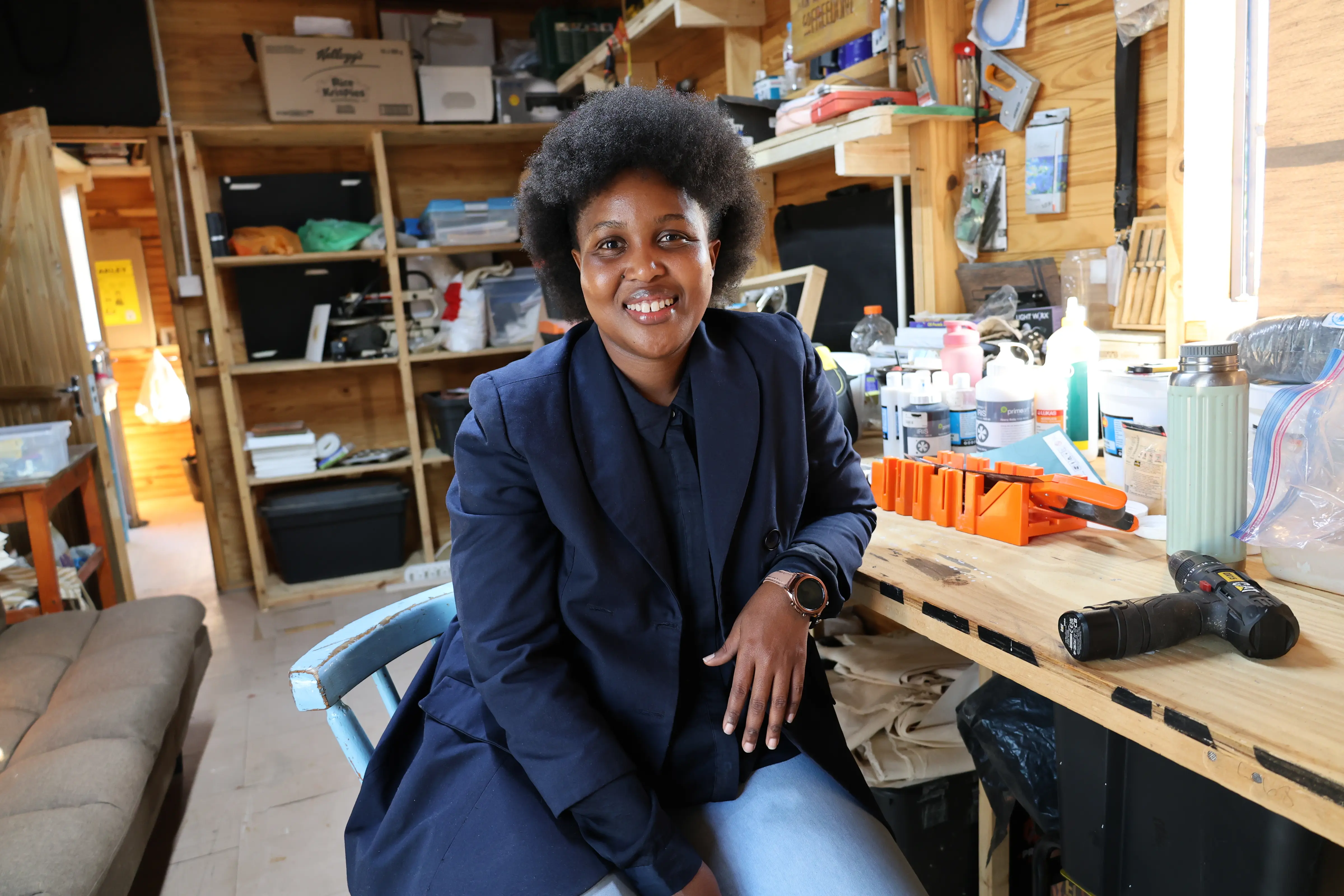
Kelebogile Marope is trying to understand what happened on August 12.
“I think I’m still in shock,” she says from Botswana, four days after being named the 2026 FNB Art Prize winner. “I thought it would have worn off after the fourth day but it’s still there. I can feel it simmering down but I’m still in that overwhelming wave.”
Perhaps the disbelief lingers because recognition has arrived at the end of a long practice of showing up. Of looking closely at things most people have learnt to overlook.
Marope’s work asks us to look again. At homes. At objects. At the seemingly insignificant rituals that make up a life. At the furniture we grow accustomed to, the domestic spaces we take for granted and the histories embedded in the things that surround us.
Her sculptures, often made from plaster, white cement, grout and other materials associated with the construction of a home, are an excavation of memory. She also works with drawing and mixed media. They are less interested in grand historical monuments than in the quiet evidence of ordinary lives.
“I was looking at the structure of the home in its entirety,” she explains. “And then I thought about it from an archaeological perspective — how it would look if we were to be archaeologists of our own present time.”
It is a question that sits at the centre of Marope’s practice: What if we did not have to wait centuries for archaeologists to discover how we lived? What if we became the archivists of our own lives while we are living them?
Marope was born in Botswana but spent much of her formative life in South Africa. From the age of 13, she was sent across the border by her parents, who wanted her to have greater exposure to education and opportunities. She completed her secondary education, university and postgraduate studies in South Africa before eventually returning home.
“I can’t speak about just Botswana alone and I can’t speak about South Africa alone,” she says. “I was born in Botswana, grew up in South Africa and learnt to be an artist in both spaces.”
Returning home was not simply a geographical decision. It was emotional, familial and eventually, necessary.
“I’ve grown up with that sense of homesickness,” she says. “It’s like a friend that you know very well. You always know that you will go home but you don’t know when.”
That longing became more complicated after the death of her father during the Covid-19 pandemic. As the eldest child, Marope felt the weight of responsibility settle differently around her.
“I need to come back home,” she remembers thinking. “It was more like the responsibility of being home, being around my mom, my sisters.”
It is difficult not to see that return in the work. For Marope, home is not merely a physical structure. It is where identity is formed, where language is acquired, where relationships are negotiated and where memories become attached to objects.
Her body of work, Archaeologies of Use, takes familiar domestic objects and structures and makes them strange enough for us to notice them again.
“I was looking at the housewife, the woman who is going through her day and feels lost between all the tasks that are happening in the home,” she says. “At one end, I’m looking at the teenager who’s growing up in the home, who doesn’t see value in the home structure because of different things that are happening.”
The home, she says, is one of the most neglected spaces in the stories we tell about ourselves.
“And that’s where everything happens,” she says. “That’s where we are in our formative years. That’s where we learn how to talk. That’s where we learn how to do so many things.”
We often only understand the value of these spaces when they are threatened by departure or loss. When a house is emptied. When a parent dies. When a family moves. When a cupboard has to be cleared and suddenly an object that seemed meaningless becomes an artefact.
“There’s like spillages of awe that happens when you’re put at a juncture to notice what’s happening within the home,” Marope says.
One of the most powerful memories informing this thinking happened when she was a schoolgirl. After travelling home on a 24-hour bus journey from boarding school, exhausted and sleep-deprived, she walked into the bathroom and leaned over the sink to brush her teeth. Something felt wrong.
“My body had memorised the height of the basins in boarding school,” she says. “It was not used to the basin that I had grown up within, the home I grew up in.”
For a moment, she became a stranger in her own home.
“I remember thinking: ‘Did the sink grow taller?’”
The experience revealed something profound: memory is not only stored in photographs, documents or stories. It lives in the body. It lives in muscle memory, in the arrangement of a room, in the height of a basin and in the objects we stop noticing because they have become part of us.
“I immediately became a stranger in my home space,” she says.
That moment has stayed with her because it demonstrated how easily we can overlook what she calls “crucial data” in our own histories. For Marope, art is an attempt to recover some of the data. Her work asks viewers to slow down. To resist the impulse to arrive at a conclusion too quickly. To look beneath what appears obvious.
“We can easily miss crucial data,” she says. “What I’m trying to help people gravitate towards is listening again, being attentive again, not being so quick to get to the full stop.”
The attentiveness extends to family. Marope believes that beneath familiar behaviours are often stories we have never been given the language to understand. Anger, for instance, might conceal vulnerability. Silence might contain grief. An ordinary object might carry a history that has never been spoken.
“The world starts with family,” she says.
Her work therefore becomes a form of preservation. A way of creating family museums from the things that might otherwise disappear.
“We go to museums looking at these works that were done by who and who, how many years ago or decades ago, generations ago and we are in awe,” she says. “But our own stories are also very important.”
Even something as mundane as an iron can become an archive. Through her work, Marope discovered stories about her father — that he loved ironing — and then learnt that her grandfather had also shared the habit.
“Little stories like that and then you hear a dimension that you haven’t heard before,” she says. “It adds another level to the story that you are also holding.”
Now, the FNB Art Prize has added another chapter to Marope’s story. Standing on stage as her name was announced, she describes being overwhelmed by the generosity of being seen.
“It’s another level of someone lifting you up,” she says.
But beyond the prestige, she believes the recognition carries a larger responsibility. It challenges the old idea that creative vocations are somehow impractical, unstable or incapable of sustaining a life. For Marope, the prize is proof that persistence can eventually become visible. The prize, she says, has given her “a whole lot of buckets and baths filled with hope”.
“Serious hope,” she adds.
Perhaps that is the most fitting description of Marope’s practice, too. It is serious hope: the belief that what appears ordinary is worthy of attention; that our families are archives; that our homes contain histories; that objects can speak; that memory can be recovered; and that the stories we inherit do not have to disappear simply because nobody thought to write them down.