


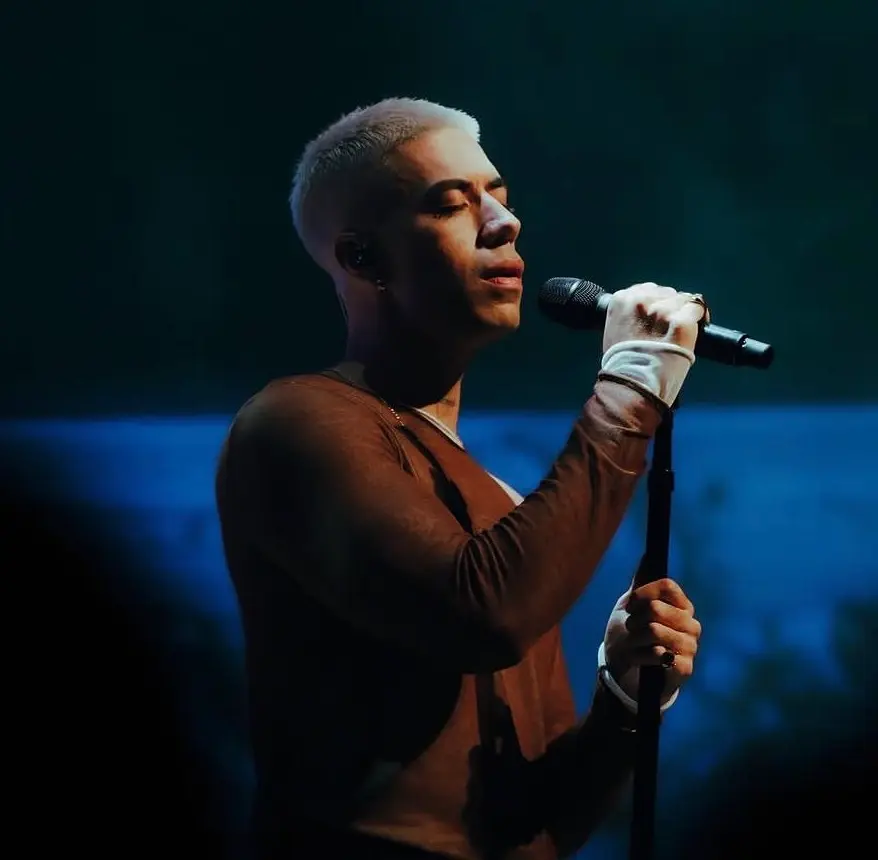
New Zealand soul singer and songwriter Te Karehana Gardiner-Toi, aka TEEKS, is performing for the first time in South Africa this week. His music is rooted in his Māori heritage. For the artist, carrying indigenous lineage influences the way he navigates the global music industry. He has an anticipation to discover synergies of South Africa's rich cultural tapestry.
“My culture and heritage definitely inform what I do with my work and the way I approach music through songwriting and live performance. But beyond that, just my culture, my heritage and the values I grew up with inform my everyday life and how I navigate the world.
“I lead with a deep understanding of who I am, who I come from and where I come from. Because in my culture, heritage and lineage and ancestry are incredibly important to self-understanding and self-awareness. We have a lot of traditions, cultural practices and rituals that we, I guess, use to inform the way we move through life to protect ourselves and also honour things in the right way.
“In regard to performing live, I like to think of live performance as a ceremony and being able to have that shared experience, that reciprocity of energy in one space with a concentration of energy. It is a huge privilege to be in control of that, and it is a responsibility. I don't take that lightly and I always want to do the best I can. But, you know, there's the crossover with the rich culture that is embedded in the tapestry of South Africa and Africa.”
The artist is influenced by soul music.
“It would be remiss of me not to acknowledge the origin of soul music and where it comes from. The world has derived the benefit through soul music and black culture. This originates back to Africa. These are bigger conversations and deeper conversations.”
The singer’s tracks, among them First Time and Remember Me, gained massive organic traction in South Africa before he set foot here. He has an idea of why his particular brand of quiet, introspective soul resonates with his South African audience.
“Going back to the essence of soul music, where it originates from and who it originates from, people are connecting to that. It's important to acknowledge the influence that black culture and Africa have had on the rest of the world and informed genres, including soul music, rock music and pretty much every genre there is.
“As an introspective person, I'm an introvert. A lot of the time I keep to myself but that's where I find the greatest access, you know, to tap into the realm, which I feel like music, songs, already out there, already written and it's just up to me, up to the artists to bring them into realisation, into this dimension. I feel very grateful and blessed that people are connected to the music in that way.”
Soul and R&B have often been avenues for male artists to express raw emotion. For TEEKS, his work tackles vulnerability in a way that feels intentional and decolonial.
His path to emotional honesty has taught him a few lessons about modern masculinity.
“It's been a journey for me, you know, because there's also a lot of unlearning that I've had to do. And even though I'm an indigenous man, I live in a country that was colonised by the British and that indoctrination seeped its way into our paradigm of thinking. There are things that I had to learn and unlearn growing up, because emotional vulnerability and expression wasn't something that came naturally or that easy to me.
“Outside performance and song, it wouldn't be normal for men to speak about their feelings and what they were going through because we're always taught to suck it up and be tough. But through just growing up and spending time learning and unlearning again, there's been a reclamation, I guess.
“There's been a lot of unlearning but a lot of reclamation of, you know, our ancestral knowledge and acknowledging the masculine and also embracing the feminine, and having them both coexist and being part of who we are. Leaning into that softness has been important. Creativity in itself is inherently a feminine trait. There's a lot of misconceptions and social conditioning that we've all had to deal with. I've come a long way.
“This also comes back to authenticity because that also ties into self-expression, being your authentic self and being vulnerable enough to express yourself.”
The artist adapts the intimacy and emotional weight of his performances to fit the venues’ different crowd dynamic.
“I try to keep things as cohesive and seamless as possible. Some things you can't control, like the environment and the setting, but what I can control is putting on a show that people will remember. That's what I'm really focused on — being able to translate all the emotion through the music and take people on a journey. No matter which city, which venue you're in, I want people to walk away with the same feeling.”
TEEKS’s live shows are often described less like standard concerts and more like sacred, quiet spaces where audiences are brought to stillness.

On how he prepares himself mentally and spiritually to hold space for an audience's collective grief, love and healing night after night, he says it's a great responsibility.
“I do the best I can to prepare myself mentally, spiritually, physically. I try to keep myself healthy, eat well, drink enough water and get enough sleep. I try to visualise and I try to meditate as much as I can to keep myself grounded.”
His debut album, Something to Feel, became a benchmark for modern soul and his new material, like Red Light, hints at fresh directions.
His relationship with his voice and songwriting has shifted since the first album.
“There's been a lot of time in between that first record and now. There's been a lot of life lived, a lot of experiences had, a lot of growing up, a lot of trauma and a lot of healing. There were quite a bit of melancholic songs, sad songs, on the last album. I was deep in my feels back then. And a lot of it came from a place of yearning.
“Now I feel like I'm in a place, a chapter, in my life where I don't necessarily want to sing sad songs all the time. I want to sing and speak about experiences I've had, that I've enjoyed and that I've had fun with. Just leaning into the human experience. This next record is a lot more mature. And it's some of the best music I've made. It's lyrically, melodically, a lot more grown up. I'm speaking from real experience. I'm not really holding back. There's just a complete absence of fear and it's just me being authentic.”
TEEKS’s latest single My Boy, released in late June 2026, garnered speculation on his sexuality causing him to release a statement on Facebook.
“Coming out publicly was never something I felt was important. My sense of identity comes from a culture rich in origin stories, lineage, connection to land and spirit. Though, unfortunately, like the rest of the world, colonisation has to a degree corrupted our ideas around sexuality and manhood. A false narrative that says you are less of a man if you sleep with one, lol.
“This stigma holds so much power over us that we would rather suppress our feelings and deny ourselves the opportunity of exploration and self discovery. Being secure in your sexuality is not the absence of the feminine or the masculine. It is embracing both sides and inviting them to co-exist. It is the absence of fear.”
On the legacy of his work and as an artist whose work feels timeless, he hopes his music communicates to future generations about where he came from and the era he lived through.
“Legacy is important to me. What I hope to communicate through my music and my songs is just the purity of the human experience. It's authenticity and it's tenderness. Sometimes it's sad. Sometimes it's happy. It's an amalgamation of feelings and all I can do is when I write music, I just write from that place.
“Once it's out into the world and people receive it, they find their own unique connection to the music, to the song and to the feeling because we all have shared experiences. And it's like a beautiful ecosystem because I'm able to do that and people are able to see the music in that way and then give me back the feedback. It makes me feel good about what I'm doing. So I keep writing music and it's just a loop and it's beautiful.”
His upcoming shows will be in Durban on 28 August and Johannesburg on 30 August.