


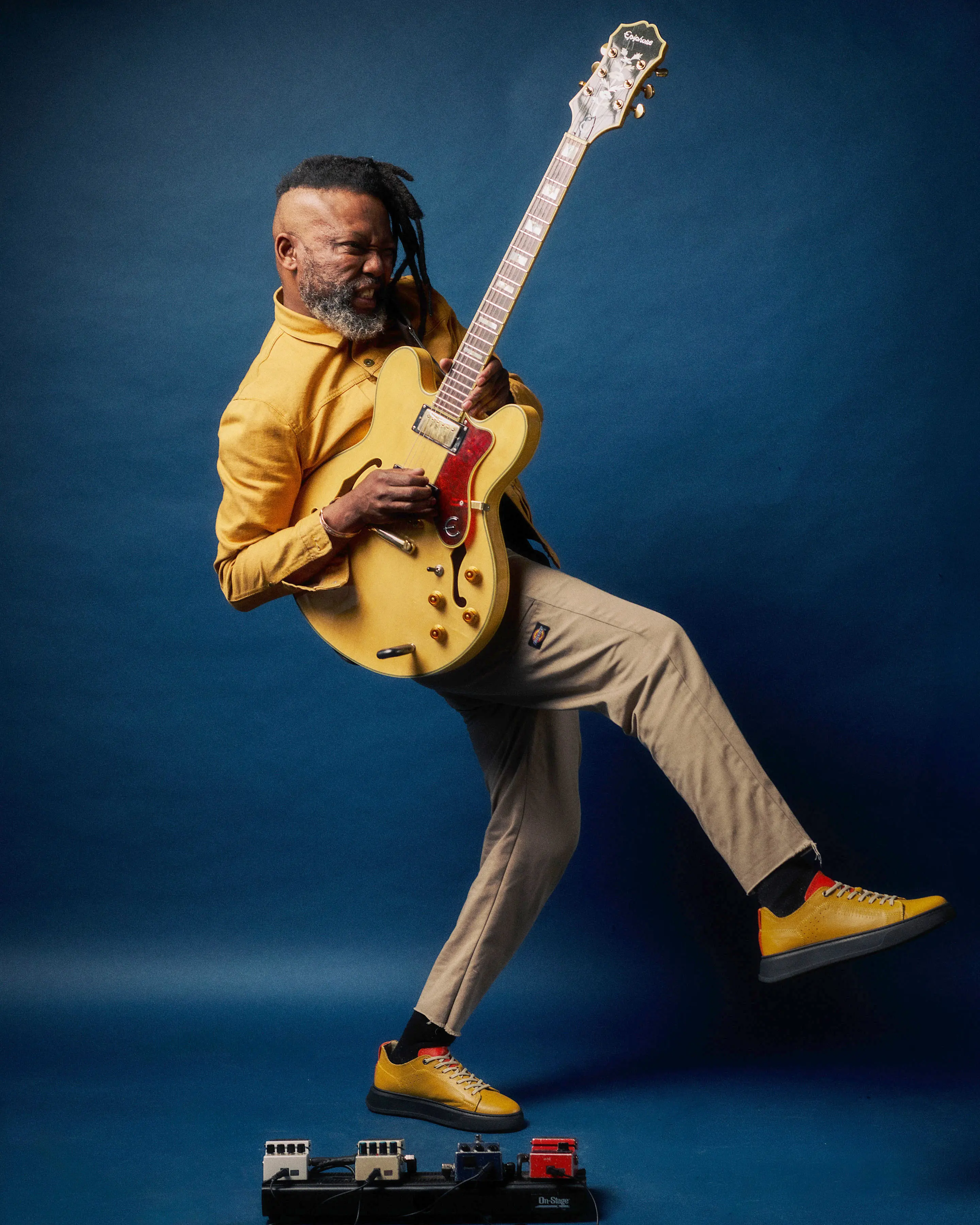
The first time I saw Tubatsi Mpho Moloi perform was at the tail end of 2017, at the first edition of the Afropunk Festival on South African soil. On that last weekend of the year when Constitution Hill became a site for celebrating black joy and creative genius in sound and aesthetic, I encountered Moloi.
He was providing a potent mixture of chanting, soaring vocals and flute-playing as the frontman of Soweto outfit Urban Village. It was during a song called Makolo Yanga, on which Moloi sang lyrics I couldn't easily decipher but could recognise fragments of Swahili, that I realised I was witnessing something special.
Nine years on, Moloi is difficult to pin down. He's a singer-songwriter and multi-instrumentalist who moves between folk, blues, jazz, mbaqanga and maskandi without ever landing in one of them. When we speak, he's calling from Soweto Gallery, a space to which he's lent his artistic voice many times before.
Moloi's career is hard to summarise in a single sentence. He co-founded Urban Village in 2013, which became the first southern African act signed to French label Nø Førmat! and picked up international praise for Udondolo, its 2021 debut.
Then there's Keleketla!, the sprawling, continent-hopping collective assembled through Johannesburg's Keleketla! Media Arts Project and British duo Coldcut, which has brought him into rooms with Tony Allen, Shabaka Hutchings and Sibusile Xaba.
And, of course, there's his collaboration with fellow singer-songwriter Msaki and French cellist Clément Petit, which produced the Synthetic Hearts albums featuring a sparser and more intimate sound than anything he'd made before it.
"I believe that music is a collaboration between sounds and vibrations," he says. "When those sounds and vibrations come together, they create this thing. Hence going back to how and why collaboration is important."
He credits it to how he grew up. Moloi was raised by a single mother in a four-room house in Orlando West, Soweto, shared with his grandparents, his mother's siblings and all their children.
"You can understand the experience, the amount of different people living in one room every single day for so many years," he says.
"That also for me has shaped my music. Being able to hold space with other people and being able to give yourself time to listen. If you give yourself an opportunity to first humble yourself, then you're giving an opportunity to yourself to be able to listen. And then you get an opportunity to hear. Then you get an opportunity to understand. Then there's an opportunity to be able to manifest."
Moloi had wanted to study music at the University of Cape Town but family circumstances meant leaving school to start working instead.
Music, though, was in the house. He had an uncle who played guitar and later became head of the music department at a Johannesburg school. Moloi had another relative on keyboard plus records and turntables to experiment with. He sang in church choirs from Sunday school through to his teens.
"Now I'm a singer, to be honest with you. I'm a singer-songwriter who plays instruments," he says.
The first instrument he picked up was a guitar, at Pretoria Technikon, where studying voice required taking up an instrument alongside it.
"I liked it because it means if you don't have a piano, you have a guitar. You can write and play covers and learn other songs."
From there the collection kept growing. Today he plays guitar, flute, mbira, a little saxophone and piano, lap-steel guitar plus what he calls "toys" — found objects and instruments he picks up while travelling.
Most striking is one he built himself, with instrument-maker Dan Gray, out of a metal sheet, four bars and strings, played with a violin bow.
"It's like a wardrobe," he says, laughing. "You hold this part of the string and pull it at the bottom. It makes a different sound. You move your hands up, it makes a different sound. It's more experimental."
For Moloi, the instruments aren't interchangeable. Each one pulls his songwriting somewhere different.
"If I compose a song from a flute perspective, it's so surreal. Your pentatonic scales, your East Arabic scale, it can take you to East Asia. And then the mbira takes you to East Africa. Therefore your writing becomes different."
It's why he resists being filed under a single genre. "I don't box music. I don't like this thing of saying, mina, I am this kind of musician only. Because that way you're closing off opportunity to collaborate."
I ask him about Makolo Yanga, the song that first stopped me in my tracks at Afropunk. He offers to tell me the story behind it, with a warning that I might not believe it.
He was on his way to rehearsal in a taxi when two women in front of him started speaking in a language he didn't recognise. He introduced himself to himself. He was, he says, feeling good. His career was starting to take off and he wanted to express gratitude to his ancestors for it.
"Immediately when I got off the taxi, I went straight into rehearsal: 'Guys, I found this melody, then I found some lyrics. Let's write the song,'" he says. "By the end of the day, we had a new song."
Makolo Yanga means "my children" and is less a lyric about literal offspring than a thank-you to family and the future.
"It was more like a thank you to my family, my children, my offspring, my future."
Urban Village remains the project most associated with Moloi's name. Formed in Soweto around guitarist Lerato Lichaba, the band came together with Moloi on lead vocals, flute, guitar and mbira, drummer Xolani "Cush" Mtshali and bassist Simangaliso "Smash" Dlamini.
Their 2021 debut album, Udondolo, picked up praise from the likes of Uncut and The Quietus for the way it wove together Zulu rock, Xhosa funk and mbaqanga. But his musical life stretches well beyond it.
His collaboration with Msaki and Clément Petit came together almost by accident, through his record label.
"There was a part where Laurent, who is the spearhead of Nø Førmat!, was there recording, and he was like: 'Guys, don't you want to do a song with a female South African? Do you have someone in mind?'"
Moloi and his Urban Village bandmates chose Msaki, whom they knew. "I came with a song, the guitar lines and I sang the lines of the song. Then she sat and just wrote a verse. And it sat so well in the album."
The song was enough to spark a bigger idea. "Laurent saw an opportunity and said: 'How about you two do a project and we can pair you up with a French cellist and do something different where you guys just sing with cello?'"
The three spent a week together on residency at the Nirox Sculpture Park outside Johannesburg. Synthetic Hearts was the result.
Moloi describes Nirox as one of the most important relationships of his career. It's not a residency so much as a collaborator in itself.
He's been connected to the space for what he estimates is more than a decade, called on for everything from festival line-ups to sound-bath healing sessions to unplugged sets cooked on rock, with no PA, halfway up a mountain.
"Nirox is not a space where you'll have a band playing and then there's a DJ playing background music. "There's nature. You hear the animals, the wildlife.
"When you leave that space at the end of a festival, you feel like: Oh man, what an explosion!"
The instinct for open-endedness is shaping how Moloi is preparing for his next big show which will be a solo set at Our Origin, a music festival running from 16 to 18 October at the Cradle of Humankind. He's been mulling the shape of the performance with the festival's organisers and fellow musicians for weeks.
"I don't like this thing of going to a show and watching an artist where the first song goes, the crowd cheers, the second song goes and the cheers are not so loud anymore because all the songs sound like one song," he says. "I like to be moved."
Unusually, he's decided to perform alone, with no band, relying instead on live looping to build up layered arrangements in real time on stage.
"I create a drum on the guitar. I loop that, then I layer, then I do my voice and I put a flute and dynamics," he explains, though he admits he's tempted to bring in a violinist for at least one song.
The 45-minute set, he says, will draw from across his catalogue including Urban Village, his work with Msaki and unreleased material from his solo project, without giving too much away. "I don't want to open up too much as to where I'm going but I promise you, the majority of the songs will be really original."
Whatever form it takes, it's clear Moloi sees the performance as another chance to do what he's spent his career doing: refusing to sit still.
"I am a musician," he says. "It means I create sounds and vibrations."