

Paris’s pale stone buildings, balconies, boulevards, café tables pushed onto pavements, scooters squeezing through traffic and the Seine magically appearing between buildings give fashion the most magnificent backdrop.
And for my first experience of Paris Fashion Week, the city was so much more than I imagined.
Everyone seemed to be going somewhere. Fittings, shows, showroom appointments, dinners and meetings and every few streets felt as though I had stumbled into another pocket of the fashion world.
Outside every show, the pavement becomes its own runway — editors, buyers, stylists, celebrities, influencers, models who have just finished another show, people from fashion houses, photographers, PR teams and spectators.
Someone spots someone recognisable and suddenly 10 phone cameras are in the air. A car door opens. Someone in an enormous coat or an impossible shoe steps out and is whisked into the venue in a puffy little cloud of importance.
I loved every second of it.
I had come to Paris because I wanted to understand fashion as an ecosystem — who creates it, who buys it, who amplifies it, who builds the brands and how relationships made in one city can move fashion across the world.
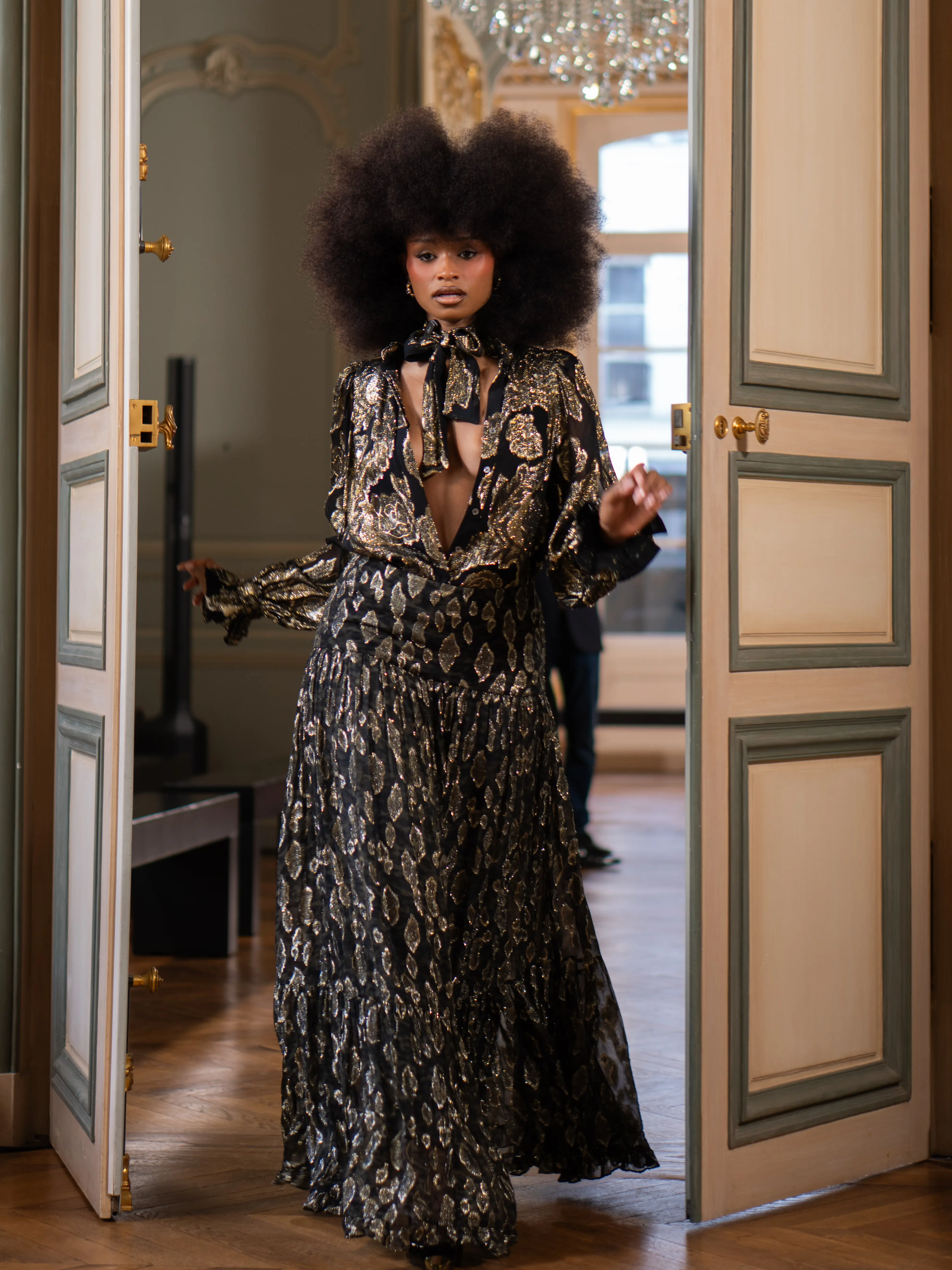
I had brought out my signature statement afro and was conscious of the perspective I was bringing into those rooms as an African woman interested in what our place can be in a global fashion economy that has drawn from this continent for generations.
A few days earlier, MaXhosa Africa had presented Izihlwele Zivumile (The Ancestors Have Approved), its first full runway show on the Paris Fashion Week Womenswear Readyto-Wear calendar. It was a collection rooted in memory, ancestry and the generations that had carried the brand to that moment but translated into a thoroughly contemporary fashion language through silhouette, textile, construction and craft.
The show invitation was a MaXhosa “passport” – a symbol of the roots and cultural stories we carry with us wherever we go. It was African culture arriving with its own codes, confidence and point of view. Sitting in a meeting the next day, I felt backed by what MaXhosa had done and by the work of African designers who have spent years pushing our fashion, craftsmanship and cultural references onto inter-national stages. It meant I could walk into those rooms with curiosity and ambition, without feeling that I needed to leave my Africanness at the door. It was part of what I was bringing to the conversation.
Which is why my experience with Kobi Halperin felt significant. Born in Israel to Hungarian parents, Kobi built his career in New York and has drawn from travel, art, architecture, history and cultures. Our stories are different but I understand the instinct to resist the idea that entering a larger world requires you to abandon the one that formed you. His work carries the imprint of his heritage while absorbing the cultures and places he encounters.
My Instagram bio states that I’m an International Zulu Girl. It’s in moments like chatting to Halperin as he styled my look for his SS27 show that the name feels especially fitting. Wearing a piece from Kobi’s collection, A Common Thread, felt almost like being in my own skin. The collection explores connection in a world shaped by cultures, histories, identities and ways of seeing. Inspired by the story of the Tower of Babel, it asks how we find our way back to one another without surrendering the things that make us distinct.
That idea made me think about movement, particularly about what it means for us, as Africans, to cross borders of small towns, rivers, cities and countries in search of opportunity, possibility and sometimes simply a different version of our destiny, while carrying home with us.
It is also where I connected most strongly with Kobi’s approach to design. His clothes seem to make room for the complexity in women. We do not all look the same, come from the same place, carry the same histories or express femininity in the same way — and we should not have to. Perhaps that is what felt natural about wearing his work. I could step into Kobi’s world without having to step out of my own. For me, the black girl from Port Shepstone living her wildest dreams, that made the experience feel bigger than simply attending his show from the front row.
In an ode to women, here are five things I love about Kobi Halperin: His femininity has strength in it I love being feminine. I love softness, movement, romance, a beautiful dress and a little drama but I never want femininity to mean shrinking yourself. That is something I connected with in Kobi’s clothes.
There is sensuality but there is also presence. The clothes move beautifully around the body without swallowing the woman wearing them. Perhaps that resonates even more with me as a believer that women can be feminine and powerful at the same time. Those things have never felt contradictory to me. Kobi seems to understand that too. The closer you look, the more there is to see As a Zulu woman, I grew up around a culture where what we wear can tell you something about where we come from, what we are celebrating, who made something, how it was made and why a detail matters. Craftsmanship will always speak to me. That is one of the things I find beautiful about Kobi’s world.
You notice the silhouette first but then your eye keeps travelling. There’s embroidery, lace, texture, embellishment, print and all the little details that reveal themselves as the woman moves. I love clothes that reward curiosity. The kind that make you lean forward because there is something else to discover.
There is a real human hand in the work and in a fashion world that can sometimes feel fast and disposable, that kind of care feels luxurious. He designs glamour for women who have somewhere to go This may be the most Nomalanga thing about why I love Kobi.
I love glamour but I also want to live in my clothes. I want to walk into a room, host an event, sit at a dinner, travel, work, laugh, dance and feel like myself. Kobi understands that glamour does not have to exist only for a red carpet or behind glass. There is romance and occasion in his work but there is also tailoring, ease, movement and pieces that feel designed for the life of a woman.

Ready-to-wear fascinates me because it is where fashion has to negotiate with real life. The fantasy has to survive a woman’s body, diary, work, travel, dinner and movement — and commercially, somebody ultimately has to want to own it.
Give me something beautiful but let me wear it. Let me move in it. Let me make it mine. Different worlds are allowed to exist in the same garment Moving from small town KwaZulu- Natal to the ‘big city’ Johannesburg, taught me that identity rarely exists in only one register. We can move between languages, cultural references, traditions and identities in the same city, sometimes in the same family. That is what I find so compelling about Kobi’s work — difference is not something that needs to be flattened in order to create harmony. Paris made me see the whole story differently I first came across Kobi almost 10 years ago. I was studying media in Durban, doing radio, auditioning and beginning to find my way into an industry I desperately wanted to be part of.
Kobi was at the beginning of something too. His namesake label was barely two years old. He had begun attracting the attention of some of America’s biggest retailers and had just joined the Council of Fashion Designers of America.
Around that time, Kobi spoke about seeing an African woman at a Paris airport, dressed in traditional clothing and carrying a child. He described being struck first by her grace, elegance and the pride communicated through the way she was dressed. Moments later, he saw her being escorted away by police. For him, the encounter became connected to questions of migration, displacement, identity and the lengths people will go to in search of a different future. It eventually informed a collection that drew on African graphic influences and ideas about how clothing communicates where we come from.
As an African woman, I find myself thinking about that story differently now. There is something powerful about the fact that what initially caught his eye was not just the cloth but the woman inside it — her dignity, her presence and the way culture seemed to travel with her even as she moved through a different world. It makes me think about a woman’s right to move through the world freely and visibly. In South Africa, that freedom cannot always be taken for granted. A beautiful dress cannot solve that reality but there is something quietly powerful in insisting that women should be free to inhabit their bodies, beauty and culture without fear.
I think about that African woman Kobi saw in Paris in 2016, moving through a foreign place with visible evidence of where she came from. And then I think about myself, a decade later, arriving in Paris carrying my own culture with me — not simply as an image or a reference but with a voice, a platform, a business mind and questions about where African women can participate in this industry as collaborators, creators, decision-makers and owners.
Perhaps that is the common thread I keep coming back to. Culture can travel without disappearing. Women can enter new worlds without surrendering themselves to them. And fashion can create a conversation between the worlds without insisting that any of them become the same.