


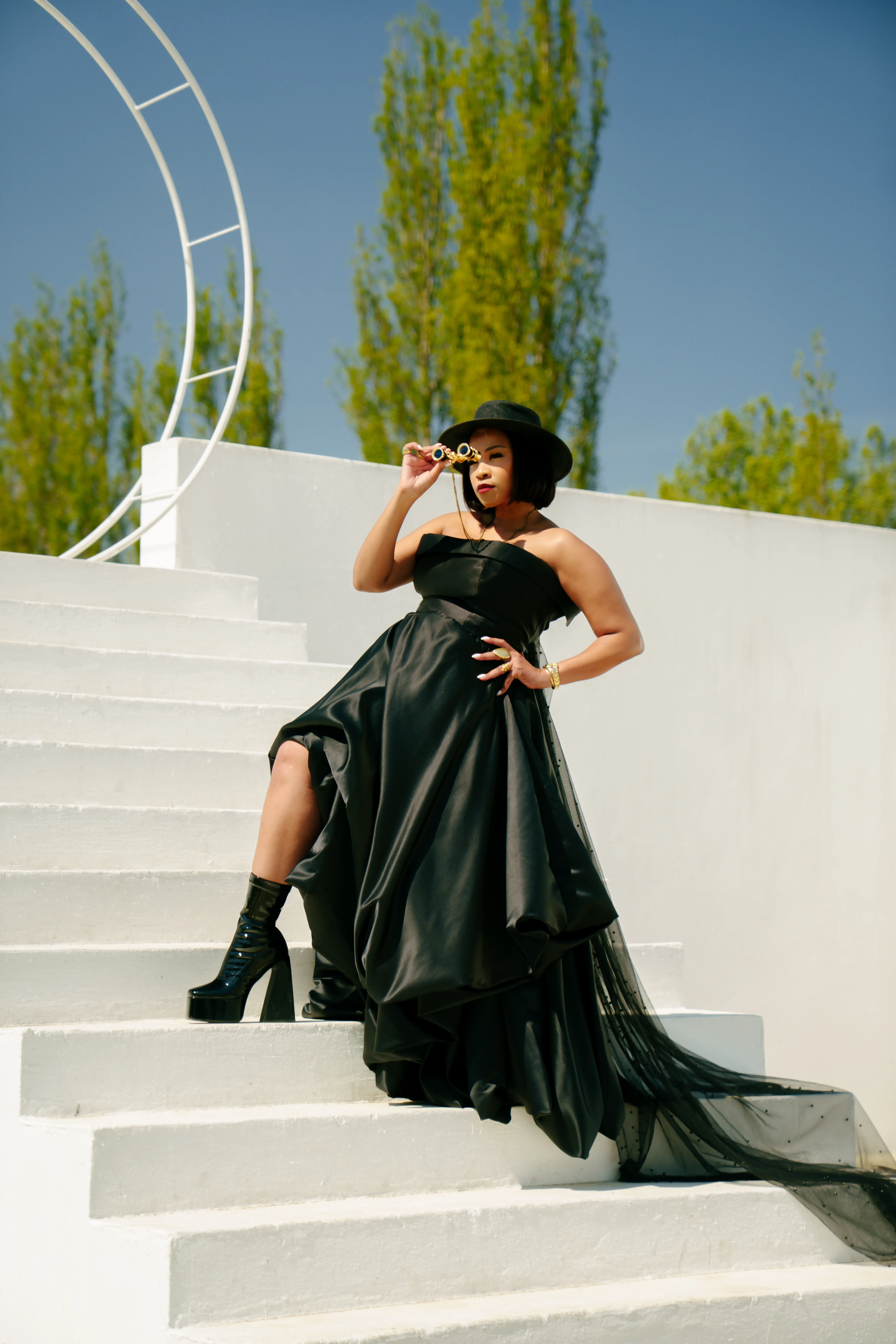
Pilani Bubu is preparing for rehearsal and she’s multitasking. She’s also choosing her press photos and wants my opinion. “Super rock star? Defiant, with shades? Close-up beauty shot?” It’s on brand for a woman who has spent 15 years as her own publisher, writer, composer and — evidently — art director.
She calls herself the Indelible Storyteller — and the title is earned. Pilani is a singer-songwriter, poet and TV presenter with seven albums behind her and an eighth on the way. She has a South African Music Award (Sama) on the shelf, four Netflix syncs to her name and performances in more than 25 countries across Europe and Africa.
She also founded the Folklore Festival, which has grown into a community of artists.
It all circles back to a poem she scribbled in the dead of night in 2014, which has finally become her new single, Caged Heart.
In 2014 Pilani was three years out of a corporate career she had reached by following the commerce route and she had quit to chase music. Then she found herself back in an agency, doing the nine to five. It was not going well.
“You discover that agency life, brand development, comms, is not thoroughly your true purpose,” she says about that time.
“Though it may have sentiments of what you love to do, like create and tell stories. I was exhausted, almost within a year, burning out. And I was like: ‘This is not the life and neither is this my dream.’”
Then came a sleepless night and a blunt question at 3am: What is the life you would rather die for? The poem that followed is mellow, melancholic and, by her own admission, semi-morbid.
“If I were to die today or tomorrow, would I be at the place that I wish to be, fulfilled and brave again and courageous to take this leap? I was talking myself out of remaining back in corporate, talking myself back into defying gravity.”
At that point she had one album out, 2012’s Journey of a Heart, and a lot of doubt. Reading the poem now, she hears the anxiety first. Then she hears something else.
“She’s got foresight, that she knew she would live up to the words written. Because 12 years later I’ve totally done better. So I would say: ‘Man, she is so courageous and bold and daring, and I’m so proud of her.’”
Pilani has plenty to be proud of. Music started for her at nine, with flute, marimba and string ensembles and a long run of choirs.
Warrior of Light followed in 2016 and then Folklore Chapter 1 in 2019, which won Best African Adult Contemporary Album at the 2020 Samas. Lockdown Lovestory arrived in 2022, a cathartic record about love in uncertain times.
In 2023 there was Konke, made with Kenyan producer AfroNautiq, and Folklore Chapter 2: Ekuseni, a deep dive into her ancestors and their rituals. The next year brought Nay’Indaba, a collaboration with French jazz-rock band Marthe about 30 years of SA’s freedom through the prism of strong women, which won Best International Jazz Album Collaboration at the Mzansi Music Awards. Along the way she has made a mini orchestra piece with Maya Angelou’s Caged Bird Legacy and appeared on Cameroonian guitarist Blick Bassy’s Bikutsi 300.
Has she done everything she set out to do? Not quite and she is negotiating with God for 96 years of life to finish the job.
Pilani remembers an early mentor telling her that it takes 10 years to become an overnight success. She is cheerfully unbothered that the hit-song milestone has not arrived.
“I don’t know what classifies a hit anymore,” she says. “I keep making music but I’m able to tour all over the world. I’ve been able to maintain my authenticity but that has come at the sacrifice of being the artist that sticks to the script. I’m building my own playbook. It’s a long-term game.”

If the poem is 12 years old, why release it now? Because the song wasn’t ready and neither was she. She recorded it many times. At one point it was solely electronic, sometimes mostly dance, before she decided to blend her two worlds of poetry and live music. It passed through collaborators in Kenya, Ghana, Romania and South Africa. In the end it came down to her voice. “Finally recording my vocals for the fifth time, there’s definitely a tonality in my voice that is a little bit more sure, that the lyric demanded, that I didn’t have then. It was like a prophecy. I was prophesying unto myself, but I had to wait till those prophecies came alive.”
Caged Heart follows July’s Doodle Do — Diminished Light and points toward an album due around mid- 2027, which she plans to roll out slowly, single by single, so the lyrics get time to land. The project is about boxes of every kind, including the genre ones, which is a fitting theme for an artist who has moved between afro-folk, soul, jazz and R&B and sprinkled poetry over all of it. Early on she felt guilty about being a polymath. Not anymore. “There’s no undoing Pilani and who she is. I’m versatile, I’m genre fluid. It’s always going to be about the story.”
That freedom is a product of independence. Pilani has funded everything herself for 15 years. The upside, she says, is creative control and being able to pour the earnings straight back into the craft. The downside is thin support in personnel and resources and the label backing that speeds audience growth. She has made up the difference through collaboration and by building a career from the outside in.
She performs more outside South Africa than inside it, with annual tours of France, a UK run every second year and stages like Love Supreme, Jazz A Vienne and Sauti za Busara on her CV. Oslo, Berlin, the Netherlands, Morocco, Benin and Togo are also on the list. At home you can catch her at the Access Showcase festival and conference, curated by the Music in Africa Foundation, in Johannesburg 31 October.
Her own festival is the other big part of the story. After Folklore Chapter 1 won that Sama, she started asking what came next. The answer was a stage for other people’s stories. “I thought that the music was working too hard for just storytelling. So I started a Storytellers Festival.”
Fringe events began in 2020, the festival proper followed in 2022. This year there was a six-week, six-city roadshow. Last year’s edition, themed Kinfolk, took over the National School of the Arts in Johannesburg with an artist development programme. She wants the festival to become Africa’s leading platform for cultural preservation.
It now comes with workshops, talks and industry nights, plus a booking agency called Folklorish that represents artists like Madala Kunene, Zawadi Yamungu and Farai Matake and sends folk artists out into the world. Next year the festival moves to the second quarter, with a new tagline: “community hall”.
“Why should a heritage festival exist only in Heritage Month, in the clutter of summer? We’re establishing a whole new season for ourselves. I’m an artist within the folklore community because I don’t move alone. We move together.”
That instinct started at home. Her brother, the pianist Apiwe Bubu, used to make beats and ask her to write something on the spot, which is how she became a songwriter who rarely needs more than 15 to 20 minutes. In August they shared a stage for the first time in about 10 years.
Pilani’s identical twin sister, a gospel singer, is “the exact other version of me”. “She still needs to take that leap and defy gravity.” Pilani, I suspect, has some thoughts on how.