

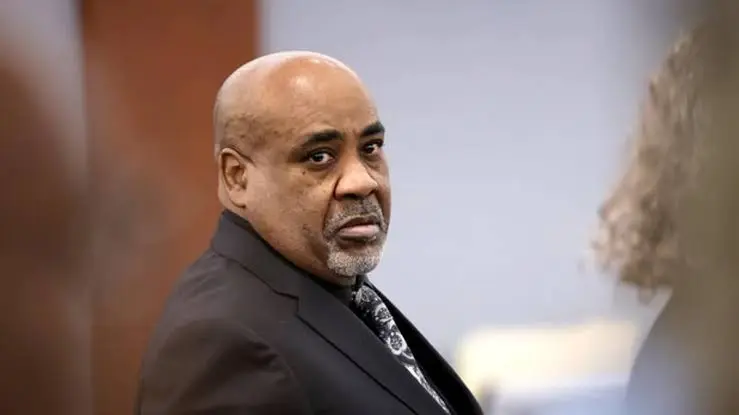
Nearly 30 years after Tupac Shakur was gunned down on the Las Vegas Strip, the man prosecutors say orchestrated the killing will spend the rest of his life behind bars.
Duane “Keffe D” Davis, a former leader of the South Side Compton Crips, was sentenced to 40 years to life in prison on Tuesday for the 1996 drive-by shooting that ended the life of one of hip-hop’s most influential voices.
Judge Carli Kierny handed down the sentence in Las Vegas, where Davis, 63, had been convicted of first-degree murder with use of a deadly weapon. Addressing him directly, she said no one got to take a man’s life and future and simply walk away, least of all when that man was Tupac.

“The world never forgot about him and his death and neither did Las Vegas,” she said.
Prosecutor Marc DiGiacomo told the court that Davis was guaranteed to die in prison whatever the sentence and argued that he deserved the maximum because he had tried to profit from a killing he committed.
That profit is what ultimately undid him. Davis was long considered a suspect, but investigators lacked the evidence to bring charges. The case moved only once he began boasting about his role in media interviews and in his 2019 memoir, Compton Street Legend. He had signed a proffer agreement with federal investigators in 2008 granting limited immunity for private statements but prosecutors argued that repeating those claims in public voided its protections.
Shakur, then 25, was in Las Vegas for a Mike Tyson fight on 7 September 1996 when his car was fired on at a red light. He died six days later.
Investigators say the shooting came roughly two hours after a confrontation between Shakur’s entourage and Davis’s nephew, Orlando Anderson. In his memoir, Davis admitted to handing over the weapon used by two alleged accomplices in a white Cadillac. He is the only person in that car who is still alive and the only one charged.
Shakur’s siblings, Maurice “Mopreme” Shakur and Sekyiwa “Set” Shakur, spoke at the hearing. She told the court her brother’s life mattered. He described the murder as devastating and heartbreaking.
Davis briefly addressed the court to ask for the return of items seized from his home, including personal photographs. Asked whether he wanted to say anything more, he declined, adding that he would appeal.
For three decades, the question of who killed Tupac Shakur fuelled documentaries, conspiracy theories and endless debate. The answer, it turns out, was one the man at the centre of it could not resist telling himself.