


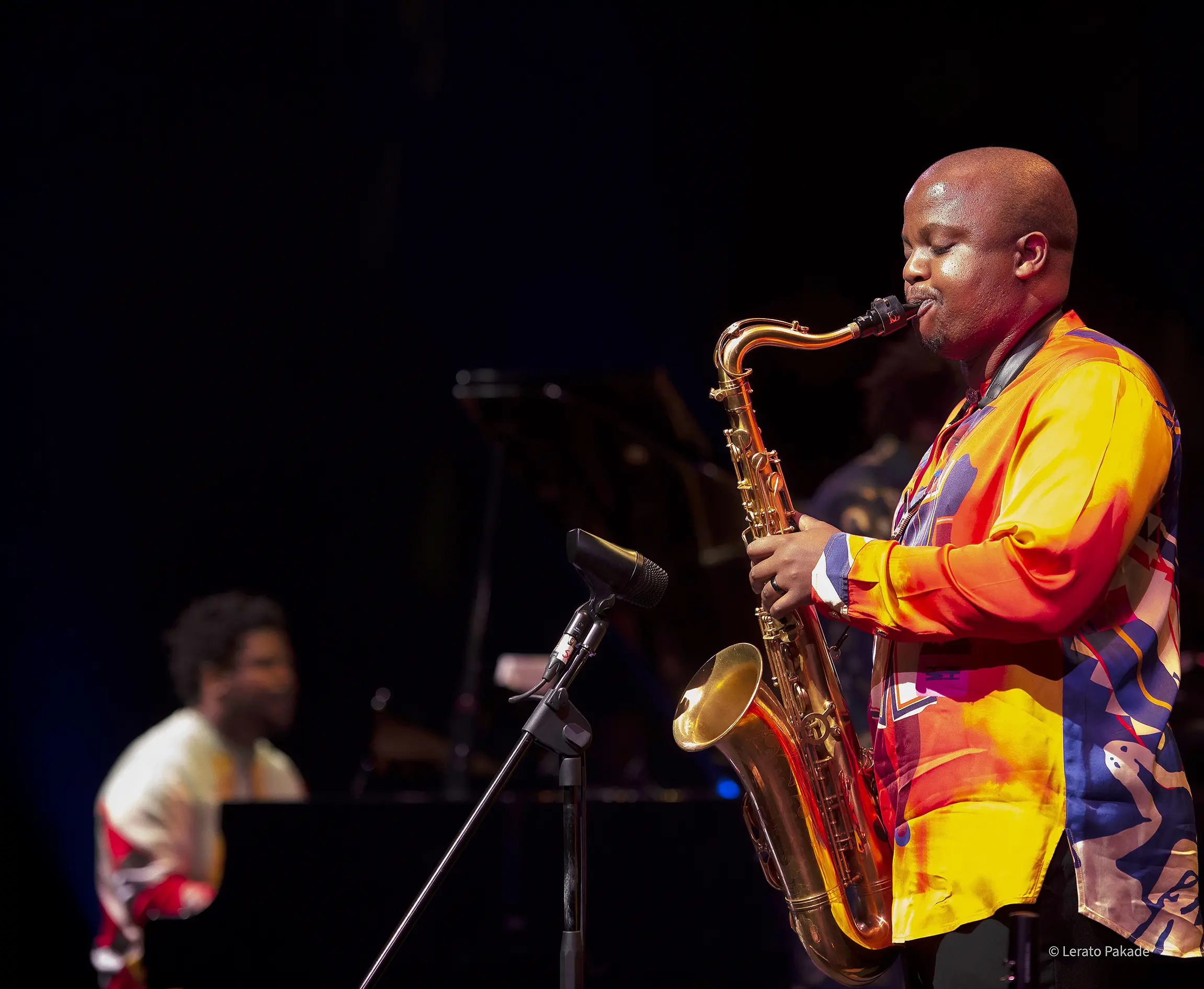
Sisonke Xonti has just come back from a run. He is a little out of breath, his screen has gone blank and he is quietly negotiating with a small person off-camera who wants to gatecrash our interview. Homework, as far as his daughter is concerned, takes priority.
“Trying to lose some weight, man,” he says when the picture returns, before delivering his age like a confession. “I’m 38 now. I’m old.”
Old is relative. Xonti is one of South Africa’s standout saxophonists: 2020 Standard Bank Young Artist for Jazz, a former member of Jimmy Dludlu’s band and a Khayelitsha-raised, Joburg-based bandleader who walked away from the law for a bandstand.
This month he adds a third album to the shelf. uKholo, released on 1 October, means faith in isiXhosa, and he needed plenty of it to get here. The last time Xonti released music, the world was locked indoors and nobody knew whether a stage would ever host a band again. That album was uGaba, The Migration, in 2020. He started writing its follow-up around the end of that year and finished only last year, which makes uKholo a five-year labour.
“Everyone was stuck at home, so we couldn’t perform,” he says. “One needed to have faith in those times to believe that whatever it is that we’re going through, one day we will make it back on stage, to perform, to do what we love.”
Covid, however, was only the opening act. Life piled on. He lost his brother and an aunt around 2024 and his stepbrother last year.
“It’s been a trying time,” he says. “My son was also born in 2024, so it was joyous and also very dark moment.”
The music, he says, was the record of all of it.
“To be able to go through so much and still be able to have faith. I know there’ll be light at some point. You just have to go through the motions and believe that it will all get better.” The six-year gap between albums wasn’t all grief. His daughter was born at the end of 2019, around the time uGaba was recorded. He pressed pause on releasing music to learn how to be a dad.
“I just thought: ‘Let me just take a break from releasing music and get used to this new life that I was trying to build.’’’
Xonti has made concept albums before and he knows how they’re built: you sit down, decide what you want to say and wrestle it into melodies. Iyonde, his 2017 debut, was a thank-you to his family for the gift of music. uGaba was about migration, about leaving Cape Town for the City of Gold and realising he wasn’t the only dreamer to do so.
“I sat down intentionally and I wrote the music,” he says of those records. “I really struggled to come up with the melodies and the harmonies.”
uKholo, by contrast, turned up fully formed.
“It felt like a higher power, whether you believe in God or the ancestors, it felt like they were messaging through me and I’m just the messenger,” he says. “I heard everything — from the drums to the bass to the piano. It felt so much easier.”
The tracks came one after another, from Khanya, the first he wrote, to Chitheka, the last.“For the first time, it felt like the story just came together by itself,” he says. “I never knew what was going to be in the end but I knew once I’d got to, I think, the ninth or 10th song, that I’ve got this body of work which tells the story about resilience and faith and fear.” He knew he had to share it. “I’m not the only one probably who goes through this thing everyone goes through: losing a loved one, going through uncertainty, going through a patch where things are dark. You don’t know whether this is what you want to do with your life but you still keep going.”When I ask him whether the album title means spiritual faith or the broader believe-in-yourself kind, Xonti goes somewhere far more practical.
“For me, faith is like a weapon. Whatever it is, whether it’s a goal you want in life, you have to have faith that you’re going to achieve it. I’m trying to run, I’m trying to get fit. I have to have faith that I will lose the weight, that I will get healthier.”
He wants uKholo to work like a soundtrack.
“It should spark a memory of a bad time in your life but more than anything, the victory, how you got over it.”
He kept the circle tight. Pianist Yonela Mnana, who also played on uGaba, co-wrote and co-produced some of the music. Shane Cooper, “my homeboy from Cape Town”, plays double bass, as he did on Iyonde. Ayanda Sikade is on drums, a dream booking: “One of the best drummers to ever come out of Africa. It was always a dream of mine to have him on a record one day and he just so happened to be available.” Gontse Makhene is on percussion.
Then there’s Mandisi Dyantyis, the vocal guest, who sings on opener Khanya, which Xonti describes as a prayer. “He’s my big brother,” he says. “I’ve known him since our UCT days. He used to take care of me.”
All that rehearsal and a few warmup gigs paid off: the whole thing was recorded in two days. “When we got to the studio, it was a little easy,” he says.
The internet has opinions about whom Xonti has played with and he is happy to correct the record. He played in Abdullah Ibrahim’s youth band. He spent years touring the world with Feya Faku and Jimmy Dludlu. Winston Mankunku? Not quite.
“I never performed with him,” he says. “I was too young. I just played his saxophone for a weekend.”
The mentors who did shape him turn up in his writing. “Their spirits live within me,” he says. “I’ll be writing a song and when I reflect back I’ll be like: ‘Whoa, that sounds like what Jimmy Dludlu would do or what Feya would do.’”
In his 13th year in Joburg, he’s also watching the audience change. Jazz’s old-crowd reputation is fading and Xonti is delighted. “It gives it a different energy, very lively spirit,” he says. “The performance is now more energetic because of the younger audience.”
He credits the pandemic, half-jokingly: “I don’t want to say thank Covid for that but I think Covid played a massive role in the resurgence of jazz.”
When I ask him whether he prefers writing music or playing it, he doesn’t hesitate. “Performance wins, bruh. In the studio you can control everything but in the live space things can turn out for the best and for the worst.” Which brings us to the live shows, where uKholo will get its proper airing. The album-launch run kicks off on 1 November at the Homecoming Centre in Cape Town, then on to the Market Theatre in Johannesburg on 7 November. The band is mostly the studio crew, with one swop: Cooper is touring with William Kentridge, so Benjamin Jephta steps in on bass.
There’s plenty around those dates too. On 31 October he’s at Kids Love Jazz in Braamfontein, the day before the band heads to Cape Town. And on 27 November the band plays Sankayi, a new jazz club in Morningside where he also curates the music and books the artists.
As we wrap up, he has one request. “Push the album launches,” he says. Then he’s off, back to the homework negotiations and presumably, the next lap. A man who calls faith a weapon isn’t likely to stop now.