


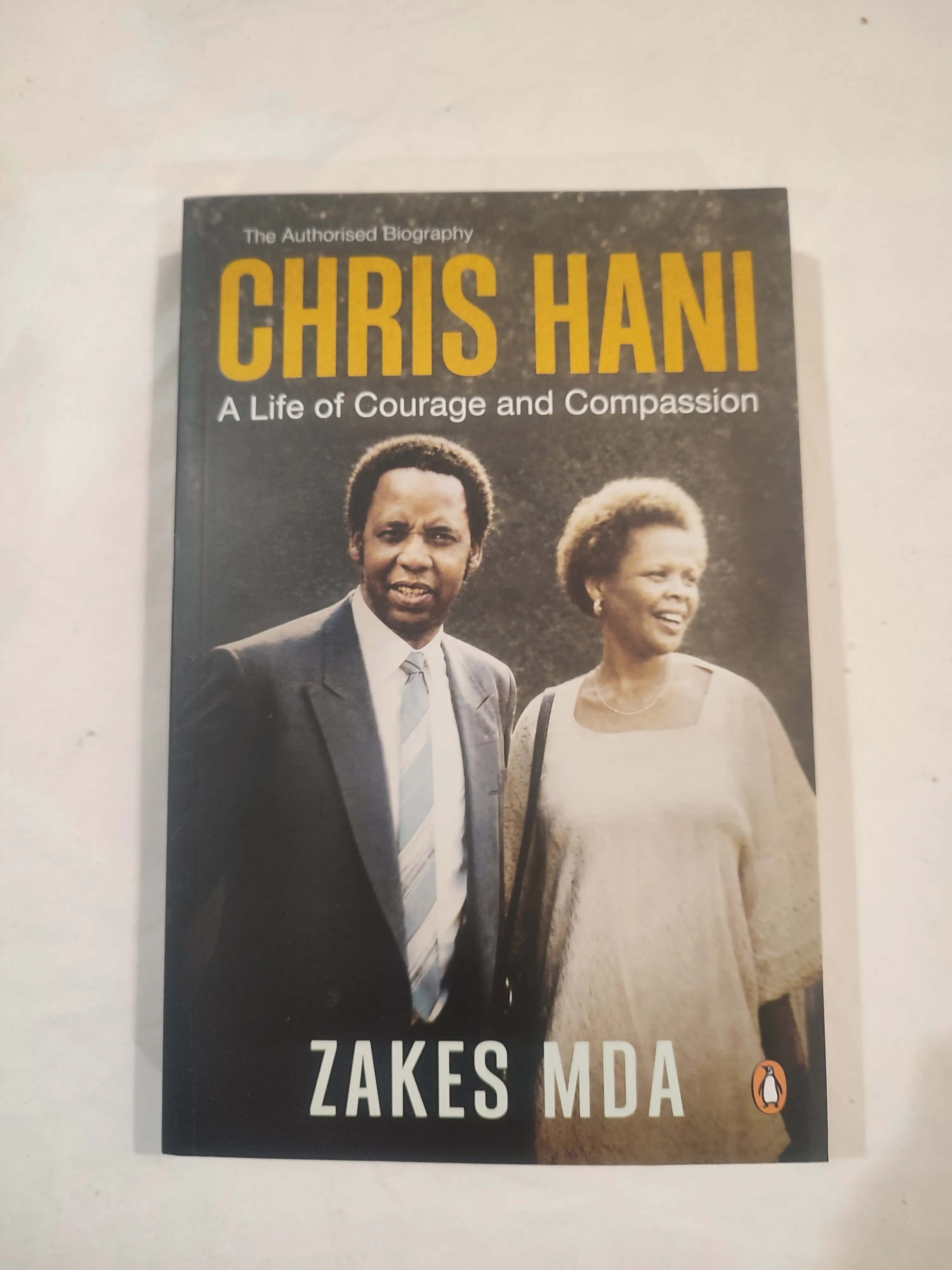
I have just unpacked the compelling political biography of Chris Hani, the celebrated anti-apartheid struggle veteran, communist leader and military commander whose assassination on 10 April 1993 shook South Africa and changed the course of the country’s transition to democracy.
Acclaimed South African novelist, playwright, poet and painter Zakes Mda draws on research and interviews with Hani’s family, comrades-in-arms and political contemporaries to look beyond the revolutionary icon. He reveals the son, husband, father, intellectual, mentor and friend behind the public figure, exploring the courage, contradictions, sacrifices and personal relationships that shaped Hani’s life.
The book also revisits Hani’s rural childhood in Cofimvaba, his political awakening, the Wankie Campaign, his underground operations and his challenges to the ANC leadership. At its heart is his commitment to social justice and his warnings about the dangers confronting the liberation movement.
In an extraordinarily substantial foreword dated Cape Town, 27 April 2026, Albie Sachs reflects on Hani’s place in South African history. Although Nelson Mandela occupied the unrivalled position of the nation’s most revered political leader, Hani commanded admiration among many South Africans for his fearlessness, revolutionary conviction and identification with the struggles of people.
The 285-page Penguin non-fiction edition makes a striking visual state-ment through its front cover photograph of Hani in a grey suit and matching tie, alongside his wife, Limpho, in a cream dress. The narrative is presented without a photographic centrefold, keeping the focus on the research, testimony and written record.
Significant political timing
With South Africa approaching the hotly contested local government elections on Wednesday, 4 November 2026, Hani’s warnings about corruption, political complacency and the responsibilities of the liberation movement resonate with renewed urgency.
The ANC is campaigning under mounting electoral pressure. Luthuli House has also recently secured a Constitutional Court ruling in its dispute with the electoral authorities over the registration of 281 candidates.
Reading Hani’s political legacy against today’s electoral climate invites a difficult question: What would the outspoken commander make of the state of the organisation for which he sacrificed so much? One can almost imagine his familiar challenge to the leadership and rank and file: the warnings were there. Why were they not heeded? Zakes Mda’s Chris Hani: A Life of Courage and Compassion is more than a biography of a fallen revolutionary. It is an invitation to revisit the ideals, internal struggles and unfinished promises of South Africa’s liberation history — and to consider their relevance to the country’s democratic future.
A life shaped by courage and compassion
Limpho, Chris Hani’s wife, also endured apartheid’s brutality and propaganda while her husband fought from exile.
At one point, Pik Botha, South Africa’s controversial hardline foreign affairs minister, claimed that Limpho had been killed. Joe Slovo, a senior ANC commissar, immediately rejected the report: “It’s a lie. Mrs Hani is with me in Mozambique.”
The episode captures the danger and uncertainty that surrounded the Hani family, even when they were far from the frontlines.
In his foreword, renowned activist and leader Albie Sachs reflects on Hani’s place in the ANC and the extraordinary affection he inspired. Sachs writes that Hani was “most loved” recalling his “radiant physical and moral courage and sheer joy of being”. He says he was “deeply honoured” when the family invited him to write about Hani’s life and times.
The person behind the reputation
Mda’s book brings that life into view: the story of a leader who remains admired decades after the liberation struggle.
Mda is known for novels including Ways of Dying, The Heart of Redness, Little Suns and The Zulus of New York. Here, he turns to Hani’s political journey, tracing the experiences and relationships that shaped a man whose public role often threatened to overshadow his private life.
The book moves from Hani’s childhood and his formation as a freedom fighter to the years of exile, political work and armed struggle. Its opening chapters introduce him first as a son, then as a young man drawn towards the risks and demands of resistance.
That approach gives the story a human scale. Hani is not presented only as a symbol or a figure in the history of the ANC.
Mda follows the person behind the reputation: someone learning what commitment would require of him, while trying to sustain a marriage and family under conditions of constant upheaval. His relationship with Limpho is especially important.
Their life together was shaped by separation, danger and the unusual geography of exile, with the family living between Maseru and Moscow before settling in Boksburg in the 1990s.
As the narrative develops, Hani emerges as a political force moving between the “front” and “rear” of the liberation struggle. Mda attends to both: the armed conflict and the political labour, loyalties and disagreements that sustained the broader movement. This wider view helps explain how a freedom fighter became a prominent leader, while conveying the strain that the struggle placed on those closest to him.
The book’s structure builds steadily, carrying the reader from personal beginnings into the larger history without losing sight of the people caught up in it.
The account of Hani’s assassination and its aftermath gives the later chapters a painful momentum. In The Janus Factor, Mda examines the killing by Janus Waluzś and the long-running attempts to secure parole for the assassin, a foreign supporter of apartheid.
These events raise difficult questions about justice, memory and the unfinished work of reckoning with apartheid. Mda places the murder in a country marked by political violence, death squads, Afrikaner nationalism, opposition and threats, as South Africa moved towards democracy. Mda’s background lends a particular attentiveness to this world. He spent part of his childhood in Soweto, a centre of resistance to racism and discriminatory laws. He carefully researched an account of that journey — from a son of Cofimvaba to one of the most loved figures in the movement — and completed his schooling in Maseru, Lesotho, which served as a base for political leaders and exiles.
That perspective is evident in the book’s interest in the contradictions of the struggle: its sacrifices and ideals, its political pressures and the intimate relationships forced to endure both. The result is a layered portrait that moves beyond legend without diminishing Hani’s courage. Mda explores the tension and sacrifices that shaped his life, alongside his commitment to justice and devotion to family, comrades and community. The book’s research gives the narrative depth, while its attention to Hani’s relationships keeps the history immediate and personal. Readers come away with more than an account of a leader’s public achievements: they see the difficult choices and private costs that accompanied them.
Hani’s journey ended in Boksburg, where the family was living together for the first time. His assassination changed the course of a country approaching democracy and left a lasting mark on South African public life.
Mda’s Chris Hani: A Life of Courage and Compassion offers a compelling, liberation struggle. It reminds readers why Hani’s bravery, humanity and clarity of purpose continue to matter.