


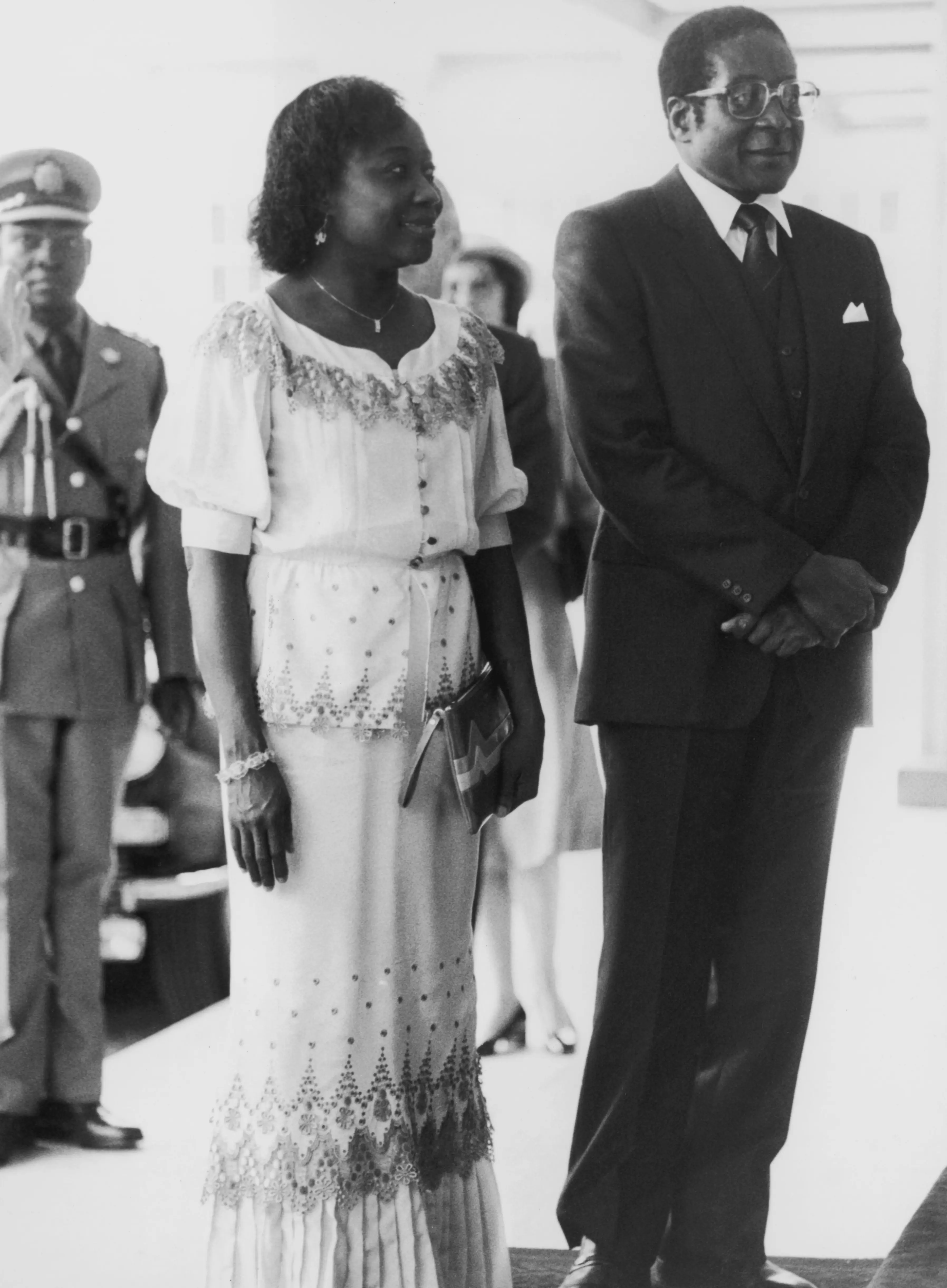
In ‘Robert Mugabe: The Black Victorian’, the life of Zimbabwe’s former president is examined through the personal experiences, political convictions and relationships that shaped one of Africa’s most controversial leaders. This lightly edited excerpt explores a particularly painful chapter in Mugabe’s life during his imprisonment under Rhodesia’s white minority government, including the death of his young son, Nhamodzenyika, and the loss of his close friend and fellow nationalist, Leopold Takawira. It offers a glimpse into the personal sacrifices and tragedies that marked Mugabe’s years in the liberation struggle.
Nhamodzenyika Mugabe appears to have been a bubbly, irrepressible child. In Sally Mugabe’s correspondence, she regularly mentioned the boy, who slept little and whose escapades around his grandparents’ house in Sekondi, in the west of Ghana, kept his mother busy.
In one letter she complained that she had intended to write an advocacy article for a newspaper, but ‘will Nhamo allow me at all?’ In another note she wrote: “Nhamo is well and fine, only he does not allow me much free time. I am always on the move especially now that he is trying to walk.” And in yet another missive she said: “Baby Nhamo is well and he is looking forward to going to Zimbabwe to fight the settlers.”
This was not to be, as one day in December 1966 — midway through the wet summer season — Mugabe was summoned from his cell by Inspector Tony Bradshaw of the Special Branch. When he got to Bradshaw’s office, he met his sister Sabina, who had come with the news that his three-year-old son had died in Ghana, where he’d been living with his mother and maternal grandparents. Earlier that month the toddler had contracted cerebral malaria, suffered convulsions and died. When Mugabe heard the news, it is said he broke down in sobs. They had to escort him back to his cell.
Carrying Nhamodzenyika had not been easy for Sally. During the pregnancy she had had high blood pressure and was admitted to hospital, where she stayed until the boy was delivered by C-section. Her doctors told her that her run-ins with the law during her pregnancy had probably caused anxiety and torment, resulting in her antenatal problems.

Mugabe would later describe the naughty boy he barely knew as a “sign of hope in the centre of a storm.” He had seen Nhamo only twice, the first time soon after his birth in Tanzania and then again for a few days in 1964 when he was in Ghana on party business. “He had never had a chance to get to know his child, really, let alone play with him. I was better off; for I knew our child for three and a quarter years. His death is something that he can never forget,” Sally said in an inter-view. “Yes, every woman wants children. My sadness remains but more for my husband than myself. I had three years of him. Robert only saw him when he was a tiny baby. He was never able to sit and play with him, put his son on his knee, sing to him, watch him grow. I had that time. I was lucky.”
Through no fault of his own, Mugabe had become like his own absentee father, perhaps the man he despised more than anyone else. After he received the news of the death, his request to be allowed to travel to Ghana was refused by the prison authorities. He later said that like any parent, he wanted to bury his child and be with his wife. “There was nothing you could do,” Mugabe told the BBC. “I tried to get permission to go and bury my child but it wasn’t possible to get that permission, the authorities wouldn’t allow.” Mugabe was probably aware of a report which suggested that Ian Smith had personally intervened in the matter and vetoed his release. The supporting letters of clemency from a fellow inmate, Edgar Tekere, and the prison chaplain, Bill Clark, were turned down.
One nationalist reportedly offered to go to prison in Mugabe’s stead until his return but even this request was denied. In the end, it was Mugabe’s young brother Donato who represented him at the burial in Sekondi. “You do not really expect the authorities to release you,” Mugabe later said. “There was no reason for them to do so, as others with you also lost people close to them, and were not allowed out.”

Sally was having difficulties with her residency status in the UK. She had been moving between Sweden, where she was a nanny for the writer Per Wästberg’s children, and London, where she founded an adult education school for women. Sally had little regard for the British.
“I say, if ever Zimbabwe falls into our hands, I personally shall have the least to do with the British,’ she told a comrade. This was a few years before the Labour government refused to renew her work permit and so pro-vide her with a settled status.
Mugabe had sent telegrams to Harold Wilson’s government asking them to grant her the right to residence in Britain. Recalling the incident later, she said she was supported by friends until the Tories came to power and they, with no fuss, gave her a work permit.
Her problems with Wilson’s bureaucracy — additional evidence of her views that he was worse than his predecessor, the Conservative prime minister Alec Douglas-Home — poisoned a fractious relationship.
In June 1970, there was another bereavement, this time inside the prison walls. Leopold Takawira, Mugabe’s old friend from Kutama, fell into a diabetic coma in his cell and died at Harari Hospital. For months Takawira had been ill, complaining of weak joints, a dry mouth and throat. When he asked for medical attention, he was instead placed in solitary confinement. Takawira’s case had been taken up by other detainees, including Mugabe, who wrote supporting affidavits. Even though he had visibly lost about 14kg and showed the classic symptoms of a diabetic, the prison doctor said.
So shocking was the state of neglect that even his wife Sunny Ntombiyelanga, a trained nurse employed at Harari Hospital, didn’t know her husband had diabetes.
The authorities suspected that he was faking illness so that he could be admitted to the institution where Sunny worked. An inquest held into his death revealed an astounding level of neglect. When Dr John Forbes, the head of the diabetic clinic at Harari Hospital, gave evidence, he said that had the correct diagnosis of the deceased’s symptoms been made some 24 hours before, Takawira might have survived.
“What’s painful about it all is they refused him medication, they refused [him] access to a hospital,” Mugabe said in 2010, remembering his old comrade, the man whom, of all the Zanu nationalists, he perhaps knew the longest. He was the struggle’s first martyr, a status acknowledged right from the time of his burial, at which everyone agreed wakafira nyika — he died for the nation.
In the 1970s, a Takawira Day was inaugurated to commemorate his memory Mugabe declared that Takawira “had lived and finally died for the struggle, murdered by the imperialist apologists of Ian Smith”. It is significant that of all the nationalists who died during the struggle, the act of his memorialisation is almost without equal: at independence, one of the main arteries into the CBD of Harare (as Salisbury would become after independence) was renamed after him.
Whenever Mugabe recalled the pain and bereavement of prison, he invariably raised Takawira’s case. Takawira’s death was a blow to Mugabe, Nyagumbo and other nationalists. They had been entranced by his gravitas, his magnetism and his capacity to persuade people by reason.

In his biography, Tekere later described Takawira as a man with a halo of stillness: if you sat near him at lunch, you spoke more quietly. In the press, perhaps as a measure of how loved he was, Takawira was one of two nationalists — the other being Joshua Nkomo — who were routinely addressed by their totemic nicknames, in his case “Lion of Chilimanzi”. Robert Mugabe: The Black Victorian is published by Jonathan Ball. The book will be launched at the Book Lounge in Cape Town on 2 November and at Exclusive Books in Rosebank, Johannesburg on 3 November.