


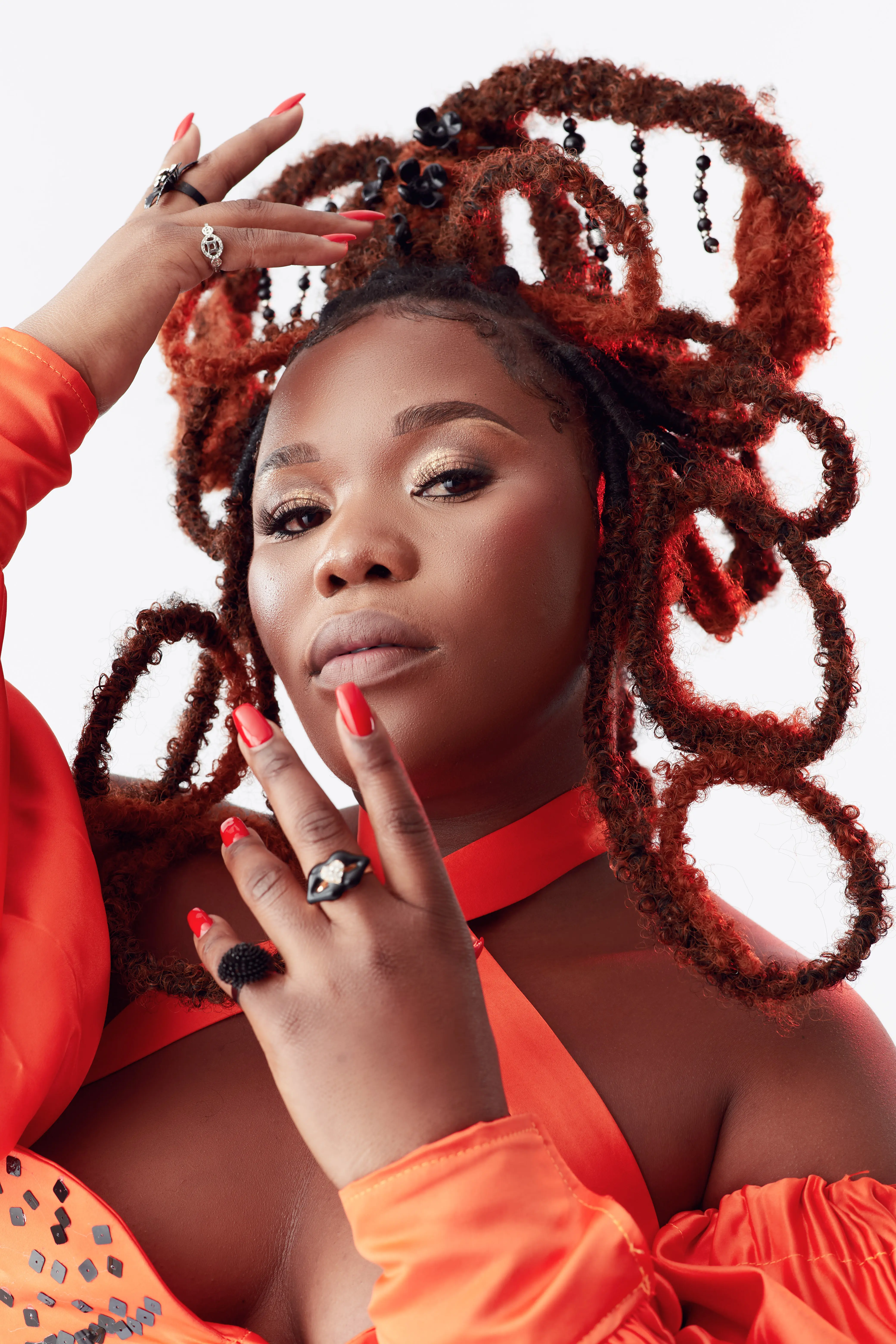
When Nobuhle Khuzwayo left KwaZulu-Natal for Johannesburg in 2020, she did so with a suitcase that only had three wheels, no record deal and an abundance of faith. She was doing her honours degree at the University of KwaZulu-Natal when the Covid-19 pandemic hit and students were forced to leave campus.
A few months earlier she had started working on music with Sun-El Musician’s team at EL World Music and they had invited her to come to Joburg to make more music while the rest of the world was shutting down. “I left because of hope and trusting that things might work out for the best,” she tells me. “But I had no idea what I was gonna do and if this was gonna work.”
At 4am she got a lift with a university friend who was making the journey to Joburg. They were stopped several times by police and had to pretend that they were both returning home to get around the restrictions on interprovincial travel.
“By faith, by God, we made it,” she says with a laugh.
Nobuhle secured a record deal that year and has since lent her distinctive vocals to songs by some of the biggest names in South African dance music, including Kabza De Small, Sun-El Musician and Master KG.
Now 28, the singer-song-writer finds herself contemplating a different kind of journey. On her latest album, Imvula: Rebirth, she’s trying to find her way back to the person she was before she got to Joburg. To understand what that means to Nobuhle, it’s worth going back a little further.
“Music for me was introduced to me by my grandmother, who was a spiritual healer,” she says of growing up in rural Nkandla in KwaZulu-Natal.
“It sounded like drums. It sounded like connecting to our people, our ancestors, to our beliefs and to our God.” Music was as much a part of her daily life as the chores she was tasked with doing as a child.
“We still had to wake up and go fetch water in the river. So every morning we would sing so that we didn’t feel so much left behind in the system, because I grew up in the rural area. So those mornings, they were full of sound, music, chanting and dancing.”
She describes coming from a family of singers and dancers and being raised by women who were actively involved in improving the lives of people in their community. Her introduction to gospel music came when she started singing in her primary school choir at the encouragement of a teacher who recognised her talent.
The influence of both African spirituality and Christianity is apparent in much of the music Nobuhle makes today. I ask her whether she’s ever experienced any tension between these two expressions of faith.
“I like to keep balance for my sanity. To know that I’m not one thing and I’m not obligated to believe in one,” she says.
“The spirit of music came and it blew up for me because it’s something that was there in my bloodline. So when I stick to those things, I am paying homage to God the Creator but also homage to people before me who raised me, who nurtured all of this.”
That relationship with spirituality extends to how she makes music. Despite having studied music at university, she’s not particularly inclined to arrive at a studio session with a fully written song.
“When I’m in the studio, I also have to listen to what I want to say. I have to listen to my feelings. So I can’t pre-rehearse any of it because my music is coming from just emotions and wanting to preach and wanting to sing and wanting to dance.”
Sometimes, much to the bewilderment of the producers she works with, she’ll ask them to switch on the microphone only 10 minutes into a recording session and improvise an entire song.
“I believe there are songs that we create and there are songs that we are given,” she says. It’s that understanding of her talent as a gift that has helped her get through periods when she’s seriously contemplated giving up music. “I wanted to give up because I was making it about me. And then I didn’t realise that there has always been a spirit of healing and gifting in my family, that it didn’t leave me behind.”
She recalls receiving a message from someone who had been contemplating suicide and had found solace in Liyangishonela, her collaboration with Kabza De Small.
“They listened to Liyangishonela and they felt like all they needed was to return home. And that’s what that song meant, basically, to return back to ourselves. If you are tired, return.”
But as much as Nobuhle believes she’s fulfilling a greater purpose through her music, she’s also a young woman trying to navigate the demands of an industry that hasn’t always been particularly accommodating of the kind of artist she wants to be.
“I have felt that our industry has a hard time accepting black women like me who have no nakedness or cursing or drama or anything like that,” she says. “I find it hard to completely exist as myself and be accepted in this industry because you can’t compare someone like me. I do what I do so differently.
“Our industry is filled with competition, who is doing it better than whom. We have not arrived at a point where it’s like we are accepting people in their differences.”
For all the emphasis placed on individuality in the industry, there’s a surprisingly narrow set of expectations about how women in particular should present themselves to the world. “I don’t want to be any of these things that you think I must be,” she says. “I want to sing. I want to make people happy.
That’s all I want to do.”
It’s interesting, then, that in calling her latest album Rebirth, Nobuhle is less concerned with reinventing herself than she is with recovering aspects of her identity.
“I’ve been walking so long doing everything that I’m meant to do. I wanted to do this album for myself,” she says. “It was me taking back the things I feel I may have lost on the way, because when you change, you lose things, you change things, you think differently. I wanna feel how it’s like to return to myself, but just a bit older and maybe just a bit wiser and with all of the lessons.”
The album also marks the end of her tenure with record label Red Box Entertainment. From next year she’ll be operating as an independent artist, a prospect she’s evidently excited about. In May she established a creative agency of her own through which she hopes to equip aspiring musicians with everything from songwriting skills to knowledge of their intellectual property rights, without them feeling pressured into compromising themselves to get a foot in the door.
She’s also keen to do more intimate theatrical shows that will allow her to explore her artistry outside the confines of amapiano, drawing on her background in music, drama and performance studies.
“I want them to come to my space. I want them to come to my candles on stage,” she says of her audience. “I want them to see that I’m such a dynamic person, because in that process of candles, I’m also going to be dancing and chanting.”
Towards the end of our conversation I ask Nobuhle what question she rarely gets asked in interviews that she wishes more journalists would ask her. “I wish people would ask, how is your mental health as an artist?” she responds almost immediately.
“How do you deal with being mentally available while also being in the chaos? What is your safe space to return to if you are not Nobuhle the musician?”
Naturally, I put the question to her. “You create a sense of trust and you surround yourself with people who know that when I walk inside your house, I am not a star. I am a human being. So hold me when I’m feeling sad. Give me space to grieve if I’m grieving. Give me space to not write or create if I’m not feeling good.
“When I get inside my home, I am not a performer,” she says. “The star business shall find me at the door when I leave to go do show business. Otherwise I’m gonna lose my mind.”
Six years ago, Nobuhle left home with a fairly clear idea of what she wanted to become and very little idea of how she was going to get there. Having achieved much of what she set out to do, she’s now giving herself the freedom to not always know what comes next. “My past albums, were surrounded by pain and identity crisis and not knowing who I am and wanting to know that quickly and be sure of it. My next chapter is going to feel like it’s okay if I don’t know. I don’t have to know. I’m going to trust that I’m in the right place and God is guiding me.”
For Nobuhle, it seems the next great leap of faith is learning to enjoy the life she’s spent the past six years trying to build.