

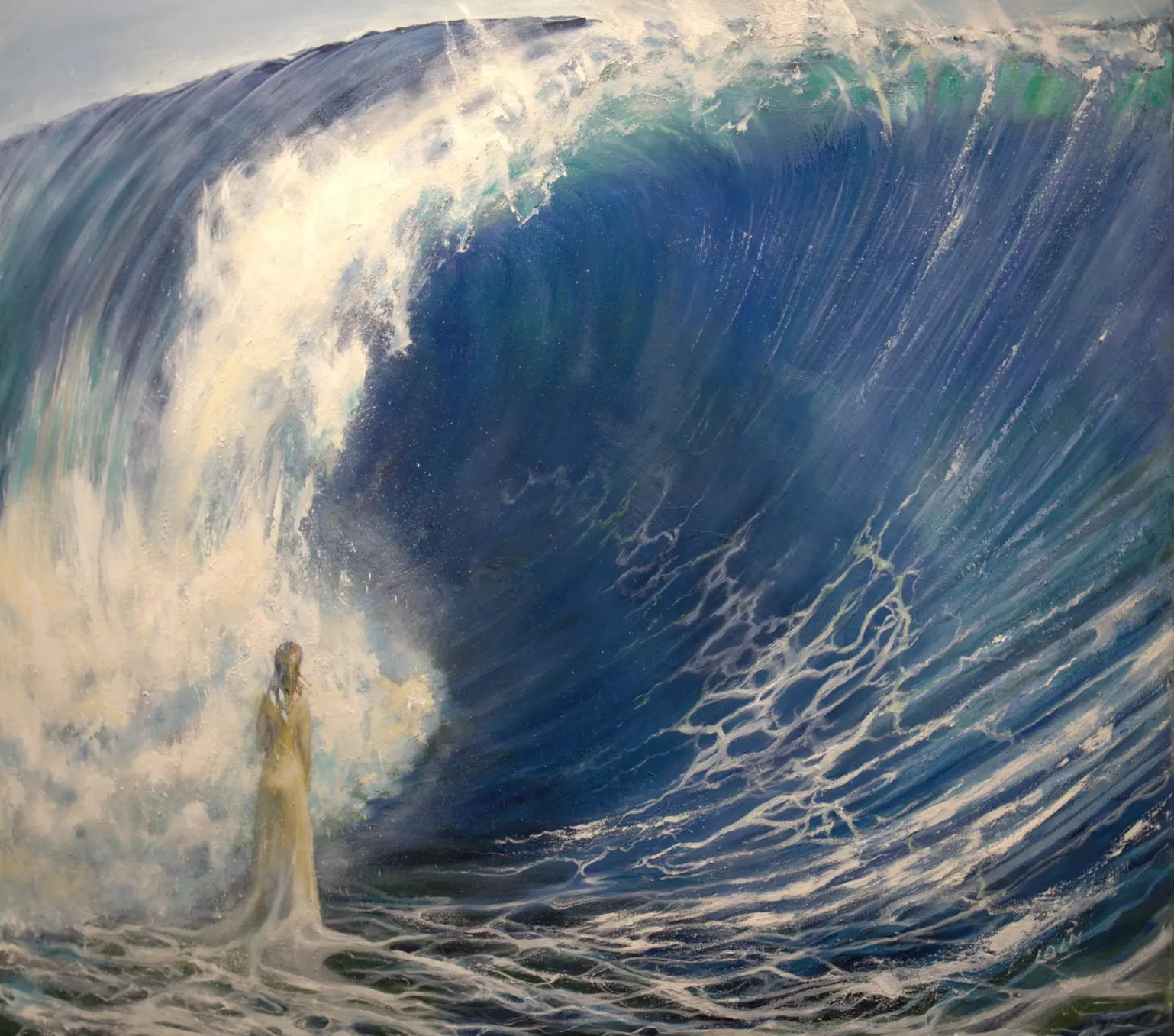
There is something about standing before a great wave that makes us conscious of our own smallness. The sheer volume of water, the gathering energy, that extraordinary moment when a wave rises, curls and begins to collapse.
It can be exhilarating, beautiful and terrifying, sometimes all at once.
In Dreamer, one of the paintings in Lyn de la Motte’s exhibition Thalassophile, a great wave curls towards the viewer, its dark interior framed by a rush of white water. It captures that suspended moment before the wave breaks, when the ocean seems to hold its breath.
De la Motte associates the painting with a dream in which she finds herself confronting something enormous and uncertain. There is apprehension in the image but also exhilaration and a sense of finding one’s place in relation to a force far greater than oneself.
The painting hangs in 3RD i Gallery in Cape Town’s De Waterkant, in a building dating from the 1700s, not far from the Gallows Hill memorial. There is something affecting about encountering these paintings of the ocean against walls that have stood for centuries, in a part of the city with its own complicated history. Here are two different expressions of time: a building that has witnessed generations of human life and an ocean whose history stretches back billions of years.
For De la Motte, this sense of time has another dimension. She speaks of the ocean as holding memories and information, an understanding of water that is connected to her spiritual practice.
The exhibition’s title comes from the Greek words for sea and lover or friend, describing someone who loves the ocean.
Living beside the ocean, De la Motte has spent years observing its changing moods, colours, movements and light. Her paintings explore what she calls the phenomenology of being at the sea: what happens within us when we walk along its edge, watch the waves or simply sit and listen.
At the exhibition opening, De la Motte spoke about her reluctance to explain too much about the individual paintings. She wanted people to encounter the work on their own terms. I found this a generous gesture, an acknowledgement that the meaning of a painting is not entirely the artist’s to determine. We each arrive with our own memories, associations and ways of seeing, and the same image can stir different feelings in different people.
“We all have sea stories within us,” she writes in her exhibition notes. It is a lovely thought and one that gives the exhibition much of its emotional appeal. The sea is never the same place for any two people. It holds childhood memories, grief, pleasure, fear, longing and the particular comfort of returning somewhere familiar. A stretch of coastline that means little to one person might contain an emotional landscape for another.
De la Motte’s paintings leave space for these personal encounters, even as they offer glimpses into her own relationship with the ocean.
For De la Motte, the experiences find expression through oil paint.
She speaks about oils with something approaching sensual delight.
There is the lusciousness of the colour, the texture of the paint, the way it can be pushed and worked, layered and manipulated, and the freedom it allows her to experiment, bend rules and discover something unexpected. Even the smell matters.
She describes the “nutty magical old world aroma of linseed oil” with affection. It is a reminder that making art is not only an intellectual or visual exercise. It is also a pleasurable engagement with materials.
Her paintings are built slowly, using a technique she describes as ébauche, working through successive thin layers of colour, each allowed to dry before the next. She prepares her canvases herself and develops the composition as she works, allowing the image to emerge through the painting process. This gives her opportunities to explore light, shadow and the forms that appear through layers of colour. There is something particularly appropriate about this approach to painting the sea, where depth, transparency, reflection and movement are constantly interacting.
The ocean is notoriously difficult to capture convincingly. Its surface is never fixed, its forms appear and disappear in seconds, and its colours depend as much on what lies beneath and above the water as on the water itself.
In Seaweed in Wave, de la Motte turns her attention to the delicate interplay of moving water and submerged vegetation. The seaweed appears almost woven into the wave, its fine forms following the movement of the water. It is an intimate image, one that rewards a closer look.
Elsewhere, the ocean is expansive and turbulent. There be Whales presents a restless sea, its surface broken by waves and shifting light. The title reminds us that beneath the visible surface lies an extraordinary world of living beings, most of it hidden from us.
In The Ancients, waves move across the canvas in a way that suggests motion and immense duration. The painting draws us back to De la Motte’s understanding of the ocean as a keeper of memory and to the possibility that being beside it can awaken something older than our individual experience. It is one of several works in which she moves between the observable world and a more imaginative, sometimes spiritual, understanding of our relationship with water.
Alongside her life as an artist, De la Motte has explored healing practices and ways of understanding the relationship between our inner lives and the natural world. Titles such as Soul Retrieval, Ancestors and Sleeping Dragons offer glimpses into this aspect of her thinking, where the sea becomes a place of transformation, mystery and myth. Yet the paintings remain open to interpretation, whether or not the viewer shares her spiritual understanding of water.
At the opening, De la Motte reflected the growing influence of technology on our experience of being human. She spoke of the choices we have in how we live and the importance of preserving our connection to our senses, creativity and the natural world. Her hope is that the paintings might offer viewers a moment of respite from the demands of modern life, simply by reminding them of the ocean’s beauty.
De la Motte holds a bachelor of fine arts from Unisa and has exhibited across South Africa, with work in private collections locally and internationally. What comes through most clearly in Thalassophile, however, is her enduring curiosity about the sea and the pleasure she takes in painting it. There is an openness to the work, an invitation to encounter the ocean through another person’s eyes without being told what to feel.
And there is something hopeful about that. For those fortunate enough to live near the coast, the ocean can become so familiar that we almost stop noticing it. In asking us to look again, De la Motte is also asking us to reconsider what deserves our attention, and how much beauty remains available to us when we make room for it.
• ‘Thalassophile’ runs until 16 January 2027 at 3RD i Gallery, 95 Waterkant Street, De Waterkant, Cape Town.
Serai Dowling is an ocean writer and author of two bestselling books about the sea. She founded Tide & Seek Ocean Experiences and her writing explores the relationships between people, water and the natural world.