


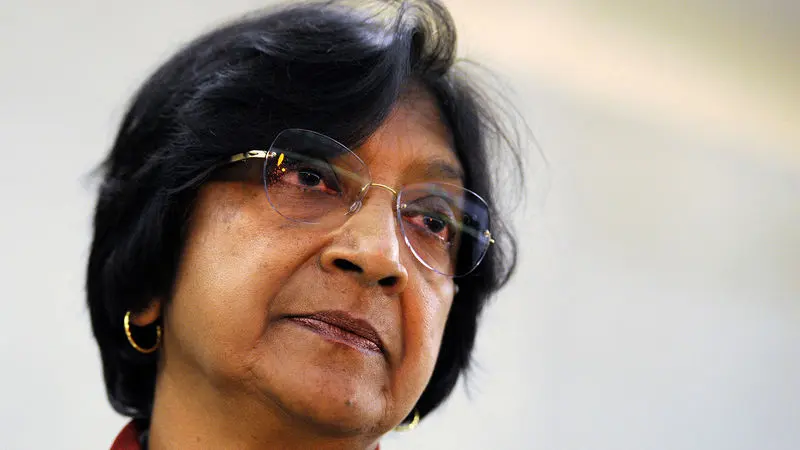
Nobel Peace Prize laureate Navi Pillay has urged governments to take collective action to defend the International Criminal Court (ICC) against sweeping American sanctions, warning that efforts to undermine international justice threaten accountability for genocide, war crimes and crimes against humanity.
The South African jurist, who was awarded the 2026 Nobel Peace Prize on Friday, has called on the United States to reclaim its role as a defender of human rights amid growing international concern over Washington's campaign against the Court.
Speaking to Reuters in The Hague on Tuesday, Pillay said the US should return to its traditional leadership in protecting human rights.
"My message is: 'You have to get back to playing your serious role as a leader, playing a liberatory role for the rest of the world'," she said.
Her remarks followed the Trump administration's announcement on Friday of sanctions against the ICC as an institution, extending earlier measures against individual judges and prosecutors.
The sanctions were announced hours after Pillay received the Nobel Peace Prize. She told Reuters she did not believe the timing was coincidental, although the US has been pursuing measures against the Court for some time.
"I think it's very unfortunate. However, the plans of targeting international criminal justice through the ICC were brewing all the time," she said.
In a separate interview with the Associated Press on Monday, Pillay described the sanctions as "completely unlawful" and called for "collective action, not just words" from governments committed to international justice.
The US measures follow the ICC's decision to issue arrest warrants for Israeli Prime Minister Benjamin Netanyahu and former defence minister Yoav Gallant over alleged war crimes and crimes against humanity in Gaza.
Israel rejects the allegations and disputes the Court's jurisdiction. The US has also challenged the ICC's authority to investigate American and Israeli nationals.
The sanctions could restrict the Court's access to financial services, technology and other essential operations. Washington has, however, suspended the latest measures for six months and authorised certain transactions to continue.
Pillay, a former ICC judge, visited the Court's headquarters on Monday to express solidarity with staff members facing mounting political pressure.
She said supporting the Court's personnel had been her immediate priority on returning to The Hague.
The ICC confirmed the visit, during which Pillay praised the dedication and courage of its staff. Court president Tomoko Akane congratulated her on the Nobel award.

The confrontation over the ICC has unfolded alongside criticism of Pillay's leadership of the United Nations Independent International Commission of Inquiry on the Occupied Palestinian Territory, including East Jerusalem, and Israel.
The commission concluded in September 2025 that Israel had committed genocide against Palestinians in Gaza.
Its investigation found that Israeli authorities and security forces had committed four of the five genocidal acts defined under the Genocide Convention. It also concluded that statements and conduct by Israeli officials demonstrated genocidal intent.
The findings followed extensive investigations into Israel's military campaign, the destruction of civilian infrastructure, restrictions on humanitarian assistance and the treatment of Palestinians in Gaza.
According to Gaza's health ministry, at least 74,382 Palestinians had been killed and 175,416 injured since October 2023, as of 12 October 2026. Many more have been displaced, while large parts of the territory have been devastated.
Israel denies committing genocide. South Africa's separate case against Israel remains before the International Court of Justice, which has ordered provisional measures but has not yet delivered a final judgment on whether genocide occurred.
Pillay has rejected accusations that the UN commission's findings were politically motivated.
Speaking to the Associated Press, she said criticism from Israel was unsurprising because the commission had held the Israeli state responsible for serious violations of international law.
"We just have this condemnation by the state of Israel because they are the ones that we have held responsible," she said.
She urged the public to examine the evidence rather than repeat political slogans.
"Don't fall for false propaganda or just repeat slogans," Pillay said.
In South Africa, the South African Zionist Federation (SAZF) rejected Pillay's Nobel award, accusing her of bias in her investigations into Israel.
"The SAZF does not believe the Nobel Peace Prize should ever have been awarded to Navi Pillay," national spokesperson Rolene Marks told the Mail & Guardian.
The South African Jewish Board of Deputies, approached for comment on the Israeli government's criticism of Pillay, referred the newspaper to the SAZF. The federation also disputed the UN commission's genocide findings.
Pillay's Nobel recognition follows decades of work in international human rights and criminal law. A former United Nations High Commissioner for Human Rights, she served on the International Criminal Tribunal for Rwanda and the ICC before becoming an ad hoc judge at the International Court of Justice.
Her contribution to the landmark Akayesu judgment helped establish that rape and sexual violence could constitute acts of genocide.
United Nations High Commissioner for Human Rights Volker Türk described her Nobel award as a collective victory for those working to uphold human rights and international justice.
South Africa has condemned the American sanctions against the ICC, reaffirming its commitment to the institution.
Deputy Justice Minister Andries Nel told the Social Justice Summit at Stellenbosch University on Monday that the Nobel award came at a time when international justice institutions were under increasing pressure.
"It is entirely legitimate to criticise a court or disagree with its decisions. That is different from applying pressure to judges or prosecutors because of the work they perform," Nel said.
Although South Africa has reaffirmed its support for the ICC, Nel's remarks did not announce specific measures to shield the Court from the sanctions.
Pillay's appeal for collective action has brought that question into sharper focus as governments face pressure to translate their support for international justice into practical protection for the institutions responsible for enforcing it.