


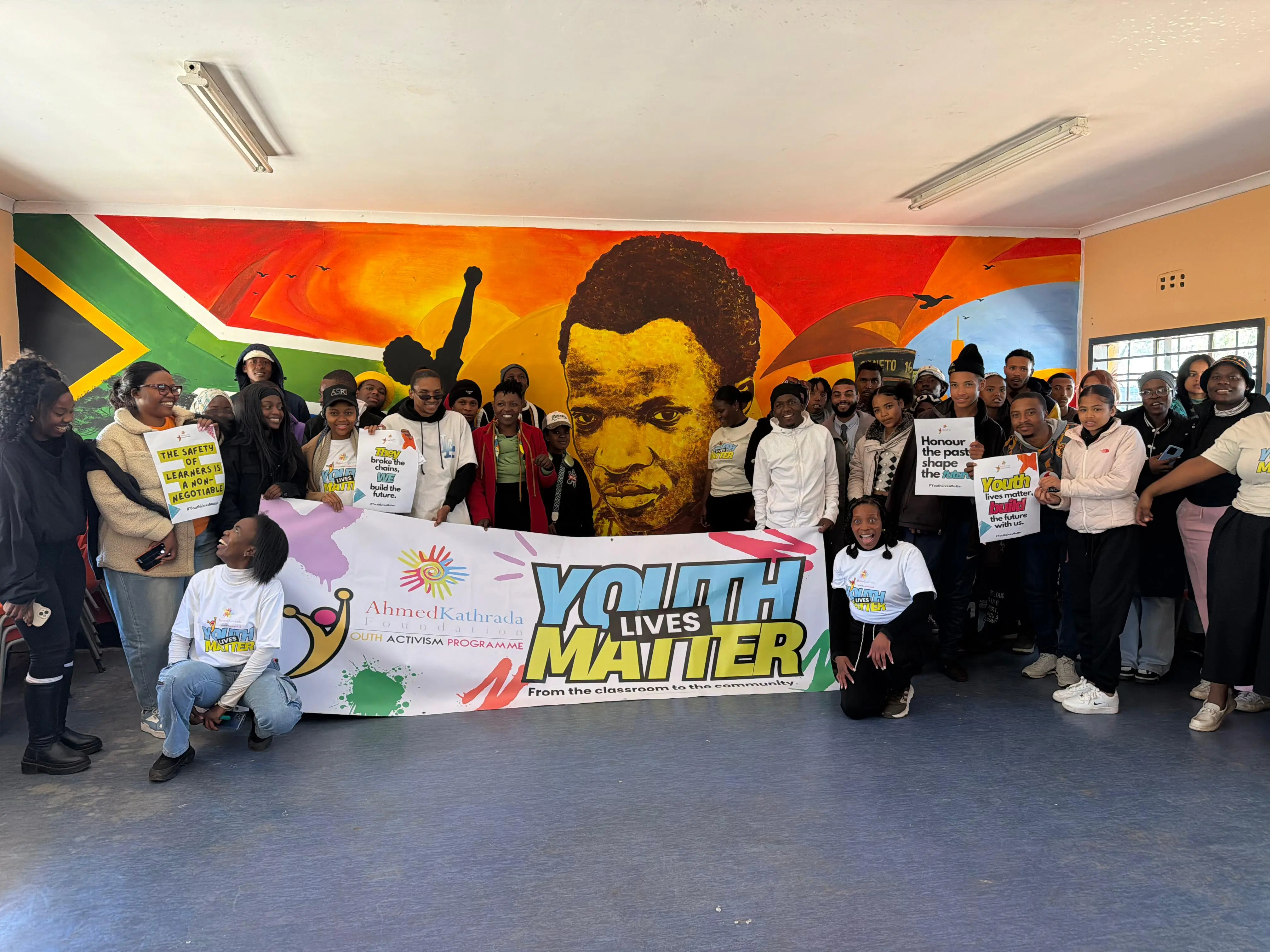
Young people gathered in Soweto last week Friday, not only to commemorate the past but to argue about its present meaning.
From Avalon Cemetery to Morris Isaacson High School, the launch of the #YouthLivesMatter campaign unfolded as a moving procession through sites embedded in South Africa’s democratic memory but also as an urgent reckoning with the conditions shaping young lives today.
The campaign, launched by the Ahmed Kathrada Foundation Youth Activism and Leadership Programme, emerged in response to widening gaps in youth participation and influence in civic and policy spaces. While young people are often visible in protest action and social media activism, organisers argue they remain structurally excluded from decision-making processes that shape their daily realities.
The initiative seeks to reposition them not as passive recipients of democracy but as active agents driving advocacy, community action and policy engagement.
The morning began quietly at Avalon Cemetery, where participants walked among the graves of those who took part in the 1976 Soweto Uprising. The tone shifted from remembrance to reflection on what that history demands of the present.
Seth Mazibuko, a veteran of the uprising, cautioned against treating 1976 as distant heritage. “We were not just participating,” he said. “We were taking responsibility.”
His message was clear: the struggle did not end in 1994 and neither should youth activism be reduced to symbolic participation. Around him, the cemetery became less a site of mourning than a space of instruction; where the past was being used to interrogate the present.
Postgraduate student and Hector Pieterson Memorial tour guide Thapelo Makota expanded on this by tracing the careful organisation behind the uprising. The students of 1976, he said, did not stumble into history. “The uprising was not an accident,” he said. “It was organised.”
Meetings had begun months earlier in churches and community halls, deliberately chosen as safer spaces away from police surveillance.
By June, student structures such as the Soweto Students’ Representative Council had developed coordinated networks across schools and drafted demands against the imposition of Afrikaans in classrooms.
If Mazibuko framed responsibility and Makota outlined structure, Nkululeko Ngolela turned attention to memory and how unevenly it is preserved. While Hector Pieterson’s image became globally iconic, he noted that other victims of the uprising remain less widely remembered.
He referenced Hastings Ndlovu, whom he described as the first pupil killed on 16 June 1976 and Lily Mithi, an eight-year-old among the youngest victims of the broader violence. Ngolela also reminded participants that even the most famous image of the uprising survived through fragile human action.
The photograph of Hector, he said, reached the world only because photo journalist Sam Nzima outmanoeuvred police attempting to confiscate his work. Nzima hid the film in his socks before smuggling it out for publication, an act that transformed a moment into a global indictment of apartheid brutality.
From the cemetery, the procession moved through Soweto towards Morris Isaacson High School, one of the central epicentres of the 1976 uprising. The physical shift mirrored the thematic one: from memory to mobilisation, from reflection to urgency.
At the school, organisers said the campaign sought to bridge the gap between visibility and power by creating structured platforms where young people can move from protest to policy engagement. Through youth clubs, voter “chillas” and youth-led dialogues, participants are encouraged to identify challenges and co-design solutions.
The campaign is structured around four pillars: active citizenry; education and social advocacy; youth economic empowerment; and climate justice. Each pillar is linked to measurable community projects such as voter registration drives, school safety initiatives and youth entrepreneurship programmes.
Neeshan Balton, of the Ahmed Kathrada Foundation, told participants that the campaign was grounded in a refusal to normalise preventable youth deaths.
“Hector Pieterson should never have died and no young person should be dying today,” he said, linking the past to present crises such as road fatalities, school-based violence, substance abuse and criminal activity in communities.
Balton also challenged young people to approach the upcoming local government elections with greater political literacy, urging them to evaluate candidates based on practical governance capacity rather than rhetoric.
“Can they read a budget? Can they actually deliver?” he asked, arguing that democratic participation must extend beyond voting day into sustained accountability after elections.
He further called for a national debate on lowering the voting age to 16, suggesting that earlier political inclusion would force leaders to take youth issues more seriously.

The campaign’s broader vision, organisers said, was to rebuild trust in democratic participation by creating authentic youth-led spaces where young people were not spoken for but led directly. Rather than abstract participation, the focus was on tangible outcomes; reopening libraries, improving school safety, ensuring access to clean water and strengthening accountability systems.
Success, they said, would be measured through increased youth voter registration, growth in youth-led community initiatives, policy influence through emerging youth think tanks and measurable improvements in wellbeing, education access and community safety.
At Morris Isaacson High School, one of the most symbolic sites of the 1976 uprising, the day shifted again from structure to reflection. Speakers emphasised that the lesson of 1976 was not only courage but collective discipline that social change emerges through organisation, clarity of purpose and sustained action.
One of the speakers described courage not as the absence of fear but as conviction in doing what was right, while another urged participants to live as if hope existed, turning belief into action rather than waiting for certainty.
The final stop was youth leader Tsietsi Mashinini’s former classroom. There, organisers asked young people to consider what they were prepared to do.
The journey from Avalon Cemetery to Morris Isaacson High School ultimately became more than a commemorative route. It traced a line between generations of activism, linking the organised resistance of 1976 to the structured, youth-led civic action the campaign hopes to build today.
Fifty years after the Soweto Uprising, the question posed in Soweto was no longer only how history should be remembered but how it should be continued.