

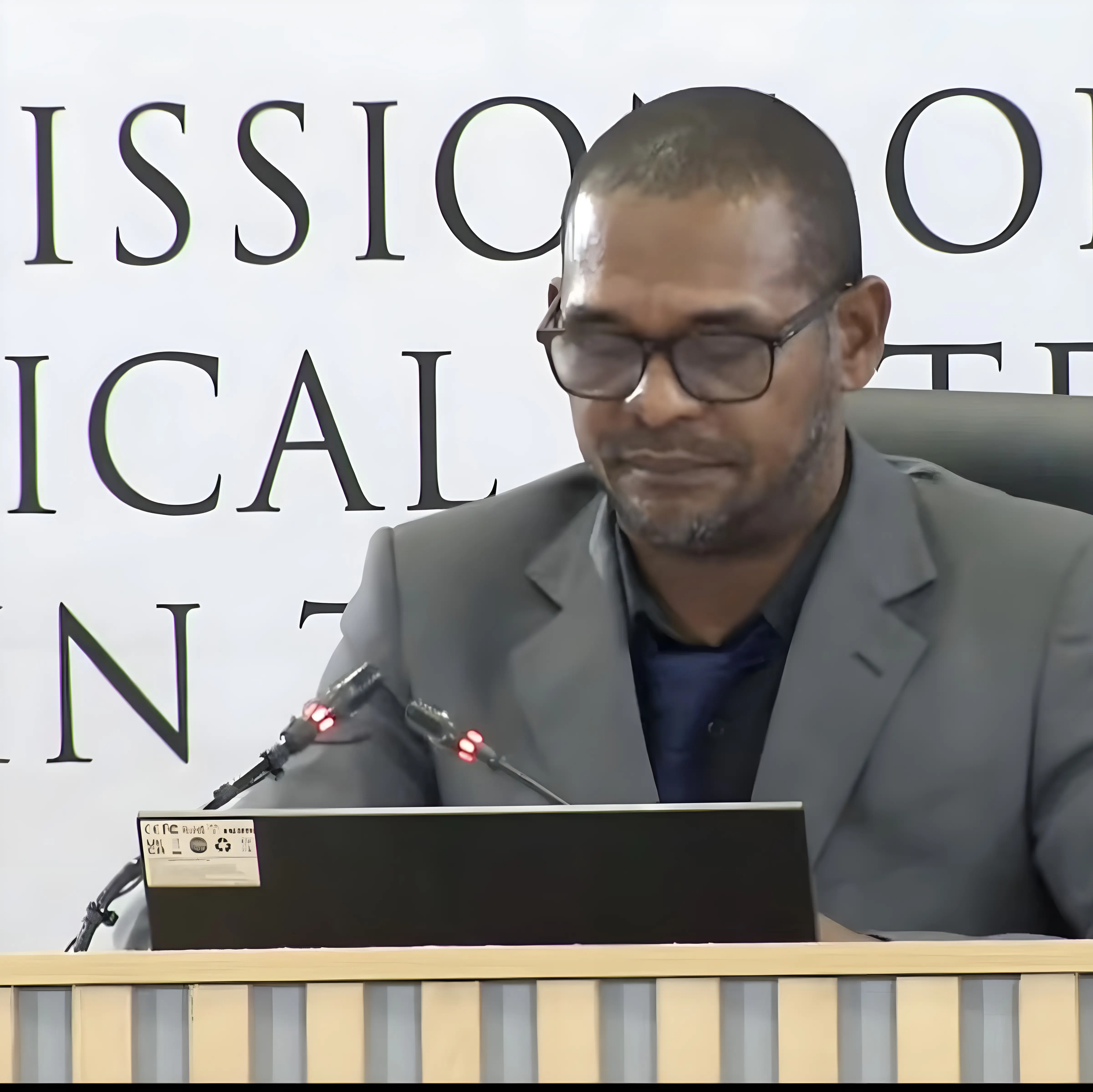
National Coloured Congress MP Fadiel Adams has denied that suspended police minister Senzo Mchunu influenced his decision to lay fraud and corruption charges against crime intelligence officials.
Within a span of four days in October 2024, Adams opened seven fraud and corruption cases against members of crime intelligence. On 1 November, he emailed Mchunu alleging that the dockets had been intercepted and asking the minister to intervene.
The evidence formed part of Adams’ testimony before the Madlanga Commission of Inquiry, which is examining allegations of political interference and criminality within the police.
The commission heard that Adams was assisted in opening the criminal account by a crime intelligence informant known as Witness G or “Elvis”, who was the handler of businessman Brown Mogotsi. Mogotsi is alleged to have acted as a middleman between Mchunu and business associates.
WhatsApp messages presented before the commission revealed Mogotsi informing alleged Big Five cartel leader Vusimuzi “Cat” Matlala that the police unit that raided his house would be dealt with. Subsequently, Mchunu disbanded the Political Killings Task Team (PKTT), which was investigating Matlala, on 31 December 2024.
Mogotsi is known for securing R150 000 in funding for the ANC’s January 8 2025 conference in Cape Town from businesses and Matlala. Mogotsi allegedly relayed messages between Matlala and Mchunu.
Adams told the commission that, in late October 2024, he found classified intelligence documents under the door of his parliamentary office.
Adams then used the information to open seven fraud and corruption cases against members of the crime intelligence division, with a particular focus on the unit’s head, Dumisani Khumalo, who was also the project leader of the PKTT.
Adams opened three cases at Western Cape police stations on 29 October 2024, alleging that crime intelligence’s secret security funds had been abused to purchase a forklift, vehicles and properties. Two days later, he travelled to Johannesburg and opened the same fraud and corruption cases there.
He alleged that Khumalo, Major-General Nosipho Madondo and police commissioner Fannie Masemola did not have the required security clearances to work in crime intelligence.
He further alleged that Dineo Mokwele, who was appointed as a brigadier to head crime intelligence’s technical support services unit, did not have the necessary qualifications for the position and had been appointed in exchange for corrupt gratification.
After opening the seven cases in two provinces, Adams emailed Mchunu the next day, on 1 November 2024, claiming that his cases had been intercepted and asked the minister to escalate the matter. The timing of Adam’s approach to Mchunu comes against testimony before the commission that the minister had expressed an intention to “clean” up crime intelligence”.
“I have opened cases in the Western Cape on a number of senior SAPS [South African Police Service] personnel … I was told that the dockets were intercepted,” Adams wrote to Mchunu, a day after he had opened the same fraud and corruption cases in Gauteng.
“In my quest for justice, I travelled to Gauteng and opened the following dockets at the Orlando SAPS,” he wrote. “However, I have also been notified that the Gauteng police head has followed the same modus operandi as the Western Cape PC [provincial commissioner] and is interfering in the investigative process,” he wrote.
“I urgently and humbly ask for the minister to intervene and ensure the integrity of the investigative process is maintained, to ensure a fair and just outcome.”
Evidence leader advocate Lee Segeels-Ncube asked Adams how he knew that the dockets he opened were being intercepted. Adams said he was tipped off by General Andre Lincoln, who died in May 2025.
“At 8 o’ clock the next morning, you know that Gauteng police are adopting the same modus operandi based on what?” Segeels-Ncube asked.
Commissioner Sandile Khumalo said there had been considerable activity in December 2024 involving Mogotsi assisting people to open cases in Soweto. “Did you by any chance speak to Brown Mogotsi around November and December 2024?,” Khumalo asked.
Adams said he had spoken to Mogotsi by phone around that time but could not recall the details. He said they had not discussed the crime intelligence cases he had opened.
“General Lincoln was in contact with Mr Brown Mogotsi, who he told me was someone who was close to the minister, which I now know to be a lie,” Adams said.
Segeels-Ncube presented Adams with a transcript of Witness G’s testimony, who stated that he assisted Adams during his trip in Johannesburg to open the cases.
“[W]hen Adams arrived at the Orlando police station, I referred him to a detective and informed the detective to attend to Mr Adams by taking his statement and/or opening the case,” according to Witness G’s transcript.
Adams confirmed that he met Witness G, whom he knew as “Elvis”, but denied phoning him the day before he arrived. He alleged he received Witness G’s contact details the day he arrived in Joburg from General Lincoln.
When asked by Segeels-Ncube whether he knew that Witness G had a longstanding relationship with deputy head of crime intelligence Feroz Khan, Adams stated that he was not aware.
“So what you are saying is, it is coincidence, that the person who assisted with opening these dockets in Orlando, is also a person from crime intelligence, a friend of General Khan, the handler of Mr Brown Mogotsi, who has an association with minister Mchunu, who you complain to the very next day about your missing dockets.”
Adams said he was surprised by the connections and denied knowing Khan. He said he received information from Lincoln about the dockets being intercepted.
Segeels-Ncube said Adams was hiding behind the fact that Lincoln could not collaborate his statement and was seeking to distance himself from Mogotsi and Mchunu.
“This is the man that says to you, ‘go to Orlando’, so he must trust Orlando. He also arranges someone from Orlando, if we believe you … but I highly doubt that anyone does but if we believe you that the Cape Town dockets were intercepted, you have covered every base to make sure the Joburg dockets don’t get intercepted.
“But the very next day you say to the minister the same thing has happened. How is that possible? Then it must be General Lincoln and Witness G that have intercepted the dockets,” said Segeels-Ncube.
“General Lincoln is in Cape Town without legs; he can’t intercept the dockets,” Adams responded.
“And yet he knows the dockets have been intercepted,” said Segeels-Ncube.
Adams said he had not spoken to Witness G or Mogotsi before writing his email to Mchunu. “I was told by General Lincoln that they are trying the same stunt again,” Adams said.
Adams said he acted quickly because of his concerns about the alleged abilities of SAPS members to make dockets disappear.
“If I can put it into context for you. I’ve laid three charges against three senior members of SAPS. I’m told the dockets are gone. I came to Johannesburg to lay the same charges … He didn’t say it’s been taken. He said they’re gonna try and take it again. In panic, I write to the minister in the morning, [stating], ‘minister, please assist,’” said Adams.
Segeels-Ncube said Adams could not have known as a fact that the dockets had been taken. She said Adams was abusing his position as an MP by reporting the matter directly to the minister the next day. There were legitimate cases of dockets going missing, she said.
“Your docket has no evidence; it is just an A1 statement. You don’t even provide documentary evidence to substantiate your allegations and yet you go to the minister using your position as a member of parliament,” said Segeels-Ncube.
Adams said he did not include the evidence because it came from the crime intelligence scoop he had received under his door and he did not want to expose classified information.
“This is my view. It was necessary. And you may hold a different view. But I did not abuse the minister and I certainly did not ask the minister to get involved in the investigative process. I asked the minister to intervene and ensure the investigative process [was maintained],” said Adams.
Commissioner Sisi Baloyi said that within 24 hours of opening the Johannesburg cases, Adams had written to the minister. She said even the minister’s office acted on Adams’ complaint on the same day.
“All of it seems unseemly. It seems like a scheme that was generated to culminate the way it did, which is at Idac [Independent Directorate Against Corruption], whom Ms Johnson has accepted had no business to get involved in this. It looks like a well-orchestrated scheme because your conduct does not make sense,” said Baloyi.
“There’s something wrong about this whole process. For lack of a better word, it stinks of mechanisation,” Baloyi said.
Adams said his actions were intended to get the investigation started promptly in the interest of justice. “When you connect dots, it does stink. I will concede to that. But my motivation was, ‘I am not going to let [them] get away with this.’”