


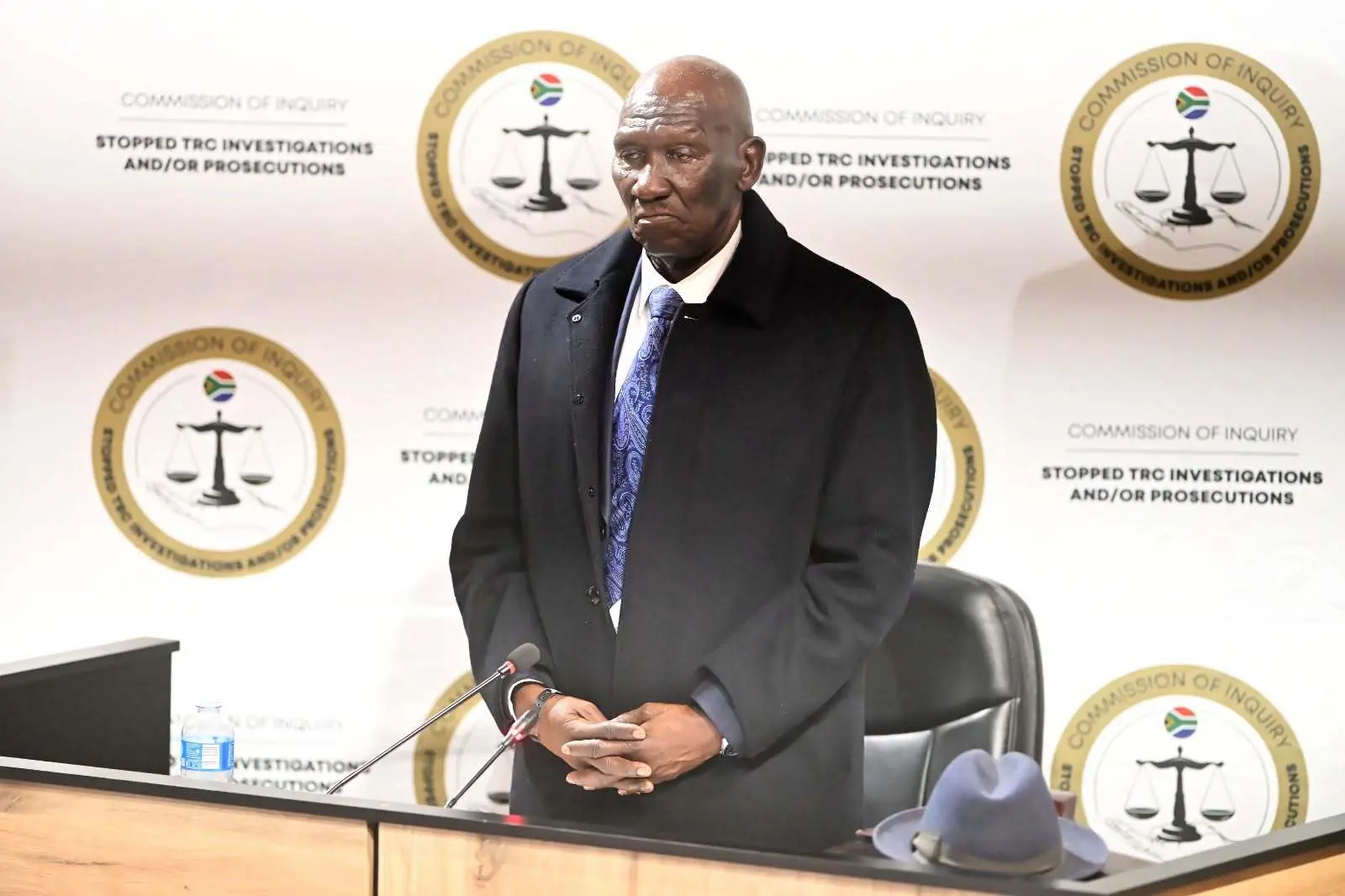
Former police commissioner and minister Bheki Cele appeared before the Truth and Reconciliation Commission (TRC) Cases Inquiry also known as the Khampepe Commision in Newtown, Johannesburg, on Thursday where he was questioned about his role concerning specific cases during his tenure.
He first appeared before the commission last month when he testified that he had been unaware of the outstanding TRC cases in 2010.
His main focus, as the then-police commissioner, had been on securing the Fifa World Cup in South Africa that year.
Former Deputy Chief Justice Sisi Khampepe, alongside retired Northern Cape High Court Judge President Justice Frans Diale Kgomo and advocate Andrea Gabriel, SC, is chairing the commission.
The Khampepe commission's main purpose is to establish reasons why the TRC cases that were referred to the South African Police Service (SAPS) for investigations and the National Prosecuting Authority for prosecutions never made it to court.
Cele, who sent an apology to the ANC national executive committee meeting which is finalising the names of candidates for the highly contested local government elections, admitted to knowing Musawakhe "Sbho" Phewa but said was not sure whether Phewa had been abducted.
Phewa was an uMkhonto we Sizwe (MK) operative who had disappeared around 1987 from Lamontville, south of Durban.
"I know him. I am not very sure if he was abducted or not. What I know and I have heard is that he went missing en route to exile. He was always on my mind when I came back from operations and I wanted to work with him.
"New information emerged as I asked about him; that he went into exile and that is when I knew that he was abducted but I did not know if it was when he was going or coming back," he told the Khampepe commission.
Mbuso Khoza, Phewa's son, filed the affidavit to the inquiry. He has called for damages to be paid out. Khoza's affidavit details the efforts that his aunt, Zama Khoza, has taken in an attempt to secure a special pension from the government. It also cites Cele as Phewa's closest ally.
Cele confirmed having received the application for a special pension.
'Given the fact that my father was closely involved with comrades who climbed the ranks of the ANC, such as Bheki Cele, we remained hopeful that when the ANC came into power, resources would be allocated to find out what happened to my father but this turned out not to be the case,' read Khoza's affidavit.
But Cele said he could not fully agree with either the sentiments expressed or the accusations.
"I was asked to confirm whether I knew Sbho or not. I did what I could to confirm that I knew 'Sbho'. The national leadership was there at the time to deal with the TRC matters. It was not dealt with at the provincial level," he said.
Cele referred to 2008 when he was the MEC for Transport in KwaZulu-Natal and a member of the ANC's provincial executive committee. He said he had not been in the national government and could not have done much at the time.
Cele was asked if he had known South African anti-apartheid activist Ntombi Kubheka who was kidnapped, tortured and killed in 1987 when her daughter, Thuli Kubheka, was three years-old. Thuli, along with other family members, is seeking justice for her mother's murder.
Advocate Howard Varney questioned Cele about his refusal to use taxpayers' money to help the perpetrators of apartheid crimes.
The former police boss said that despite being ordered by the racist regime, the operatives were carrying out criminal activities in the name of apartheid.
Cele said some taxpayers were victims of apartheid and he would therefore not use their money to fund past atrocities.
"It should not have been debated; no need for the eye of the needle. We are debating how to take care of the proponents of apartheid. Nobody is taking the Steve Biko inquest very seriously, for example," said Cele.
Biko was killed in 1977. No one has been held accountable for his murder.
Varney said families of the victims did not have support, unlike the perpetrators of apartheid. He added that even the inquiry did not have the state's support.
"We are dependent on pro bono work. We look for charity."