


South Africa knows where women are most at risk of violence, how alcohol and firearms contribute to their deaths and how reported rape cases fall away as they move through the criminal justice system.
It has progressive laws, a national strategy and decades of research into interventions that can save lives. Yet intimate-partner femicide is rising again and most women who report rape never see their cases result in a conviction.
The problem is no longer simply a lack of evidence. It is the failure to act on what is known.
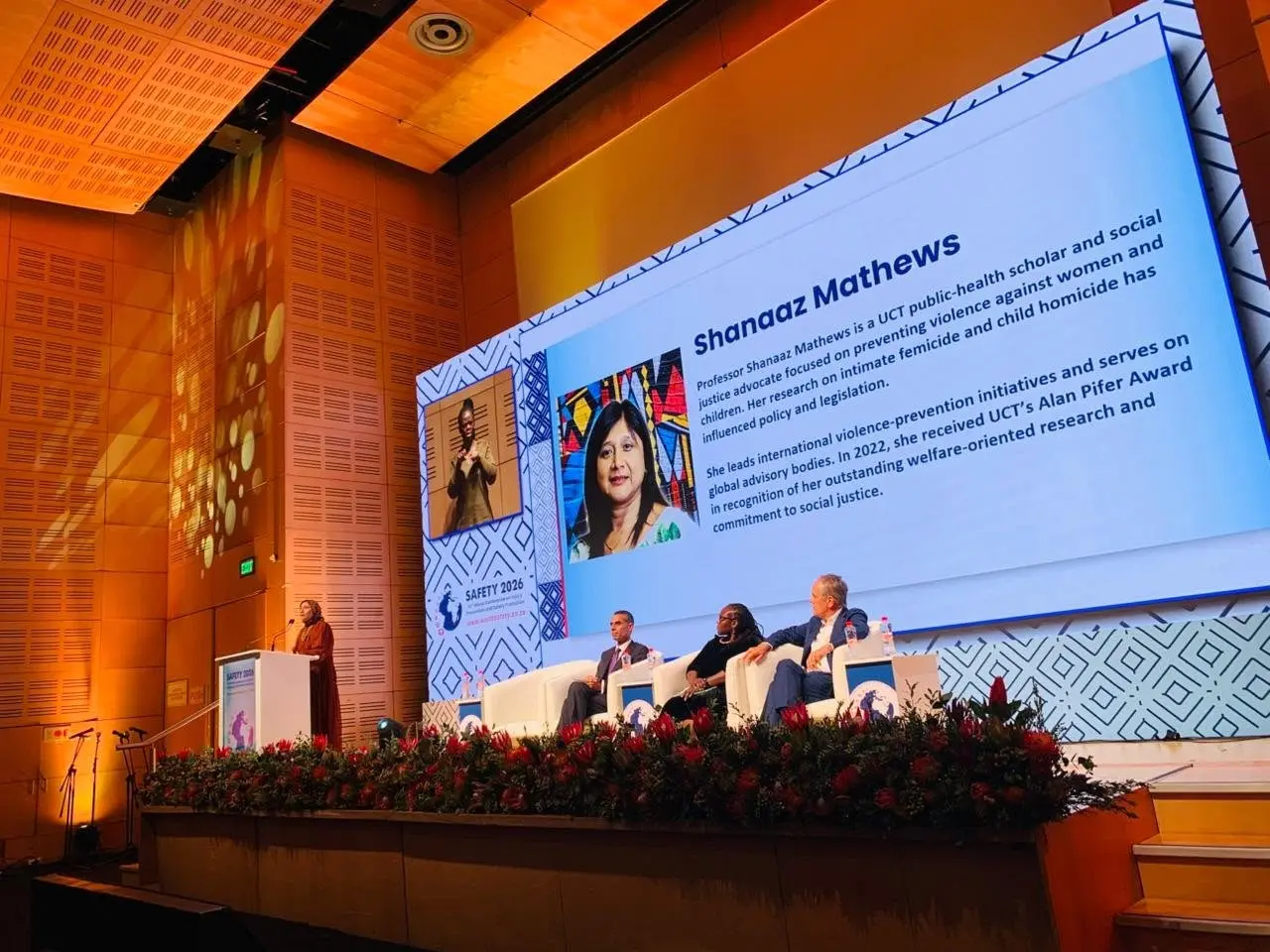
That warning ran through the opening plenary of the 16th World Conference on Injury Prevention and Safety Promotion in Cape Town on Wednesday, where researchers challenged governments — and their own scientific community — to confront the systems that allow preventable harm to continue.
Safety 2026 has drawn researchers, policymakers, practitioners and civil society representatives from more than 80 countries.
Hosted by the Foundation for Professional Development, co-hosted by the South African Medical Research Council (SAMRC) and co-sponsored by the World Health Organisation, it is being held under the theme Ubuntu: United for a Safer Future.
The conference returns to Africa after two decades and marks 30 years since the World Health Assembly recognised violence as a major public health problem.
According to the WHO, violence and injuries kill about 4.8 million people a year and account for nearly 8% of global mortality. Road crashes account for about a quarter of these deaths, followed by falls, suicide, homicide and drowning.
SAMRC president and chief executive Ntobeko Ntusi told delegates that safety could not be created by a single profession, institution or country.
"Evidence alone does not change the world," he said. "It must be translated into action. Action must be implemented at scale, and implementation must be sustained."
Behind every injury statistic was a person, a family and a question society had to confront: could something have been done differently? In many cases, Ntusi said, the answer was yes.
A road death, for example, could involve road design, speed, alcohol, vehicle standards, policing and access to trauma care. Addressing one factor in isolation was unlikely to produce lasting change.
"The science of prevention is a science of systems," he said.
SAMRC executive scientist Rachel Jewkes provided a stark South African example of what happens when political commitment and institutional performance fail to keep pace with research.
Findings from the country's femicide surveillance studies showed that substantial progress in reducing the murder of women had stalled, while intimate-partner femicide had begun increasing.
The age-standardised intimate-partner femicide rate declined from 9.5 per 100,000 women in 1999 to 6.6 in 2009 and 4.9 in 2017. It then rose significantly to 5.5 in 2020-21 — about five times the global rate.
Overall femicide declined from 24.2 per 100,000 women in 1999 to 10.6 in 2020-21, while non-intimate-partner femicide fell from 11.4 to 4.1 over the same period.
Jewkes linked the earlier decline partly to stronger gun-control legislation and enforcement. But those gains were undermined as corruption weakened state institutions and law enforcement deteriorated.
South Africa's experience showed that progress won through activism, research and legislation was not irreversible.
Jewkes traced the country's path from when violence against women was treated as a private matter to what she described as an "era of implementation" after 2002, when laws, regulations and services were strengthened.
Growing corruption and weakening state institutions from about 2012 then brought stagnation and decay in parts of the system.
Renewed activism from 2017 helped return gender-based violence to the political agenda and led to the adoption of the national strategic plan on gender-based violence and femicide.
Yet, Jewkes said, a disconnect remained between the priority the government claimed to give the issue and the quality of services women received.
Research tracking reported rape cases showed them falling away at every stage of the criminal justice process — from the arrest of a suspect and referral for prosecution to the start of a trial and eventual conviction. Most women who reported rape therefore never saw their cases end in a conviction.
Evidence from the Covid-19 lockdown also illustrated the relationship between alcohol availability and fatal violence against women.
South Africa moved through several combinations of alcohol restrictions and curfews during 2020 and 2021. During the strictest period, when alcohol sales were prohibited and a stay-at-home curfew was imposed, the country recorded an average of about 82 femicides a month. During periods without either restriction, the monthly average was 218.
Published research found that overall femicide was 63% lower under the strictest combination of alcohol and movement restrictions. Because the two operated simultaneously, the findings do not identify alcohol as the sole cause of the decrease. But Jewkes said the evidence strengthened the case for regulating the alcohol industry as part of the response to gender-based violence and femicide.
Johns Hopkins University associate professor Abdul Bachani said the field had generated substantial knowledge over 30 years, but the persistence of violence and injury showed progress had been insufficient.
"The most important question for this conference is therefore not simply what more do we need to know, but rather what do we need to do differently with what we already know?" he said.
Implementation took place within political, institutional and economic systems, where interventions could fail because financing was not sustained, state capacity was weak, responses were fragmented or political incentives were misaligned.
University of Cape Town professor Shanaaz Mathews said prevention could not focus only on the person immediately affected while ignoring inequality, gendered power, unsafe environments and institutional failures that allowed perpetrators to escape accountability.
Jennifer Tucker, director of Wesleyan University's Center for the Study of Guns and Society, described the United States as an extreme firearm-death outlier among wealthy countries.
A study using 2015 data found that the US accounted for nearly 84% of firearm deaths across 29 high-income countries, almost 92% of women killed with guns and more than 98% of firearm deaths among children aged four and younger.
The final speaker, researcher K.L. Dunkle warned that an intervention could reduce violence without achieving equity.
Dunkle presented preliminary findings from an intimate-partner violence prevention programme in Rwanda. Violence among women with disabilities declined from 60% at the start of the programme to 43% at its conclusion. Among women without disabilities, it fell from 46% to 31%.
Although both groups benefited, women with disabilities ended the programme with almost the same prevalence of violence as women without disabilities had at the beginning.
Disability had not been considered when the programme was designed, women with disabilities had not been consulted and the findings excluded those unable to access the intervention.
"If we don't centre the people most affected, we get it wrong," a presentation slide warned. "We miss inequities. We miss system barriers. We miss critical questions. We miss feasible solutions."
Dunkle said accountability had to extend from setting priorities and designing an intervention to interpreting and communicating its findings.
If those most affected had no meaningful power to reject decisions, an initiative could not credibly be described as participatory research.
The conference is expected to finalise the Ubuntu Cape Town declaration for a safer world and a national consensus plan setting out priorities for South Africa.
But the opening plenary established the standard against which those commitments will be judged.
South Africa already has policies, research and experience showing what can save lives.
The question is whether its institutions will turn that knowledge into protection for women's experiences in their homes, communities and streets — and whether those most exposed to harm will have any power in deciding how that is done.