


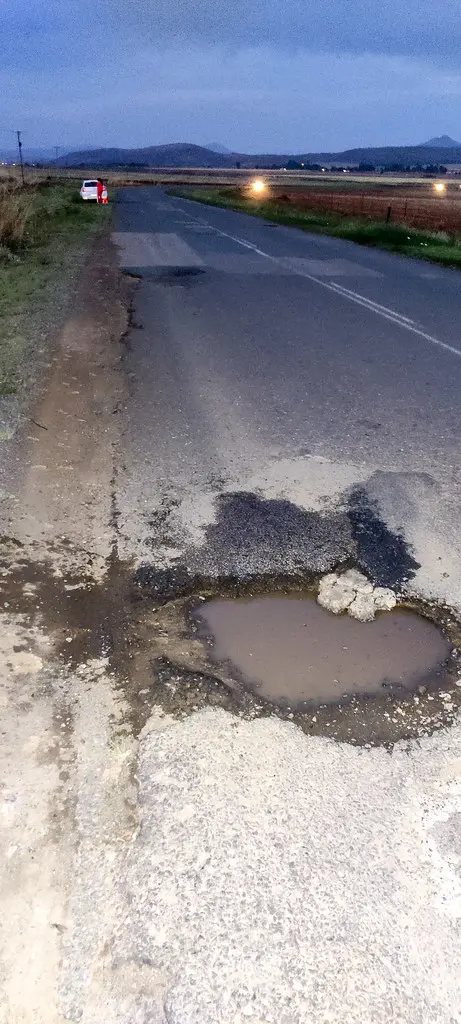

For Johannesburg motorists, the daily commute can feel less like a journey than an obstacle course, with potholes forcing drivers to weave across lanes, slam on the brakes or gamble on which road cavities will do the least damage.
For one motorist, two separate encounters with potholes this year resulted in almost R4 000 in repair and replacement costs - and a car now sitting at home without a roadworthy tyre.
"In February, I was driving through Gordon Road, coming from Florida at around 10pm and I hit a pothole on the right side of the car. Both the front and back tyres got damaged," he said. The impact also triggered the car's ABS and traction-control warnings.
Then, about three weeks ago, it happened again. "I was driving [at night] from Springs via the Wemmer Pan Road Turfontein and I hit a pothole on the left side of the car and then the back tyre burst."
The front tyre was damaged and also needs to be replaced. "Now, I'm stuck with a car in the house that doesn't have a tyre," the motorist said.
But potholes are more than an expensive nuisance. With Johannesburg heading to the polls on 4 November, they have become a highly visible measure of how residents experience their city and, according to political analyst professor Dirk Kotzé, potentially one of the biggest symbols of this year's local government election.
"Potholes have become symbolic of problematic management of a local authority so it becomes more than simply a pothole; it symbolises bad management or lack of management," Kotzé said. "It's not about that pothole specifically. It's about the fact that it represents, in the end, much more."
Unlike broader questions of economic development or job creation, a pothole is something residents encounter directly, sometimes every day.
"Potholes will definitely have a big impact in this election," Kotzé said, because they are visible, affect many people and can have an immediate financial and safety impact.
"You can't sometimes avoid them. If you are driving, especially at night and you don't see it and your car strikes it … it shocks you actually and sometimes it costs you. It's a very direct experience … Potholes are in your face."
Earlier this year, Democratic Alliance (DA) mayoral candidate for Johannesburg Helen Zille illustrated that political visibility when she filmed herself swimming in a flooded pothole in Douglasdale after residents had complained about the problem for years. The incident attracted widespread attention and municipal crews arrived the following day to repair the burst pipe and pothole.
For Kotzé, the episode demonstrated how a mundane infrastructure problem could become a powerful political symbol. He said political parties were increasingly focused on demonstrating that immediate, practical problems could be fixed rather than framing them as ideological battles.
Voters, he said, were increasingly concerned with what political parties could deliver in their immediate surroundings. "It's not about who's the party that can transform South Africa; it's what they can do in my very immediate environment."
The DA's highly visible pothole-filling initiatives were one example, he said, while Solidarity's community projects in smaller towns showed a similar understanding of the psychology of practical service delivery.
The objective was to demonstrate to voters that something could actually be done, even if the intervention addressed only a tiny fraction of the wider problem.
That makes Johannesburg's roads about more than potholes, but the scale of the problem remains substantial.
The Johannesburg Roads Agency (JRA) said the city's road network spans more than 13 500km. Its latest visual condition assessment found that 21% of the network was in poor condition and another 8% in very poor condition. Together, almost three in every 10km fall into the two worst condition categories.
The JRA reported repairing 130 473 road-surface deterioration defects during the 2024/25 financial year and another 126 100 in 2025/26 — a total of 256 573 defects over two years.
The agency stressed that these are road-surface deterioration defects and not necessarily potholes. It also did not provide the number of pothole reports received each year or the proportion of repairs that subsequently failed.
Instead, the JRA said potholes were generally a symptom of underlying problems and patching was an interim measure to keep traffic moving.
It identified ageing infrastructure, heavy-vehicle loads, rainfall intensity and excavations for services crossing the road network as factors contributing to road deterioration and pothole formation.
The agency said routine maintenance was funded from its operating budget, while resurfacing and rehabilitation were funded through its capital budget. It acknowledged that resources were limited, with budget allocations determining what could be done.
"JRA's overall infrastructure runs into billions of rands, meaning that the demand on the ground exceeds existing capacity," it said.
The wider infrastructure challenge is reflected in its estimate of an overall infrastructure backlog of about R276 billion, of which about R144 billion relates to stormwater and catchments.
While the JRA's figures show the scale of municipal repair activity, Johannesburg's pothole response is also being supplemented by a major private-sector intervention.
Discovery Insure's Pothole Patrol, launched in 2021 in partnership with the JRA and Avis, has repaired more than 365 000 potholes in Johannesburg, averaging about 75 000 repairs a year, or 1 500 a week.
Precious Nduli, chief commercial officer at Discovery Insure, said its data shows a 67% decline in potholes reported in areas where the initiative operates. The number of repairs has nevertheless fluctuated, with 6 508 more repairs completed in 2024 than the previous year, but 7 308 fewer in 2025.
She said available Johannesburg rainfall data indicates that 2025 was significantly wetter than 2024, "which helps explain why higher reporting volumes may coincide with lower completed repairs during wet periods".
Discovery's telematics data shows road defects concentrated on major arterial roads and busy residential collector routes, including Bryanston, Randburg and Sandown, as well as Jan Smuts Avenue, Winnie Mandela Drive and Oxford Road.
More than 90 000 potholes have been reported through the Pothole Patrol app by Johannesburg residents. Nduli said reports could have a multiplier effect because when a team is sent to a reported pothole, it also looks for other defects in the surrounding area.
Its data also suggests repairs can be durable. Discovery said random checks of potholes repaired at the beginning of the programme in 2021 found that fewer than 0.2% had failed. Independent audits, she said, had verified a 99% repair success rate 12 months after launch.
But the distinction between fixing a pothole and fixing a road is important, said Dr Imuentinyan Aivinhenyo, a lecturer in transport planning and engineering at the Wits School of Civil and Environmental Engineering.
Aivinhenyo said recurring potholes could result from poor rehabilitation design, inappropriate materials or poor construction methods.
Pothole patching and resurfacing generally target the uppermost surface layer of a road, he said, while complete rehabilitation or reconstruction involves rebuilding the road's structural layers, including the subsurface.
Failing to maintain roads according to their planned maintenance strategy can lead to rapid deterioration and ultimately the need for more expensive rehabilitation. Traffic volumes, construction materials and methods, stormwater seepage and poor drainage can also contribute to deterioration.
Aivinhenyo cautioned, however, against automatically attributing Johannesburg's road deterioration to its stormwater problems.
"While stormwater and poor drainage could lead to weakening of road foundation and subsequently accelerate road failure, understanding whether Johannesburg stormwater is impacting its road deterioration will require an in-depth investigation."
The progression from a small crack to a major pothole illustrates why reactive repairs alone may not be enough, he said.
"Potholes usually start as small surface cracks that develop and expand over time, and with infiltration of water that gradually weakens the subsoil foundation, leading to complete failure."
Regular surface maintenance could address cracks before they develop into potholes, while drainage problems affecting the road surface and subsurface should also be addressed.
Where a road's structural layers have been significantly weakened, simply patching the pothole or resurfacing the road may not be enough.
"If it is established that a particular stretch of a road is found to have significantly weakened structural layers from surface to bottom layers, a complete rehabilitation may be more appropriate than just resurfacing or patching," Aivinhenyo said.
For motorists, the cause of a pothole matters little: hitting one can cause damage in seconds. For politicians, that immediacy makes potholes powerful symbols of whether a municipality works.
And that may be why, in this election, a hole in the road or sometimes a crater, has come to represent something much bigger than the road itself.