


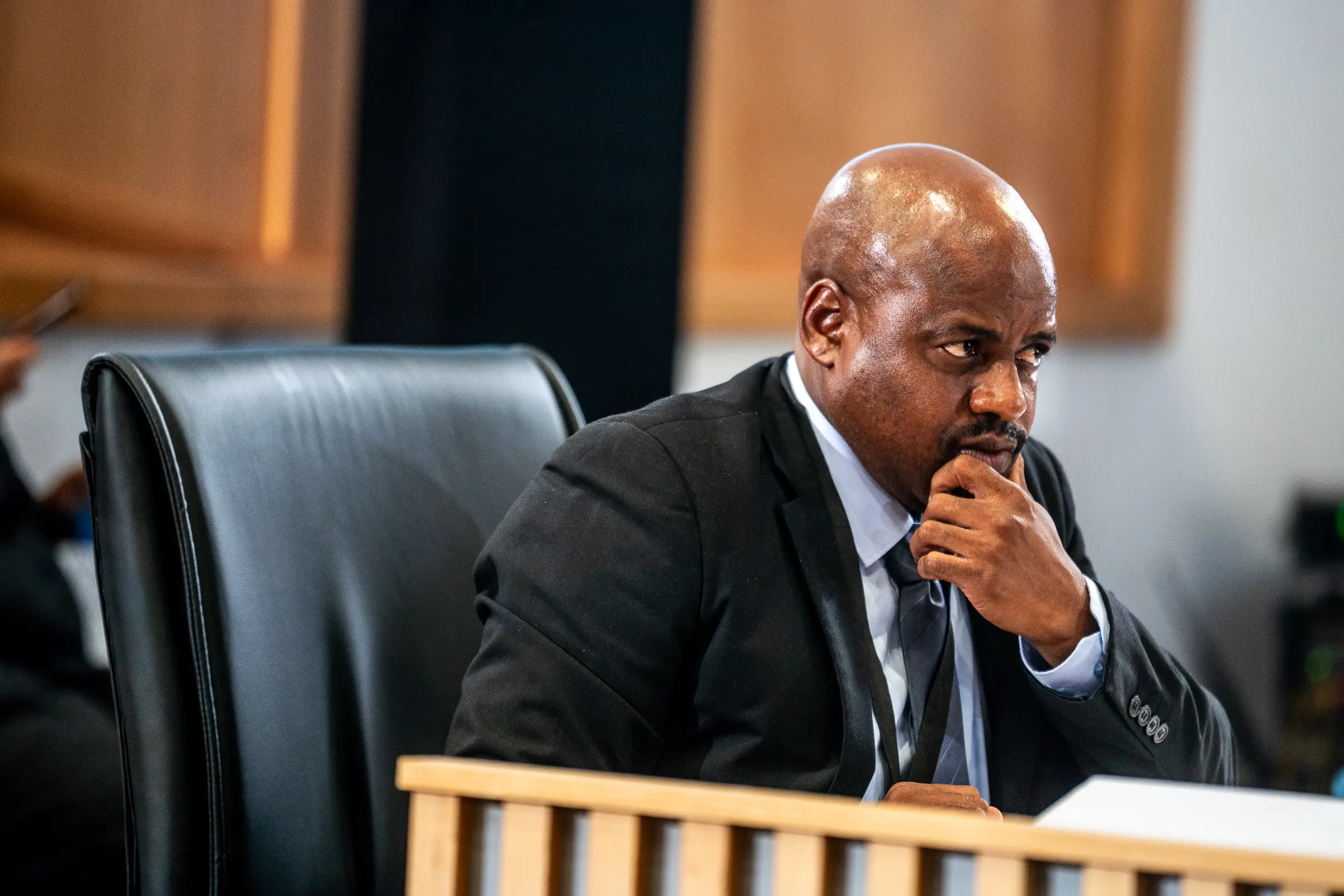
Julius Mkhwanazi's four arrests in separate criminal matters have raised questions about how previous arrests, pending charges and earlier bail grants are considered when an accused person returns to court seeking bail.
The suspended Ekurhuleni Metro Police Department deputy chief has been granted bail in three matters, while the state has opposed his release in the latest case involving the murder of businessman Emmanuel Mbense. He was also served with a fifth arrest warrant while appearing in court in August, although this did not amount to a fifth completed arrest.
But the number of arrests does not, by itself, determine whether an accused person should be granted bail in a new matter, according to pupil advocate Asanda Kubheka. He said the starting point in South African criminal procedure is that an accused person is presumed innocent until proven guilty and that every criminal matter must be considered on its own merits.
Kubheka said the type of charge is important in determining how a bail application is dealt with.
In matters that do not fall under Schedule 5 or Schedule 6, the court considers whether releasing the accused would be in the interests of justice, with the state having to discharge the relevant onus.
"Under normal circumstances, where it's not Schedule 5 or 6, the court, in determining whether or not the accused should be released on bail, would consider whether or not it is in the interest of justice for the accused to be released on bail. It is the State that has to discharge that onus," he said.
The court can consider whether an accused is likely to interfere with the investigation or witnesses, whether there is a risk that they could evade trial and whether their release could pose a threat to the safety of the community.
Kubheka said that if an accused person can demonstrate that they will not evade trial, interfere with the investigation or pose a threat to society, it can be in the interests of justice for them to be released.
"If an accused person is able to prove that they are not going to run away, they are not going to interfere with the investigation and they don't pose any threat to society, then I think it will be in the interest of justice for the court to rule that that particular accused person is released on bail," he said.
Mkhwanazi's previous bail applications provide context but do not automatically determine the outcome of a later application. He was arrested in April in connection with allegations that he was involved in a scheme in which Ekurhuleni city manager Kagiso Lerutla allegedly paid R400,000 to have another person impersonate him in court over a speeding matter.
Mkhwanazi was granted R30,000 bail. In July, he was arrested in connection with alleged irregular blue-light arrangements involving private security vehicles and was granted R50,000 bail.
Days later, he was arrested in connection with an alleged bogus police raid linked to precious stones valued at about R14.9 million and was granted R5,000 bail.
His fourth arrest relates to the 2022 murder of businessman Emmanuel Mbense and defeating the ends of justice.
The matter was classified as a Schedule 6 case and the state opposed bail.
While Mkhwanazi was appearing in that matter, he was also served with a fifth arrest warrant linked to the separate blue-light investigation involving vehicles connected to Vusimuzi "Cat" Matlala's security company.
Kubheka said that being out on bail in another matter can be disclosed to the court but it is not automatically grounds for denying bail.
"Being out on bail is something that they can disclose to the court but it's not one of the elements that must be proved in order for one to be granted bail."
In essence, each application must be considered in light of the particular charge and the interests of justice, while the presumption of innocence remains intact.