


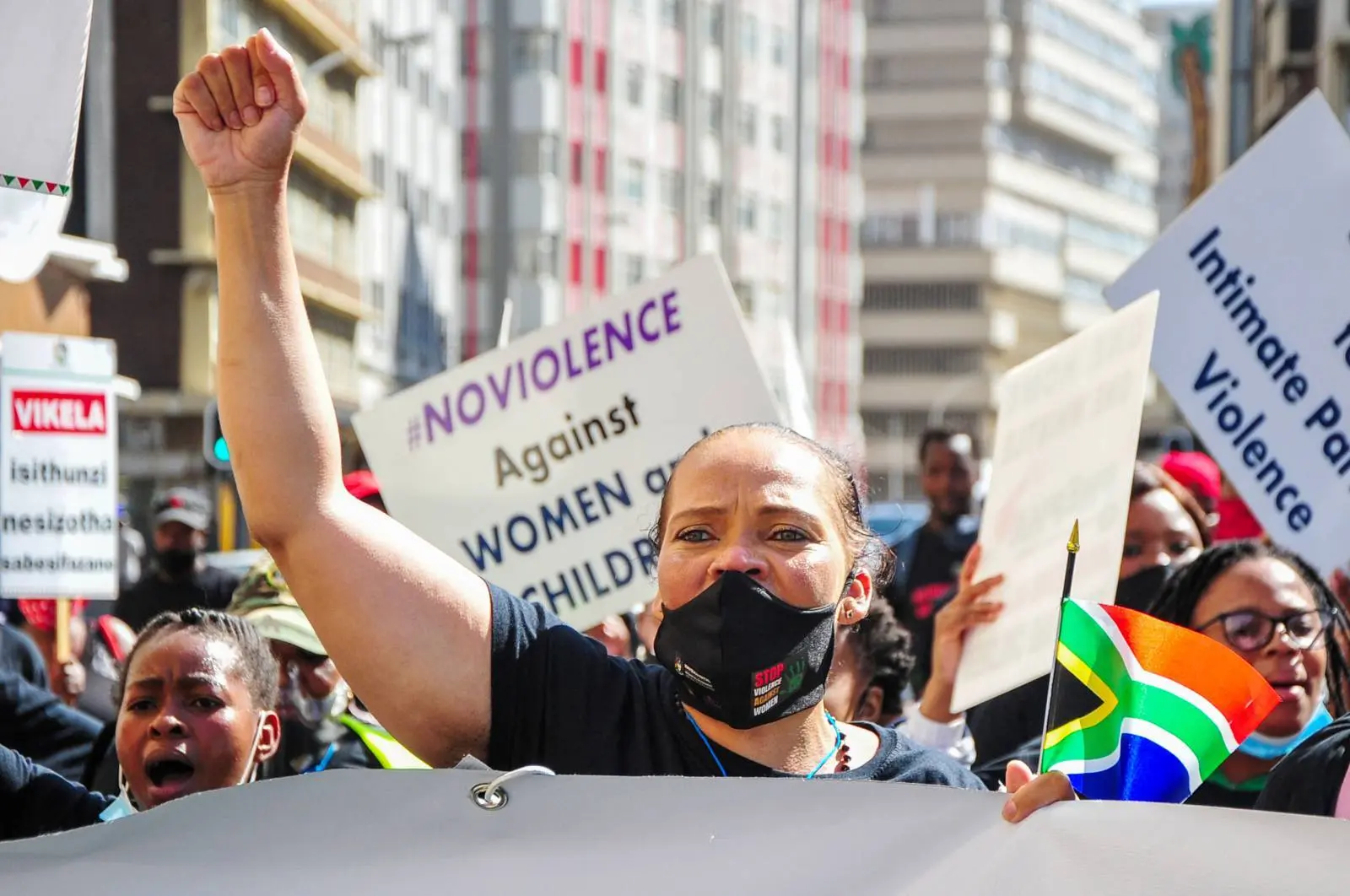
South Africa’s overall murder rate is falling but the latest figures offer little comfort to women who continue to face violence in their homes, on the streets and in public spaces.
Behind the decline in the national murder rate is another reality that is harder to measure in a single headline.
Hundreds of women are being killed every quarter, thousands of women and children continue to report rape and families are left searching for answers after women disappear.
The numbers may be moving in the right direction overall but for many women, the country remains a dangerous place to live.
The recent deaths of women in and around Kempton Park have brought the fear into sharp focus.
Elizabeth Mokolo Moselakgomo, known as Tsontso, disappeared after leaving her Kempton Park home for an afternoon run on 10 September.
Her eight-year-old daughter noticed that she had not returned by about 6.30pm and alerted the family.
Four days later, her family identified her body at the Germiston mortuary.
Her murder comes as police are investigating the deaths of other women whose bodies had been found in the wider Kempton Park area, with a fifth body later found in Olifantsfontein.
For her family, the statistics have a face and a name. Lt-Col Andries Moraka Matlaila, Moselakgomo’s uncle, described her as “the glue of the family” and said her absence had left a deep hole in the family.
He recalled how relatives would ask where Tsontso was when she was not at family gatherings, before she would appear with her familiar smile and say:“I’m here.”
The family has been receiving psychosocial support while waiting for the police investigation and post-mortem process to be completed. Matlaila said the family did not want to speculate about whether the deaths in the area were connected; they would leave that question to the police.
The cases have understandably raised fears in the community but police have cautioned against drawing conclusions before the investigations are complete.
A multidisciplinary team has been established to examine the circumstances, evidence, timelines and possible links between the cases.
Acting Gauteng police commissioner Major-General Fred Kekana has said it is premature to conclude that the deaths are connected or that they involve one perpetrator.
The distinction matters because the wider crisis facing women in South Africa does not depend on whether the particular cases eventually prove to be connected.
The fear has nevertheless become a safety concern, particularly for women who use the streets around Kempton Park and Rhodesfield early in the morning or later in the day.
Phakamile Mbengashe, the spokesperson for the City of Ekurhuleni, said the municipality activated its Joint Operations Centre on 14 September as part of its response to the situation. The centre is a multidepartmental operation led by the Ekurhuleni metropolitan police department and is intended to act as a central communication point with the SAPS, which remains responsible for the criminal investigation.
Mbengashe said the city would support the SAPS by increasing police visibility in Kempton Park and Rhodesfield, particularly during peak periods in the morning and late afternoon.
He said residents should expect a heightened presence when joggers were normally out in the morning and when people returned from work later in the day.
The city has appealed to residents to report suspicious activity and information that could assist investigators, saying that finding those responsible required cooperation between law enforcement and the community.
The response is significant because the question of safety extends beyond who is responsible for investigating a murder. Municipalities control or influence many of the conditions under which people move through public spaces, including local law enforcement, public infrastructure and communication with communities.
While the SAPS leads the investigation into the deaths, the immediate fear among residents has put pressure on the city to demonstrate that women can move through the areas without feeling abandoned by authorities.
Mbengashe said the city wanted the person responsible to be brought to justice as soon as possible and acknowledged the concern among residents.
What is clear, however, is that women continue to experience violence at an alarming scale even when the country's overall murder figures show an improvement.
The latest national crime statistics show that 5 427 people were murdered between April and June 2026, a 5.9% decrease from the same period the previous year. Within that figure, the verified number of women murdered stood at 569, while another 1 052 survived attempted murder. Of the 9 201 rape cases recorded during the quarter, 8 814 involved women and children.
The figures show why a fall in overall murders cannot automatically be treated as evidence that women are becoming safer.
A national indicator can improve while particular groups remain exposed to serious and persistent forms of violence.
The important questions are therefore not only whether crime is falling but which crimes are falling, where they are falling and who remains most vulnerable. The experiences of women need to remain visible within the broader crime picture rather than being absorbed into an overall murder figure.
This is also where South Africa’s response to gender-based violence and femicide faces a deeper problem. GBV and femicide were declared a national disaster in November 2025 in recognition of the scale and urgency of the crisis. The declaration was followed by renewed commitments from the government around prevention, survivor support, accountability and stronger coordination. Yet a declaration cannot by itself create the systems needed to deal with a form of violence that has become entrenched in South African society.
Lisa Vetten, a long-standing GBV researcher who has studied femicide in South Africa for decades, argues that violence against women should not be approached in the same way as a temporary emergency such as a flood or disease outbreak. It is a chronic condition linked to social, economic and institutional factors and requires sustained intervention across different parts of the state.
For Vetten, the declaration can signal that the government recognises the scale of the problem but recognition is not the same as effective action.
Vetten said she had not seen new or additional funding reaching the shelters and victim-support services with which she works in Gauteng and noted that the number of shelters has declined despite the national disaster declaration.
Her concern is that what the government says about GBV and what is delivered continue to be two different things.
The issue is therefore not simply whether South Africa has the right policies but whether the state has the administrative capacity and political commitment to make the policies work consistently.
There is another problem that makes this difficult to assess. South Africa does not always appear to have a consistent picture of the violence it is trying to stop.
Vetten has previously raised concerns about contradictory SAPS figures for women murdered during the same reporting periods. For 2023/24, one SAPS presentation recorded 5 578 women murdered, while the quarterly reports added up to 3 839 and the annual report recorded 3 485. Similar discrepancies appeared in the previous reporting year.
For Vetten, this is not a minor technical problem because statistics determine how the state understands violence, where resources are directed and whether interventions appear to be working.
Her concern also challenges the tendency to describe South Africa’s GBV crisis simply as a failure of “implementation”. Vetten argues that the language does not explain why policies are not being carried through.
The problem reaches into the administration of the state, including how budgets are calculated and spent, whether departments have competent staff, whether data is properly interpreted and whether the criminal justice system has enough capacity to respond.
“The question, I think, has to shift to administration of the state,” Vetten said, arguing that the systems supporting interventions need much greater attention.
There is evidence that the picture is more complicated than violence simply becoming worse every year. Research by the Medical Research Council has found that femicide in South Africa more than halved between 1999 and 2020/21.
Vetten points out, however, that the overall decline has not been uniform. Some provinces have experienced different patterns from others and research has raised questions about changes in the mechanisms used to kill women. Firearms, for example, were the leading mechanism in the earliest national femicide research and later returned to prominence in the 2021 study.
South Africa now has a National Strategic Plan on GBVF, a national disaster framework and a range of commitments aimed at prevention, policing, survivor support and accountability. The government has also spoken about strengthening coordination between different spheres of the state and civil society.
But the test of the commitments is not how many policies exist on paper. It is whether a woman can walk home safely, whether a survivor can access meaningful support and whether a family reporting a missing woman can trust that the state will respond quickly enough.
For families such as Tsontso’s, that protection cannot come after another tragedy. It has to exist before a woman disappears on her way home, before another body is found and before another family is left standing at a mortuary waiting to identify someone they love.
The decline in overall murders is worth acknowledging but it should not become a reason to look away from the violence that remains. South Africa cannot measure progress only by counting fewer deaths. It must also ask whose lives are being protected, where violence is changing and whether the systems responsible for protecting women are working.
The numbers may be falling. Women are still dying.