


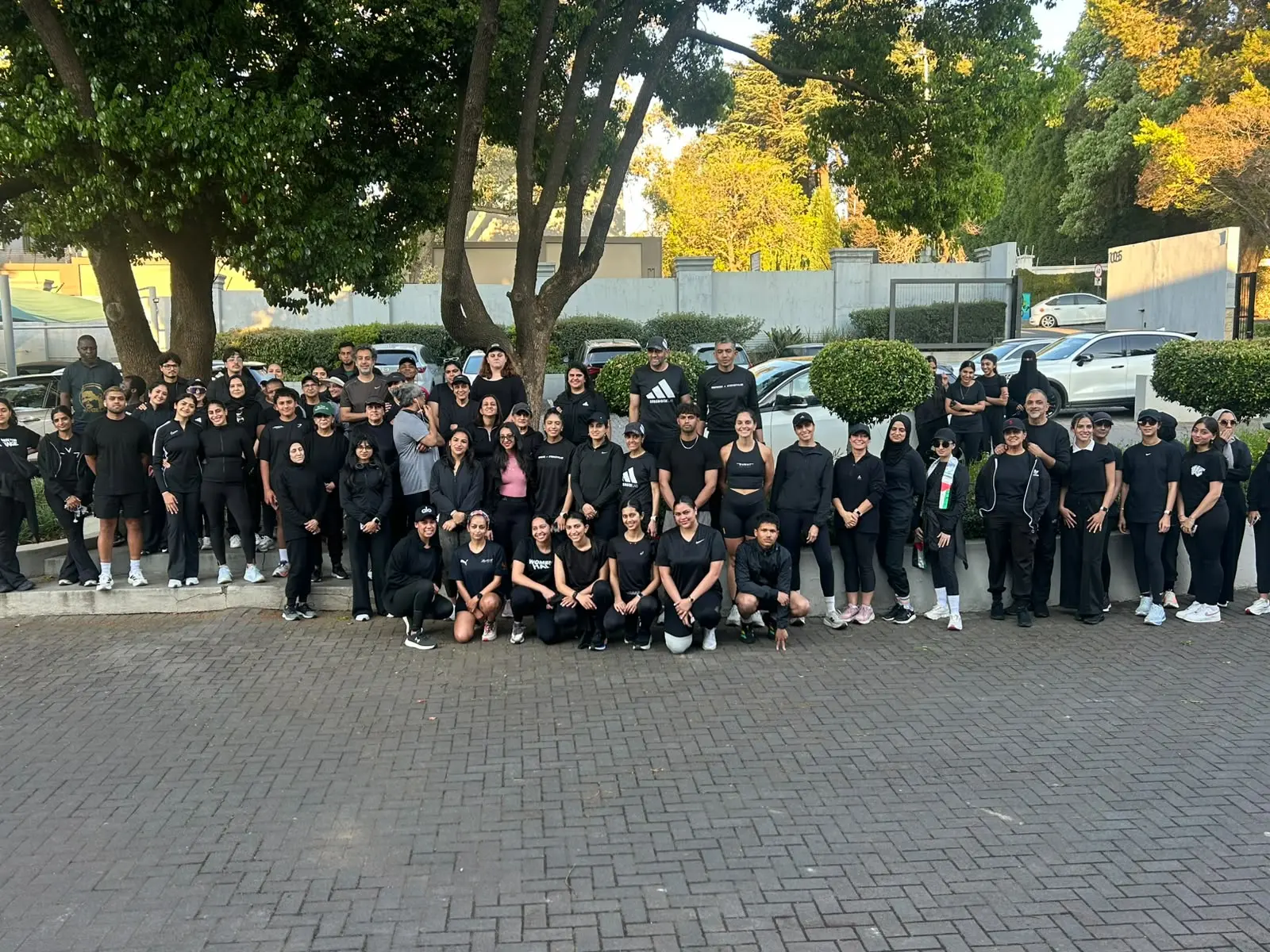
Runners dressed in black are taking to the roads across Gauteng and beyond in honour of women killed in Ekurhuleni, where eight women’s bodies have been recovered since July.
Some tribute runs took place on Tuesday morning, with others planned for later in the week. Photographs shared online showed runners turning their regular training sessions into acts of remembrance and demands for women’s safety in public spaces.
In Houghton, Inspire Run Club organised a five-kilometre “In Their Honour” run on Tuesday evening. It was one of many events arranged by running clubs and community groups in response to the killings.
The Caring Women’s Forum encouraged its members and their families to attend. Its advisory chairperson, Zaheerah Bham Ismail, said the organisation was taking a strong stand because the continued killing and abuse of women could not be allowed to become something society simply expected, mourned and then moved on from.
“Women should not have to constantly calculate risk — where we go, how we get home, who we trust or whether our daughters are safe,” she said. “This is not normal and we must stop accepting it as such.”
The runs followed the murder of 38-year-old Elizabeth “Tsontso” Moselakgomo, who disappeared after leaving her Kempton Park home for an afternoon run on 9 September. Her partially clothed body was found behind a hotel in Rhodesfield on 12 September.
Moselakgomo, an avid runner who had recently completed the Wanderers 21km race, became the face of a danger women runners have long tried to manage by sharing their locations, changing routes, avoiding isolated areas and training in groups.
Her death prompted runs across Johannesburg, Tshwane and Ekurhuleni, with participants dedicating their distances to her and other women killed through gender-based violence. The response also reached Eswatini, where runners completed morning distances in her honour, including a 10km club run.
The message from the running community was blunt: women should not have to change their clothes, routes and routines to stay alive.
“Our bodies are not disposable, and coming home should never be a privilege,” Team Botlhale Boikanyo said after its Tuesday morning run, calling for urgency, accountability and justice instead of more warnings telling women to be careful.
Police confirmed on Tuesday night that an eighth woman’s body had been recovered in Ekurhuleni, bringing to eight the number found in the metro in less than two months.
One person has been arrested in connection with one of the killings in July, while police are pursuing a person of interest. A R400,000 reward has been offered for information leading to a breakthrough.
Police said it was premature to speculate about a pattern and had not established that all eight deaths were linked. A multidisciplinary task team, including specialists from the police’s Investigative Psychology Section, is examining the dockets, victim profiles, locations and possible behavioural patterns.
Earlier on Tuesday, investigators added to the probe the case of a woman whose body was found floating in a river in Clayville, near the Mall of Thembisa, on 7 September.
Acting Gauteng police commissioner Major-General Fred Kekana said she was found wearing only underwear. Her death would be examined alongside the other cases to ensure investigators did not “leave anything” out.
The body of a woman believed to be about 35 was also found outside a clinic in Kwa-Thema, Springs, on Tuesday. She was naked and in an advanced state of decomposition. On Monday, a passerby found another woman partially clothed on the side of a road in Olifantsfontein.
The cases date back to 15 July, when a 37-year-old woman was found naked and bound with cable ties in Rhodesfield. A suspect, reported to be her boyfriend, was arrested two days later.
A 32-year-old woman was found partially clothed on 24 August. Another woman’s decomposed body was discovered on 10 September, followed by Moselakgomo’s body two days later and the discoveries in Olifantsfontein and Kwa-Thema.
Details about where and when the eighth body was found had not been released by the time of publication.
Police have said most of the victims who could be assessed were sexually assaulted. Several were found naked or partially clothed, but investigators have not established a common motive.

The deaths have raised questions about when the authorities first suspected a possible pattern and why communities were not warned earlier.
Run With Sole founder Tumi Sole said residents learnt about the earlier deaths only after Moselakgomo disappeared.
“At the very least, a warning should have been sent out,” he said.
Sole joined other runners outside Kempton Park police station on Monday to demand greater protection for women.
Police have since advised women to run in groups, avoid isolated areas and take additional precautions. Women’s rights organisations say this again places the responsibility for preventing violence on women, who already plan their movements around the risk of attack.
Bham Ismail said public outrage had to result in stronger accountability, responsive policing and justice systems, greater protection for women at risk and communities that refused to excuse, enable or protect perpetrators.
“GBV in South Africa is not a collection of isolated tragedies; it is a persistent societal crisis,” she said. “Women should not have to organise their lives around the possibility of violence.”
The Commission for Gender Equality has called for an urgent safety audit of the affected areas. It wants officials to assess lighting, surveillance, pedestrian and public transport routes, neglected spaces, police visibility and access to emergency assistance.
“Women should not have to be killed before an area receives heightened attention,” commission spokesperson Javu Baloyi said.
The City of Ekurhuleni activated its joint operations centre on Monday and said it would increase metro police visibility in Kempton Park and Rhodesfield, particularly in the early morning and late afternoon.
President Cyril Ramaphosa said he had been briefed by the police minister and acting national police commissioner and had directed them to prioritise the investigation.
“These incidents are causing fear and uncertainty in our communities, and especially among women,” he said. “No stone will be left unturned in bringing those responsible to justice.”
Ramaphosa appealed to the public to provide information that could help investigators. Anyone with information, or who is missing a relative or friend, was asked to contact Warrant Officer Elvis Manyike on 082 465 7249.
The killings come less than a year after gender-based violence and femicide was classified as a national disaster. Yet 569 women were murdered between April and June this year and another 1,052 were victims of attempted murder. Of the 9,201 rapes reported during the quarter, 8,814 involved women and children.
The tribute runs are both a memorial and a demand: women must be able to run, walk and move through public spaces without wondering whether they will make it home.
“Every woman deserves the right to live — and to return home — safely,” Bham Ismail said.