


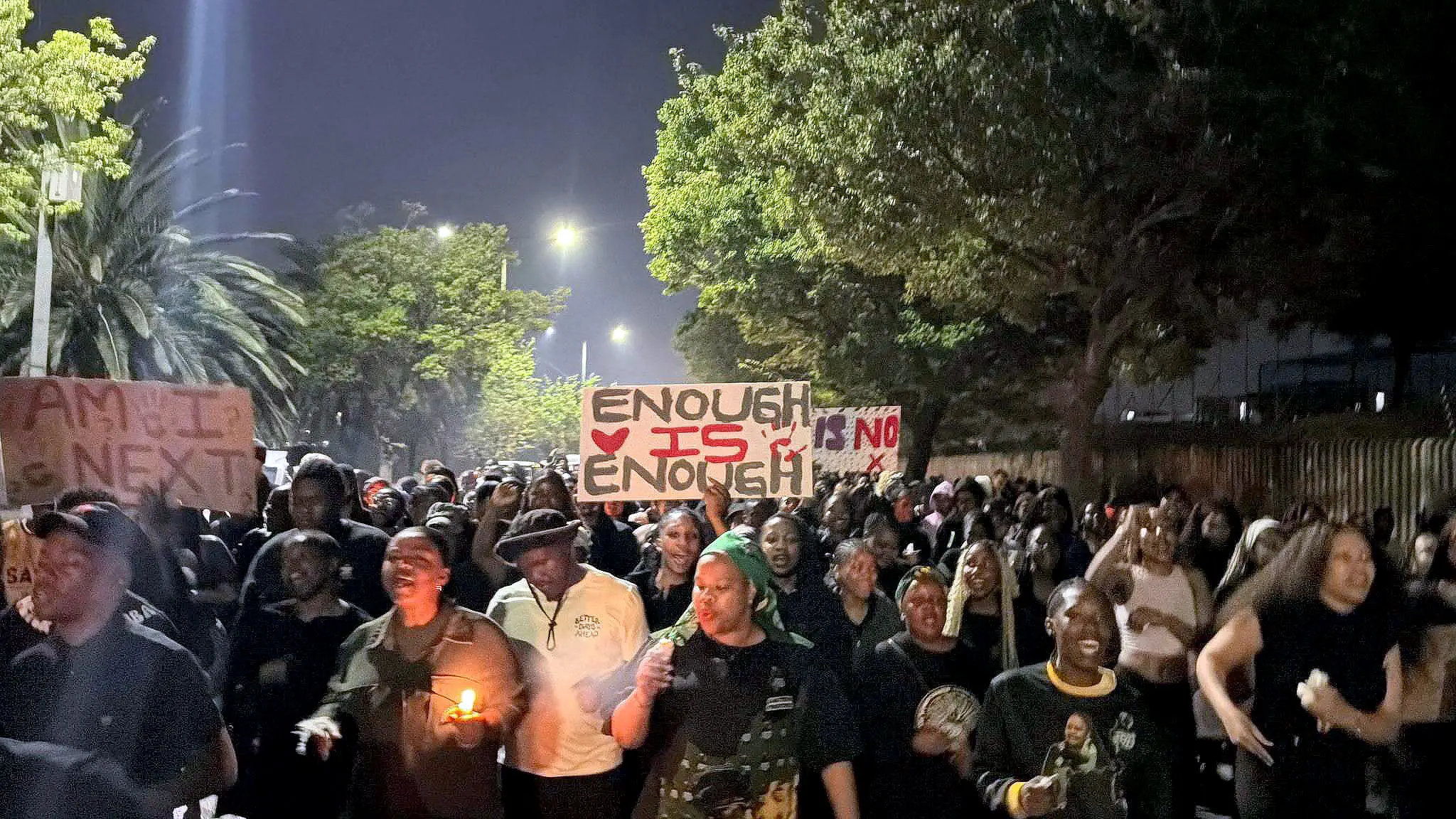
Nine women have been found dead across Ekurhuleni since July, six of them still unidentified, prompting a major police investigation and renewed warnings to women in the area.
But the deaths have also raised a broader question: what does it mean for South Africa to declare gender-based violence and femicide (GBVF) a national disaster if the urgency still only seems to arrive after women have disappeared or been killed?
Almost a year since GBVF was declared a national disaster in November 2025, organisations working with victims of gender-based violence argue that the response needs to extend beyond reacting to violence after it occurs.
The country, they say, still lacks a clear picture of the full scale of violence against women, while families continue to rely on police, communities and their own searches when women go missing.
The first South African national gender-based violence study, conducted in 2022 and published by the Human Sciences Research Council in 2024, found that more than one in three women aged 18 and older had experienced physical or sexual violence in their lifetime.
More than half of ever-partnered women reported controlling behaviour by a partner, while only 17.1% of women who had experienced physical or sexual intimate-partner violence said they had told authorities or services.
The figures suggest a crisis that begins long before a woman is found dead, highlighting a substantial gap between experiencing violence and turning to the formal institutions meant to protect her.
At the most extreme end of that violence, the latest national femicide research paints a similarly troubling picture.
A 2025 analysis by researchers from the South African Medical Research Council and several universities, based on four national mortuary-based surveys, found that 57.5% of women killed in 2020/21 were killed by an intimate partner.
It also found that police had failed to identify the perpetrator in 44.2% of cases.
For Amnesty International South Africa executive director Shenilla Mohamed, the central problem is one of implementation and accountability.
"The failure to effectively prevent violence, investigate crimes and hold perpetrators accountable reflects a lack of urgency and political will within the state and specifically in the justice system to act meaningfully," Mohamed said.
The government's declaration of GBVF as a national disaster was intended to elevate the issue and strengthen a coordinated response across the state. But Mohamed said that declarations would mean little without implementation.
The government has acknowledged GBVF as a "second pandemic" and a national disaster, she said, but "if we are not implementing the relevant legislation and holding perpetrators accountable then these are all platitudes".
For Amnesty, a more effective response would include properly resourced and trained investigators, stronger forensic capacity, action on the DNA backlog and greater coordination between police, prosecutors and other agencies.
It also requires changes at police stations, Mohamed said, including victim-friendly rooms, vehicles for call-outs and sexual-offence training across all levels of policing, rather than limiting specialist training to investigators.
Most fundamentally, she said, women need to be able to trust that a report will result in action.
"We need a police service that takes every report seriously. One that does not ignore or ridicule women," she said. "One that, in the face of femicide, conducts a full and thorough investigation."
Reliable information is crucial
In August 2025, the South African Police Service (SAPS) suspended the publication of disaggregated crime statistics, including figures relating to violence against women and children, citing concerns about the accuracy of data.
For Mohamed, this has consequences beyond statistics. "Reliable data is not a technical detail, it is a prerequisite for accountability," she said.
Without consistent data, it becomes harder to establish where violence is increasing, identify patterns, allocate resources and measure whether interventions are working.
The issue has also become more urgent in the wake of the Madlanga Commission, whose proceedings have exposed allegations of corruption, dysfunction and criminal infiltration within parts of the criminal justice system.
Mohamed said the state should not wait for the commission's final outcome before acting on problems that are already known.
"The evidence given at the Madlanga Commission has exposed the dysfunction, corruption and criminal infiltration in the South African Police Service and this is something that the state must deal with immediately and not only wait for the outcomes of the commission.
"The revelations at the commission point to the crisis in the police that can no longer be ignored. We need to see concrete and enforceable action to fight crime and not more processes that delay justice.
"We need a police service that takes every report seriously. One that does not ignore or ridicule women. One that does not tell a victim that it is a family matter that should be resolved in private. One that, in the face of femicide, conducts a full and thorough investigation. One that answers the phone and collects rape kits once they have been conducted and processes them timeously.
"One that collects, analyses and accurately publishes data on GBV. Police officers require ongoing training, resourcing and auditing. Training on sexual offences for police at all levels, and not just investigating officers, has to be a priority. All police stations need to have victim-friendly rooms and need to have access to vehicles so they can respond to call-outs."
The SAPS did not respond to the Mail & Guardian's enquiries.
Heed warning signs
For Sonke Gender Justice, prevention needs to move beyond awareness campaigns and respond to warning signs before violence escalates.
"Warning signs may include monitoring a partner's phone, isolating her, controlling money, stalking, threats, sexual coercion, persistent jealousy or repeatedly violating a protection order," said Mpiwa Mangwiro, policy development and advocacy unit manager at Sonke.
"These men are not always unknown to the system," she said, noting that they may already have come into contact with police, courts, healthcare workers, social services, employers, schools, traditional leaders or faith institutions.
The problem, Mangwiro said, is that these warning signs are seldom brought together through a coherent risk-assessment, referral and case-management system.
Sonke argues that South Africa needs to move beyond waiting until a serious offence has been committed before intervening, while ensuring that early intervention remains lawful and respects due process.
While responding to violent crimes is important, prevention needs equal focus. Too often, it is reduced to awareness campaigns, commemorative events and short-term civil society projects rather than a sustained national system that identifies risk, intervenes early and measures whether behaviour changes.
Sonke's case monitoring has found poor investigations, forensic delays, weak coordination between police and prosecutors and procedural failures that can lead to cases being withdrawn or accused people being released, with some later implicated in similar offences.
In some cases, convicted perpetrators have been granted bail pending appeal but the appeal was never lodged or pursued timeously. The right to appeal is essential to a fair justice system but there needs to be an automatic mechanism to track whether an appeal is filed, flag non-compliance and trigger a review of bail.
Mangwiro said South Africans should be seeing more than public statements. "The declaration [of a national disaster] should have triggered dedicated resources from government and private sector partners to drive prevention, strengthen community-level responses and improve accountability."
Meaningful change, she said, would mean "visible, funded and accountable prevention".
"The declaration should have triggered dedicated resources from government and private sector partners to drive prevention, strengthen community-level responses and improve accountability.
"By now, communities should be seeing visible action: better policing, accessible support services, and clear prevention initiatives that reduce the risk of violence before it happens."
Instead, Mangwiro said, the response remains too slow, fragmented and reactive. "Too much emphasis is still placed on what happens after harm has occurred, rather than on the systems needed to prevent it.
Meaningful change would mean visible, funded and accountable prevention, she said, and "not another year of promises" while women, children and gender-diverse people continue to live with unacceptable levels of violence.
Without transparent evidence of implementation and impact, the national disaster classification risks becoming another political announcement that has failed to change the reality on the ground.
Sonke is calling for a national prevention and perpetrator-intervention programme, backed by a costed delivery plan, ring-fenced prevention funding and clear responsibilities across government, with public reporting on implementation.
Prevention, Mangwiro said, cannot remain "the side project of one department or the unfunded responsibility of civil society".