


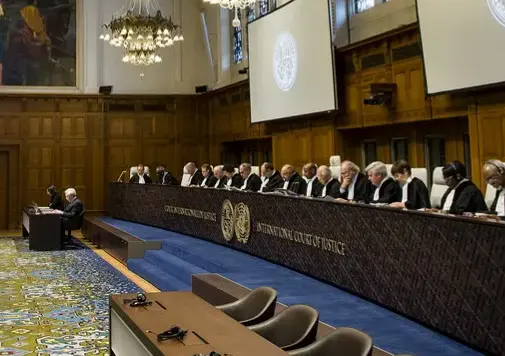
South Africa’s genocide case against Israel represents a “second age” of the country’s greatness after its liberation from apartheid, former British MP George Galloway said in Cape Town on Wednesday.
Speaking at a media breakfast alongside British journalist and author Yvonne Ridley, Galloway said the decision to take Israel to the International Court of Justice (ICJ) had made a contribution to humanity that South Africans should not underestimate.
“This is the second age of South Africa’s greatness. Its first being its own liberation, its second being its role in seeking to liberate Palestine,” he said.
The pair were speaking at the Bo-Kaap Cultural Hub during their People Power Tour, which focuses on Palestine and broader human rights issues. The briefing examined South Africa’s international role, the destruction in Gaza, colonialism and the responsibility of journalists.
Galloway credited the South African legal team and the government for pursuing the case, arguing that it had won support far beyond the country’s borders.
He acknowledged that South Africans would judge their government on its domestic record, but urged them to recognise the significance of its intervention on Palestine.
“It’s your job now to judge your government,” he said. “But please don’t underestimate the service you did to humanity by bringing that genocide case before the ICJ.”
His praise was accompanied by scepticism about what the court would ultimately deliver. Asked what countries could do while the proceedings continued, Galloway said the case’s political influence was already evident.
“I’m not expecting anything very much from the ICJ,” he said.
“For me, your case at the ICJ is political theatre. And political theatre is very powerful and important.”
He used the description to emphasise the case’s ability to focus attention on Palestine and the responsibility of other countries. The proceedings had occupied much of the breakfast discussion, he noted, and were being discussed around the world.
South Africa brought the case under the Genocide Convention. The ICJ has issued three binding provisional-measures orders to protect Palestinians in Gaza, but has not delivered a final judgment on whether Israel has committed genocide. Israel denies committing genocide.

Asked why he described Israel’s actions as genocide, Galloway pointed to what he said was an intention to remove Palestinians from their land.
“It’s genocide because it is the avowed intention of the occupation of Palestine to disappear all of the Palestinians,” he said.
He contrasted this with apartheid South Africa, where the economy depended on black people as workers and consumers.
“When apartheid ruled here, they needed the black people as a labour force, and as customers, as a consumer base,” he said.
In Palestine, he argued, the objective was to possess the country while excluding its people. He linked the destruction in Gaza to the displacement of Palestinians and the generations who had subsequently lived in refugee camps or exile.
“They intend to deport or destroy all of the Palestinians,” he said.
Galloway recalled meeting a Palestinian family from Jaffa while on a speaking tour in Yellowknife, Canada. Their distance from home illustrated the reach of Palestinian displacement, he said.
His argument about genocide rested on the intention he attributed to the occupation, rather than on the scale of destruction alone. The question of whether the evidence establishes the specific intent required under the Genocide Convention remains before the court.
South Africa submitted a further dossier to the ICJ in August, alleging that Israel had failed to comply with its provisional orders. The international relations department said the submission reaffirmed the country’s commitment to international law and multilateral institutions.
Galloway also portrayed American pressure on South Africa as punishment for its stance on Palestine. He argued that Washington’s support for Israel made South Africa’s intervention a challenge to both countries.
“The United States and Israel have become the same thing,” he said.
Their strategic interests had become so closely aligned, he argued, that debating which was acting as the other’s proxy no longer adequately described the relationship. He placed South Africa’s court action within a broader struggle over whether countries in the Global South could hold powerful states and their allies accountable.
Ridley said Palestine had also exposed failures in Western journalism, particularly in the language used to report deaths and destruction.
“Words are the tools of our trade, and we have to use them correctly,” she said.
She criticised descriptions of Palestinians “losing” their children or their lives, arguing that such language obscured the violence responsible for their deaths.

Ridley, who said she became a journalist 50 years ago, argued that giving a voice to oppressed people was central to the profession. She rejected an understanding of impartiality that required journalists to treat oppression and the experiences of those subjected to it as morally equivalent.
“Impartiality is a myth in journalism,” she said. “All there needs to be in journalism is some context and balance, and we’re not getting it.”
Asked how words could be connected to action, she said journalists had to understand their influence and use it responsibly. Reporting could mobilise people, but misleading language could also direct them towards the wrong target.
“Words, I think, are the tinder towards a fire,” she said.
Both speakers urged sustained public pressure while the legal process continued. Ridley drew on South Africa’s liberation history when asked what campaigners could do if their efforts appeared insufficient.
“You have to keep on going,” she said.
She argued that international solidarity during apartheid had sometimes been greater than people inside South Africa could see through mainstream reporting. Digital communication now allowed campaigners to connect across borders more immediately.
Galloway said governments sympathetic to Palestine had a particular responsibility to use the powers available to them.
“We all have this duty,” he said.
He also warned against using accusations of terrorism and anti-Semitism so broadly that they weakened the meaning of those terms.
“Anti-Semitism is a real thing. Hatred of Jews is a real thing,” he said, arguing that support for Palestinian rights should not automatically attract that accusation.
Recalling his involvement with the anti-apartheid movement, he said Jewish activists in Cape Town had housed and supported him during visits in the 1980s.
Galloway predicted that support for Palestinian freedom would eventually become widely accepted, as opposition to apartheid had.
“If not me, my children will live in a time where everyone will claim that they had been on our side all along,” he said.