

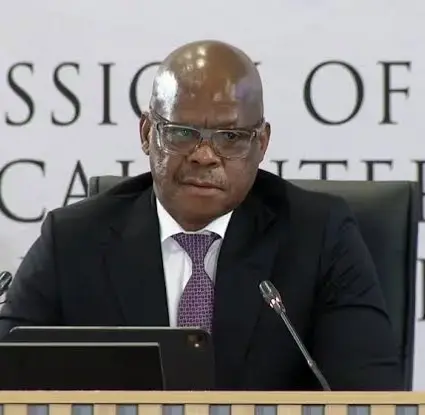
Mpumalanga taxi boss Joe “Ferrari” Sibanyoni has denied entering into a corrupt deal with bus operator Putco, telling the Madlanga Commission that his interactions with government officials were legitimate attempts to advance the interests of the KwaNdebele community.
Sibanyoni is facing cross-examination over his alleged links to organised crime, extortion rackets and the manipulation of high-value government contracts.
He told the commission that Putco’s chief executive approached him seeking assistance to move the company from a month-to-month contract with the government to a longer term agreement.
Sibanyoni said GCBS, an affiliate business company, also wanted a 30% stake in the transport routes, while businesses in KwaNdebele sought a share of the contracts.
Sibanyoni said he facilitated engagements between the Putco chief executive and government officials at an election event attended by President Cyril Ramaphosa and minister of petroleum resources Gwede Mantashe.
“My interaction with the president and a Cabinet minister was conducted in relation to legitimate public and community matters of which I had first-hand knowledge,” he told the commission.
He said he had engaged with the KwaNdebele community over demands that 30% of transport routes be reserved for locals.
The commission played video footage of an election event in which Sibanyoni reaffirmed his support for the ANC and called for greater government participation in service delivery.
He insisted that he had never requested payment or kickbacks from Putco.
Sibanyoni said the community wanted a subcontract from Putco to operate buses on the affected routes and acquire additional buses to service its 30% allocation.
He also referred to GCBS, a bus company that wanted to participate in the proposed arrangement with Putco. Sibanyoni said GCBS did not have enough buses and was unable to secure financing from banks because Putco’s contract was only month to month.
WhatsApp messages presented to the commission appeared to show Sibanyoni discussing efforts to secure the 30% allocation with an unknown government official.
“Do not put the red tape, assist us as to how we get into space. We are fighting for our own 30 percent within the Putco section. It is gazetted that the 30 percent belongs to the people of Kwandebele. But when talking to HODs, we are told about the thing of the red tape. We do not need red tape. If they do not follow that, we will fight for ourselves,” Sibanyoni wrote.
In another message, he wrote: “There are mines that are here in our space, we will go and visit them, do not worry. Whilst you still are restructuring the government, it is fine. We will go there to the mines. When you see people at the mines, from KwaNdebele, you must know it is us. Do not fight us.”
Sibanyoni said he had not engaged with Putco since some of its buses were burnt about 18 months ago.

The commission also heard about the history of Putco’s government contracts.
A public protector investigation into allegations of the irregular implementation of Putco’s bus contract by the Gauteng department of roads and transport resulted in a report published on 31 January 2022.
The public protector found that a short-term contract awarded to Putco on 26 March 1997 had been repeatedly extended, effectively becoming an “evergreen contract”.
The report also noted that there were at least 108 other contracts with conditions similar to those of the Putco contract.
During several days of testimony at the commission, Sibanyoni has been questioned about WhatsApp messages concerning a R500 million contract to upgrade the R572 Moloto Road.
One of the messages referred to a contractor knowing there was a “new sheriff in town”. Evidence leaders suggested this referred to Sibanyoni taking power after the death of former taxi boss Jotham “King Mswazi” Msibi.
Sibanyoni rejected the description, saying he preferred to be called “the president” of the taxi association.
Businessman Tengane Thomas Ntuli has submitted a statement alleging that Sibanyoni and his alleged accomplice, Bafana Sindane, operated a protection racket and forced him to pay protection fees to secure mining-related contracts.
Sibanyoni denied extorting Ntuli, saying they were legitimate business partners and that the payments were corporate dividends.
The commission also presented evidence that Sibanyoni and Sindane had financed the legal expenses of people convicted of taxi-related murders.
Sibanyoni defended the payments, saying he was not supporting criminal syndicates but had assisted after the mother of a convicted hitman approached him for financial help.
Sibanyoni and Sindane face criminal prosecution in a separate case involving charges of extortion and money laundering. Both men are out on R50 000 bail.