


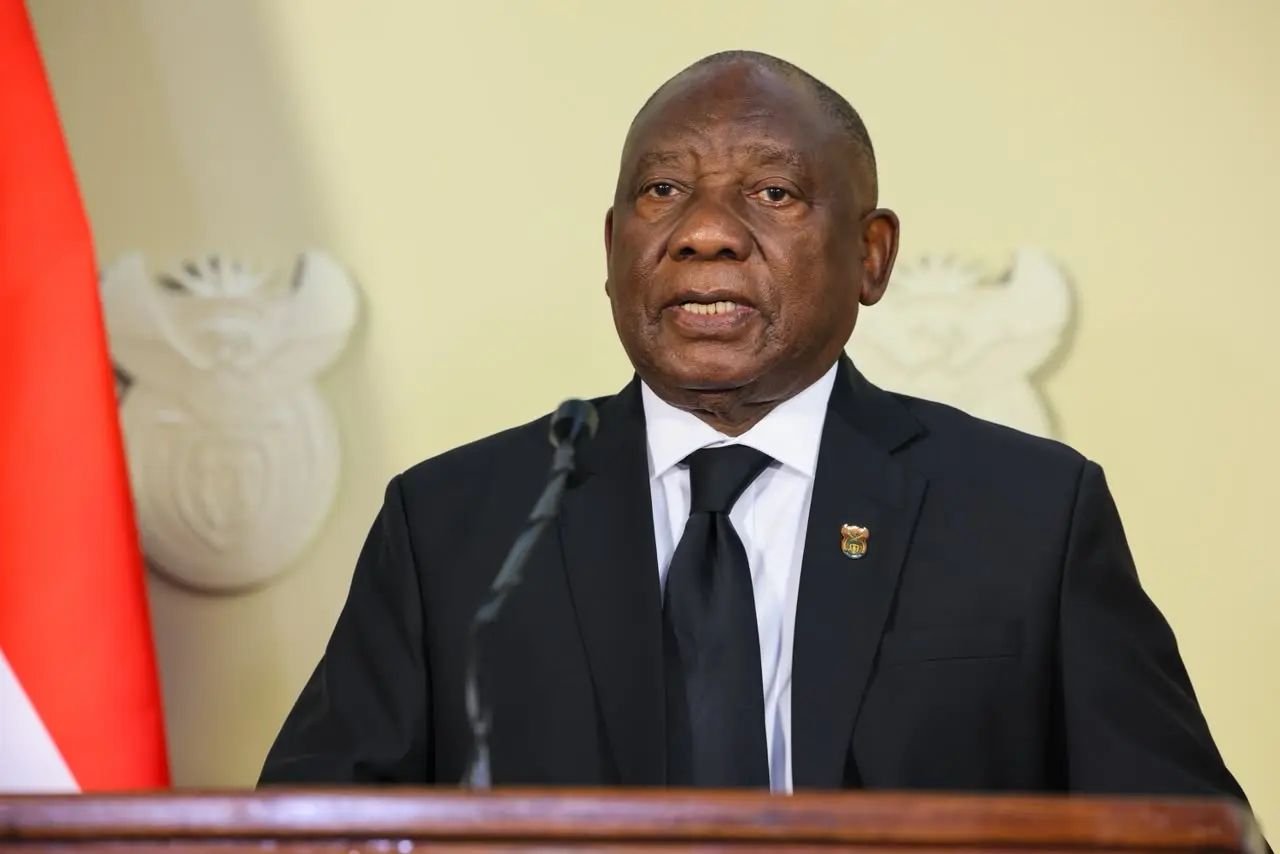
President Cyril Ramaphosa has ordered a nationwide review of unresolved murders, rapes and serious sexual offences involving women and children, imposing deadlines on police, prosecutors and municipalities as he conceded that the government’s response to gender-based violence and femicide had “not been enough”.
The intervention, announced in an address to the nation on Tuesday night after the discovery of 11 women’s bodies in Ekurhuleni since July, includes a national operation to identify stalled cases, a plan to reduce forensic backlogs and safety audits in every municipality.
“What we have done has not been enough. We need to do much more,” Ramaphosa said.
He ordered the police and justice ministries, working with the South African Police Service and, with due regard to its independence, the National Prosecuting Authority, to conduct a national case-recovery operation covering unresolved murders, attempted murders, rapes and serious sexual offences involving women and children.
Within 60 days, authorities must establish the number and age of unresolved cases, identify those awaiting forensic evidence and determine where suspects have been identified but not arrested or investigative or prosecutorial action has been unreasonably delayed.
Within 90 days, individual recovery plans must be in place for priority cases and those that have stalled, setting out what action remains outstanding, who is responsible for it and the deadline for moving the case forward.
Ramaphosa also ordered the police minister, national police commissioner and forensic authorities to produce a funded plan within 60 days to reduce forensic backlogs and establish turnaround times for priority GBVF cases.
The plan must quantify the size and age of the backlog, shortages of personnel and equipment, the resources required and deadlines for reducing it. Forensic samples involving the rape or murder of women and children are to be prioritised for urgent processing.
Progress will have to be reported publicly every quarter.
Ramaphosa also directed every municipality to conduct a women’s safety audit, with high-risk areas identified in conjunction with provincial governments and police.
Within 60 days, municipalities must identify broken streetlights, overgrown public spaces, abandoned buildings, unsafe transport routes and facilities, poorly secured parks and other conditions that put women at risk.
The most urgent hazards must be addressed within 90 days after the audits are completed or included in funded implementation plans with clear deadlines. The findings and progress in addressing them must be made public.
The measures come amid mounting concern over the discovery of women’s bodies in Ekurhuleni.
Ramaphosa confirmed that 11 bodies had been found since July, including that of another woman discovered in Springs on Sunday.
Police have not found evidence that the killings were committed by a single perpetrator, he said, although all possibilities remained under investigation.
Arrests have been made in three of the investigations.
A suspect was arrested on Sunday in connection with the killing of Ntombifuthi Nxumalo, whose body was found on Saturday. Two suspects have been arrested and appeared in court in connection with the killing of Jabulile Ntimba, while another suspect is in custody for the murder of Busisiwe Mahlangu.
In the other cases, police have identified persons of interest and collected forensic material including DNA and blood samples, clothing, cellphones and cellphone records. The Council for Scientific and Industrial Research is assisting with the digital forensic investigation.
“These cases will not be allowed to go cold,” Ramaphosa said.
Only two of the women found dead in Ekurhuleni had been reported missing.
Ramaphosa stressed that there was no requirement to wait 24 hours before reporting someone missing and urged people to contact police immediately if they feared something was wrong.
Alongside the criminal justice measures, Ramaphosa ordered provincial and municipal authorities to intensify enforcement of liquor laws, particularly against unlicensed outlets and establishments operating outside permitted hours.
The ministers responsible for trade and industry, health, social development, police and cooperative governance have been given 60 days to submit a coordinated legislative and enforcement package aimed at reducing alcohol-related violence to the cabinet.
“Alcohol does not cause gender-based violence and it can never excuse it. Responsibility always lies with the perpetrator,” Ramaphosa said.
But he said harmful alcohol use was a significant aggravating factor in interpersonal violence and had to form part of the government’s prevention strategy.
The Inter-Ministerial Committee on GBVF and the National Council on GBVF will monitor implementation. A first consolidated public progress report must be released within 90 days, followed by quarterly reports.
Ramaphosa also said additional resources would be allocated by the finance minister in the Medium-Term Budget Policy Statement.
The new directives build on an emergency response announced by the Inter-Ministerial Committee on GBVF on 20 September, which included elevating the multidisciplinary investigation into the Ekurhuleni killings to national level and increasing visible policing.
The specialised investigation therefore predates Tuesday night’s address. It brings together detectives, crime intelligence, forensic specialists, investigative psychologists and digital investigators under the coordination of the deputy national commissioner for detective services.
Ramaphosa said stronger laws, institutions, programmes and additional police would not on their own end violence against women, and turned much of the latter part of his address to the role of men and boys.
He cited a South African Medical Research Council study which found that more than 60% of women murdered in 2021 and 2022 were killed by an intimate partner.
“The solution to violence against women cannot be to make women less free,” he said.
“We cannot build a safer country by turning women into prisoners of precaution.”
Ramaphosa said attitudes about male control, entitlement, rejection and consent had to be confronted in homes, schools, universities, places of worship, sporting organisations and workplaces.
“For too long, gender-based violence has been treated as a women’s problem to solve,” he said.
“The freedom promised by our Constitution cannot be a freedom enjoyed fully by men and cautiously by women.”
He also directed the sport, arts and culture minister to strengthen the work of the Moral Regeneration Movement in addressing attitudes, social norms and practices that enable violence against women.
Seven years after delivering another national address on violence against women, Ramaphosa acknowledged that South Africa was again confronting the same crisis.
“The names of the victims are new. The crime is not,” he said.
This time, he sought to attach deadlines and public accountability to the government’s response.
“These directives are not just a statement of good intentions,” Ramaphosa said.
“They establish responsibilities, deadlines and a duty to submit reports on a regular basis to the nation.”