

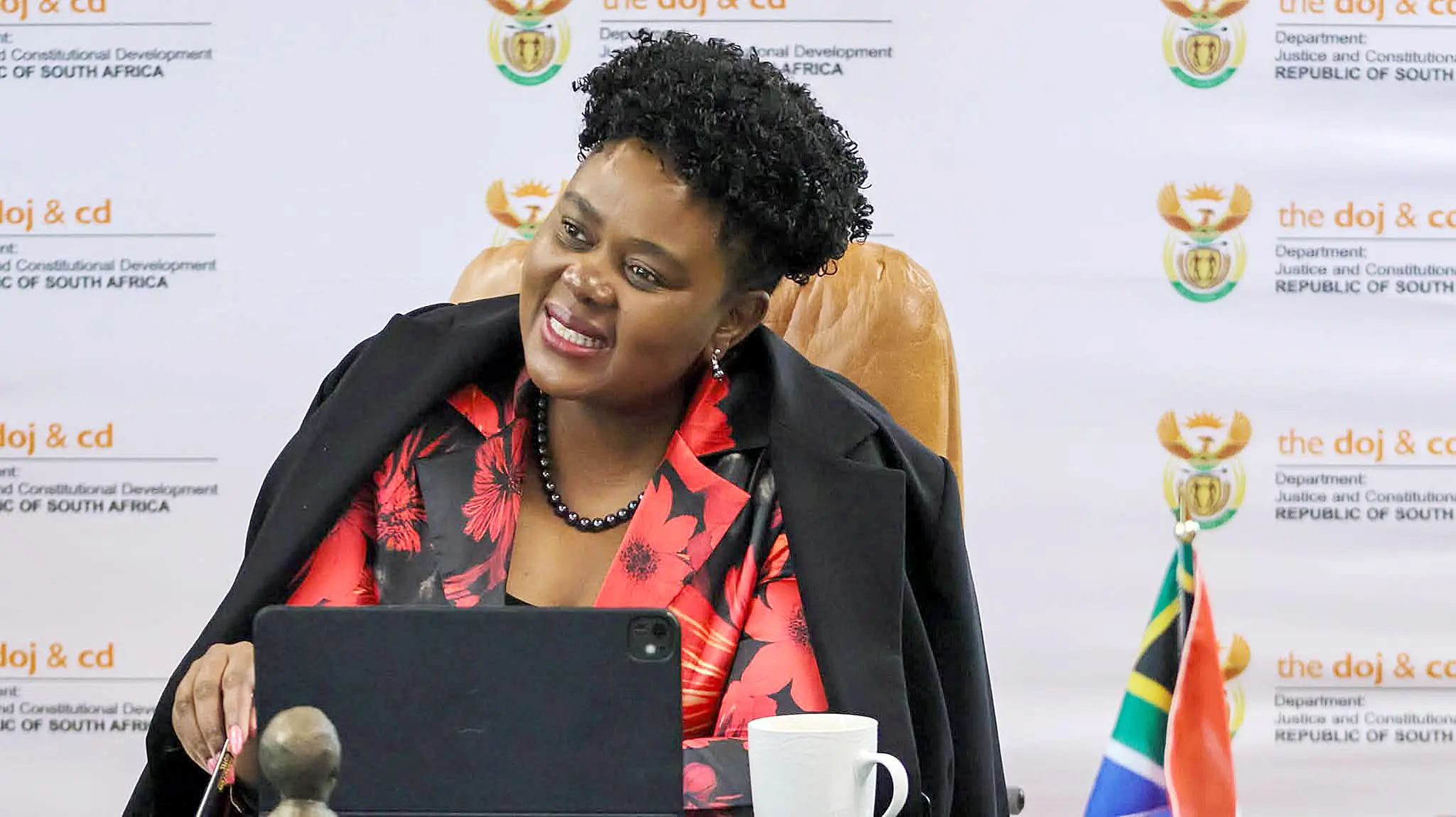
The government has acknowledged that a Constitutional Court judgment on asylum seekers has resulted in long queues at Home Affairs refugee offices, as thousands of foreign nationals seek to access the asylum determination process.
The Inter-Ministerial Committee on Migration (IMC) said on Wednesday that the five refugee reception offices around the country had been overwhelmed following a directive issued by the Department of Home Affairs after the ConCourt’s judgment.
The IMC, which meets monthly to coordinate the government’s migration policy, said it respected the judgment but was concerned about what it described as its “unintended consequences”.
“We respect the Constitutional Court’s decision. We are, however, concerned about certain unintended consequences of this important judgment,” said IMC chairperson and Minister of Justice and Constitutional Development Mmamoloko Kubayi.
Kubayi said the IMC has written to the Gauteng Judge President to resolve the unintended consequences of the ConCourt judgment. A panel to review the judgment will sit on 29 October.
The Constitutional Court handed down its judgment on 7 July, declaring certain provisions of the Refugees Act 130 of 1998 unconstitutional and invalid.
The court confirmed the invalidity of provisions requiring asylum seekers who had entered South Africa unlawfully to justify their failure to comply with certain procedural requirements before being allowed to apply for asylum.
The judgment considered the international principle of non-refoulement, which prohibits the return of a person to a country where they face persecution or serious harm.
Following the judgment, Home Affairs issued a directive to refugee reception offices around the country. Minister in the Presidency Khumbudzo Ntshavheni said the implementation of the directive had contributed to confusion and overcrowding.
The government has sought to distinguish between access to the asylum process and the automatic granting of refugee status.
Kubayi said the court judgment did not grant refugee status or permanent residency to anyone who entered South Africa.
“The judgment does not grant refugee status or permanent residency automatically to anyone who enters South Africa. It simply requires that individuals claiming asylum be allowed access to the asylum determination process so that their claims can be properly assessed in terms of the law,” she said.
She said applications could still be rejected if they were fraudulent, abusive, unfounded or failed to meet the requirements of the Refugees Act.
“The court’s decision only remedies a procedural defect regarding how applications were initially processed. It ensures that individuals are not summarily deported or barred based solely on administrative technicalities such as lacking a transit visa or missing a tight reporting deadline without an interview,” Kubayi said. Asylum seekers must still go through the formal refugee status determination process, where their claims will be assessed.
“Those found to be abusing the asylum process or failing to meet the legal definition of a refugee will continue to face lawful deportation once due process is completed,” she said. Kubayi also rejected claims that the judgment would allow refugees to vote in South Africa.
“Those granted refugee status do not have the right to vote in terms of our laws in the country, contrary to what is being circulated in our country,” she said. She also sought to reassure South Africans that the influx at refugee offices would not prevent them from accessing Home Affairs services. “It is also not true that Home Affairs services will not be able to service South Africans because they are flooded by refugee applications. As it stands now there are only five centres in the country. And this process is only processed at these five refugee centres,” she said.
“All other offices of Home Affairs will attend to other needs of South African citizens and no South African citizen will be barred.”
Kubayi warned that misinformation could discourage people from accessing essential Home Affairs services, including matric pupils who require identity documents ahead of their examinations.
“The IMC recognises and acknowledges that these directives, which were intended to comply with the Constitutional Court judgment, may have led to the arrival of many foreign nationals at offices which Home Affairs did not have the capacity to deal with,” she said.
She said Home Affairs, the Border Management Authority and the police were working together to enforce the country’s migration laws. The IMC also intends to release crime statistics relating to undocumented foreign nationals in an effort to counter what it described as misinformation.
Minister of Employment and Labour Nomakhosazana Meth rejected what she described as selective criticism of foreign nationals, particularly those from certain countries or racial groups.
“There is no way that we can only choose particular races and leave others [out],” Meth said.
She said employers found to be employing undocumented foreign nationals would be dealt with regardless of the labourers’ nationality.
“We know in South Africa the notorious sector is the agricultural sector, and the majority of commercial business people are white nationals. If we go to a business and we find someone who is employed who is illegal in South Africa, we process you as an employer to the police stations and we deal with you,” she said.
Meth said the Employment Services Amendment Bill, which seeks to regulate the employment of foreign nationals and the recruitment of workers with scarce skills, was currently open for public comment until 6 November.
She said the legislation was intended to prioritise South African workers where the necessary skills were available locally.
“Once this bill is passed there will be no foreign national who is employed in South Africa with a skill that is available in South Africa. So you can see that the intention is to protect and prioritise South Africans,” Meth said.
She accused some employers of exploiting undocumented foreign workers by paying them below the minimum wage or withholding compensation.
Ntshavheni said the IMC was reviewing the Home Affairs directives to prevent further confusion and overcrowding.
“The first misinformation is that it is a government decision. It was the Constitutional Court decision of the 7th of July 2026,” she said.
She affirmed the principle of constitutional supremacy but argued that it had to be balanced against national sovereignty and territorial integrity.
“If the Constitution is not protecting South Africans and the sovereignty of this country, the territorial integrity of this country, the safety and security of South Africans and this country, we have to talk about that,” Ntshavheni said.
“We are currently in national dialogues as a country. We must talk about the amendment of the Constitution if it does not work in our interest.”
Ntshavheni said the government was considering mechanisms to resolve contradictory court judgments, including a panel similar to powers given to the Gauteng judge president to deal with conflicting High Court judgments.
She said people who did not meet the requirements for asylum would ultimately be subject to deportation following due process.
“There is no economic refugee that is provided for in the Constitution and in our laws and in the international conventions of the United Nations. The people who are refugees in terms of international conventions are those who are fleeing from war and persecution,” she said. Ntshavheni questioned whether nationals from neighbouring countries experiencing no war or widespread persecution should qualify for asylum in South Africa.
“There is no war in Zimbabwe, Mozambique, Lesotho, Botswana, Eswatini and Namibia,” she said.
“We need to look at what provisions of our laws allow people who are not coming from countries that are entitled to use South Africa as their first country of safety in line with the UN conventions.”
Home Affairs director general Tommy Makhode said the Special Investigating Unit had been investigating the issuing of permits since the inception of the 2002 Immigration Act, including permanent and temporary residence permits and naturalisation.
He said South Africa currently had five refugee reception offices, in Gqeberha, eThekwini, Epping, Tshwane and Musina.
He said only these were overwhelmed while other Home Affairs offices continue to service South Africans. Makhode also highlighted ongoing legislative work on the Zimbabwe Exemption Permit, which has completed its public consultation process. The IMC is also reviewing what Makhode described as the “unending blue sky” of appeals that allow rejected asylum seekers to remain in South Africa while their appeals are being processed.