


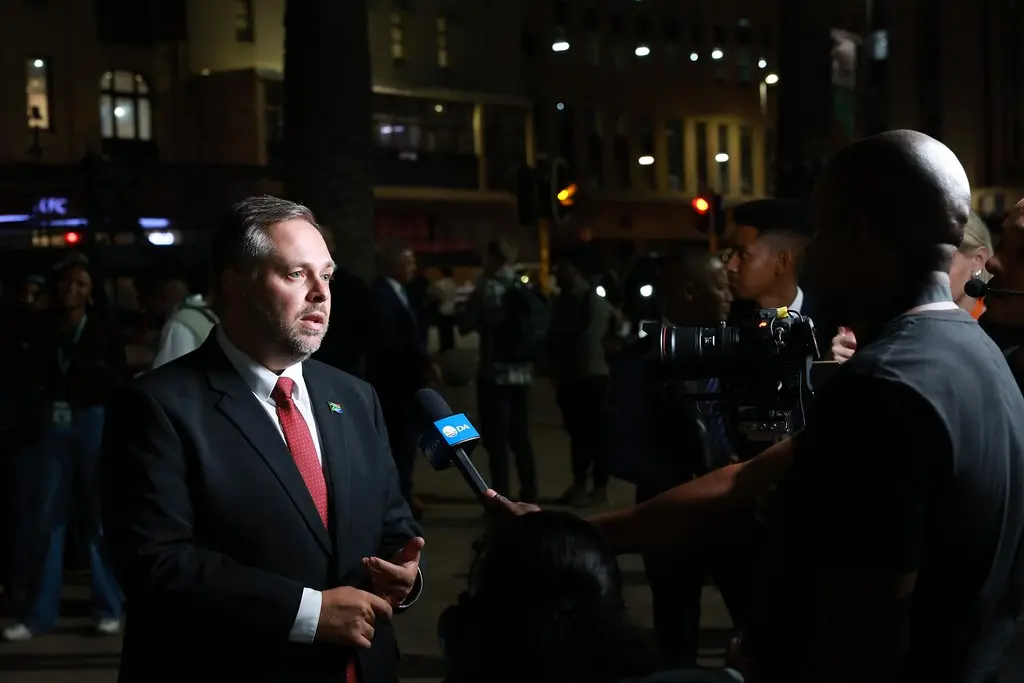
Home Affairs Minister Leon Schreiber has defended the withdrawal of a directive intended to implement a Constitutional Court judgment on asylum applications, saying the government changed its position after refugee reception offices were overwhelmed and serious public safety concerns emerged.
The decision, announced on Friday, follows violent anti-immigrant protests in Soweto and Durban on Thursday, during which 24 vehicles were torched and foreign-owned businesses targeted.
It also comes a day after an inter-ministerial committee reaffirmed the government's obligation to comply with the July Constitutional Court judgment, which requires asylum seekers to have their applications considered even if they entered South Africa unlawfully or failed to meet certain administrative requirements.
In media interviews on Friday, Schreiber said the court could not have foreseen the consequences its ruling would have for refugee reception centres and surrounding communities.
He said Home Affairs had "shifted its position" because the "facts shifted".
The department said its director-general had withdrawn the directive issued on 28 September after refugee reception offices were overwhelmed within days, officials were placed at risk and serious threats to public safety and order emerged.
Home Affairs said the instruction was issued as an operational measure without the knowledge of Schreiber or any other political office-bearer. It rejected claims that the directive was politically motivated, noting that the department had opposed the Constitutional Court case.
The department said it would develop a new approach to implementing the judgment but has not explained what interim arrangements will apply at refugee reception offices or when replacement instructions will be issued.
The Constitutional Court judgment, delivered on 7 July in litigation involving the Scalabrini Centre of Cape Town and Lawyers for Human Rights, remains binding despite the withdrawal.
The ruling addressed provisions of the Refugees Act that prevented asylum seekers from accessing the application process because they entered the country irregularly, failed to obtain an asylum transit visa or missed prescribed reporting deadlines.
It requires officials to consider individual claims rather than automatically excluding applicants on procedural grounds.
The judgment does not grant undocumented migrants automatic refugee status, citizenship, permanent residence or voting rights. Applicants must establish that they qualify for protection, while those whose claims are rejected may face deportation following due process.
This distinction has been obscured by misinformation circulating on social media, including claims that the ruling amounted to the blanket legalisation of undocumented foreign nationals.
The controversy escalated into violence on Thursday when protesters opposing the processing of asylum applications targeted vehicles and foreign-owned businesses in Soweto and Durban.
Acting national police commissioner Lieutenant General Puleng Dimpane said 10 vehicles were torched in Soweto and 14 in Durban.
In Orlando West, Soweto, protesters gathered near a Home Affairs office before moving towards foreign-owned businesses. Police received reports of shots being fired towards demonstrators before vehicles were set alight.
In Durban, shops were looted and vehicles burnt. Hundreds of asylum seekers gathered outside the refugee reception centre were instructed to leave because of security concerns.
Three foreign nationals were arrested for allegedly assaulting a protester, an incident police said might have contributed to the unrest.
Police reported that calm had returned to both areas on Friday, although officers remained on alert.
The violence followed an emergency meeting of the inter-ministerial committee on migration on Wednesday night.
Briefing the media on Thursday, Justice and Constitutional Development Minister Mmamoloko Kubayi acknowledged that the country's five refugee reception offices had been overwhelmed by applicants.
Kubayi, who chairs the committee, said the government respected the judgment but faced significant operational challenges. She emphasised that the ruling did not prevent the enforcement of immigration laws or the deportation of people who did not qualify for refugee protection.
The committee announced plans to strengthen asylum processing capacity, improve biometric screening, accelerate decisions on applications and investigate fraud within the system.
It also sought legal advice on implementing the judgment, including options where compliance required significant time and resources.
Minister in the Presidency Khumbudzo Ntshavheni said on Thursday that the government was reviewing the Home Affairs directives to address confusion and overcrowding.
The review was therefore under way at political level before Friday's withdrawal, although the department has not disclosed whether Schreiber or the inter-ministerial committee requested or approved the decision.
The reversal leaves unresolved how Home Affairs intends to reconcile its operational difficulties with its constitutional obligations, particularly while anti-immigrant protests threaten access to refugee reception offices.
The Scalabrini Centre and Lawyers for Human Rights had not issued a publicly available response to Friday's withdrawal at the time of writing.
Home Affairs maintains that it respects the judiciary and remains committed to complying with the court order.
But with the directive withdrawn and no replacement announced, uncertainty remains over how asylum seekers previously excluded from the system will be able to lodge applications while the government develops a new approach.