


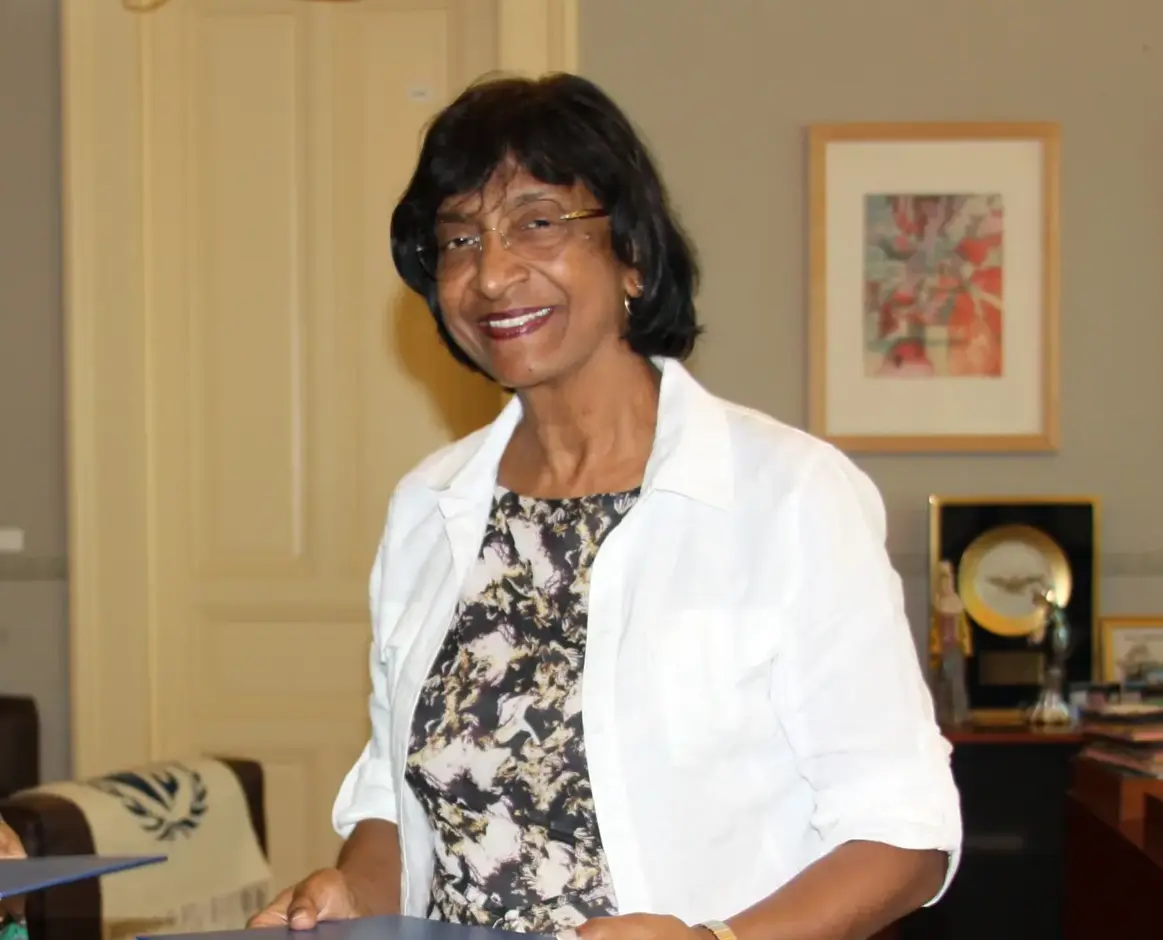
South African human rights lawyer Navi Pillay has become the fifth South African and the first South African woman to win the Nobel Peace Prize. Pillay has been recognised for her lifelong contribution to international justice, including her leadership of a United Nations investigation that concluded Israel had committed genocide against Palestinians in Gaza.
The Norwegian Nobel Committee announced the 2026 award on Friday, honouring the 85-year-old Durban-born jurist for her exceptional courage, integrity and commitment to strengthening international law and ensuring accountability for war crimes, crimes against humanity and genocide.
She joins Albert Luthuli, Desmond Tutu, Nelson Mandela and FW de Klerk as South African recipients of the prestigious award.
Her recognition marks a historic moment for South Africa, honouring a woman who overcame the racial and gender discrimination of apartheid to become one of the world's most respected international jurists.
"The Nobel Peace Prize for 2026 goes to a person who with exceptional courage and integrity has led the way towards a more comprehensive global legal order," the committee said.
It praised Pillay for helping expand the reach of international law and strengthening institutions responsible for holding states and political leaders accountable.
The award comes just over a year after the UN Independent International Commission of Inquiry on the Occupied Palestinian Territory, which Pillay chaired, concluded that Israel had committed genocide against Palestinians in Gaza.
In its September 2025 report, the commission found that Israeli authorities and security forces had committed four of the five genocidal acts defined under the Genocide Convention, including killings, causing serious bodily and mental harm, deliberately imposing conditions of life calculated to bring about the destruction of Palestinians, and measures intended to prevent births.
It also concluded that senior Israeli leaders had incited genocide. Israel rejected the findings.
Under Pillay's leadership, the commission investigated Israel's military operations in Gaza, as well as its occupation of Palestinian territory, settlement expansion, forced displacement and violations of Palestinian rights in the West Bank and East Jerusalem.
Pillay repeatedly called on governments to fulfil their obligations under international law and pursue accountability for violations, warning that political considerations could not override the responsibility to prevent and punish genocide.
Her Nobel recognition comes as South Africa continues its case against Israel at the International Court of Justice, where it has accused Israel of violating the Genocide Convention. The court has ordered provisional measures but has not yet delivered a final judgment on the allegations.
While the Nobel Committee recognised the full breadth of Pillay's career rather than attributing the award to any single investigation, it specifically acknowledged her leadership of the UN commission on the occupied Palestinian territory.
The committee also used Friday's announcement to warn about the growing threats facing international courts and judges, including sanctions and political attacks against institutions responsible for enforcing international law.
"The system of international law is under tremendous pressure, and its institutions are under attack," it said.
"We see a shift towards power politics at the expense of legal frameworks and global respect for law and justice. Whenever might overtakes right, it undermines stability, trust and peaceful co-existence."
The committee acknowledged that powerful states had frequently escaped accountability and that international legal proceedings had produced different outcomes depending on the perpetrators and victims.
It said the award was intended to reaffirm the importance of the rule of law in preventing violence and resolving conflicts peacefully.
"Peace requires justice," it declared.
For Pillay, that principle has shaped a career spanning more than five decades.
Born in Durban in 1941 into a family of Indian Tamil origin, she grew up under apartheid, experiencing the racial and gender discrimination that would influence her commitment to human rights.
She entered the legal profession at a time when opportunities for black women were severely restricted and established herself as a pioneering lawyer, defending anti-apartheid activists and challenging the treatment of political prisoners.
Her early work included defending Nelson Mandela and others who resisted apartheid, a contribution specifically acknowledged by the Nobel Committee.
Following South Africa's democratic transition, Pillay was appointed to the High Court in 1995, becoming the first woman of colour to serve in that position.
She subsequently joined the International Criminal Tribunal for Rwanda, where she helped establish one of the most important legal precedents in the prosecution of genocide.
In the landmark Akayesu case, the tribunal recognised that rape and sexual violence could constitute genocide when committed with the intention of destroying a protected group.
The judgment transformed international criminal law by recognising sexual violence as a deliberate instrument of genocide rather than simply a consequence of armed conflict.
The Nobel Committee also credited Pillay with contributing to another legal breakthrough in the same case, involving charges of incitement to genocide through propaganda.
She went on to serve as a judge at the International Criminal Court before being appointed United Nations High Commissioner for Human Rights in 2008, a position she held until 2014.
She later chaired the UN commission investigating violations in the occupied Palestinian territory and Israel, and currently serves as an ad hoc judge at the International Court of Justice in proceedings concerning allegations of genocide against the Rohingya in Myanmar.
The committee described Pillay as one of the great defenders of international legal principles, saying her independence, expertise and steadfastness had made her an internationally respected jurist.
It said she had consistently emphasised the responsibility of individuals and states to comply with the rule of law, while helping define the legal principles used to prosecute some of the gravest international crimes.
The committee also paid tribute to judges working under increasing political pressure, describing them as guardians of the boundary between order and chaos.
At a time when international courts are facing challenges to their authority, it said the world needed people with the courage, vision and determination that Pillay had demonstrated throughout her career.
Her award places her alongside four South Africans whose Nobel Peace Prizes were closely associated with the struggle against apartheid and the country's transition to democracy.
Pillay's contribution has taken that legacy onto the international stage, from the prosecution of genocide in Rwanda to efforts to establish accountability for atrocities in Gaza.
The Nobel Committee said her commitment to justice and human dignity offered hope to victims of violence and conflict around the world.
The Nobel Peace Prize will be formally presented in Oslo on 10 December.