


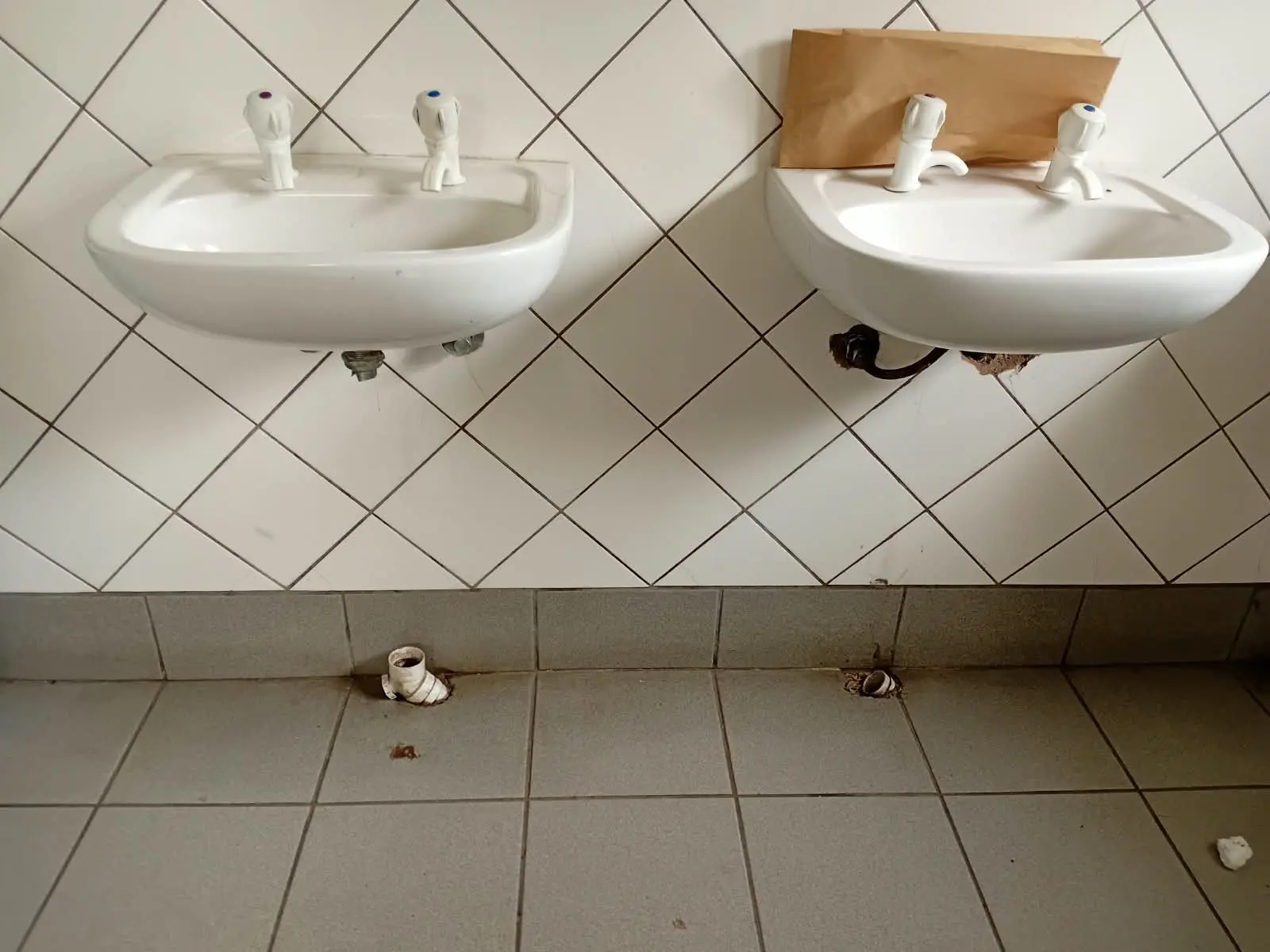
A criminal network targeting hospitals in the Free State is repeatedly stealing taps, toilet flush mechanisms and copper pipes, forcing already strained healthcare facilities to spend hundreds of thousands of rands replacing the equipment.
Staff at three hospitals visited by the Mail & Guardian this week described a persistent problem that has forced facilities to lock public toilets, deploy private security and spend money replacing stolen equipment, while raising concerns about the risks to patients.
Operating theatres have been affected by the theft of copper pipes used to supply oxygen.
The thefts have forced hospitals to repeatedly replace the stolen equipment, adding to the financial pressure on already under-resourced facilities. Intensive care unit patients have also been put at risk.
According to some staff members at these hospitals, their prime suspects are maintenance contractors and some of the people working within the facilities.
The M&G visited hospitals in Bloemfontein, including the National District Hospital, Universitas Academic Hospital and Pelonomi Regional Hospital, where we found that the theft of Cobra flush masters was a common problem.
A quick Google search shows that the Cobra flush masters used in these hospitals cost between R7 000 and R9 000.
However, a senior official at one of the hospitals told the M&G that because the items had to be purchased through the supply chain pro-cess, the cost could rise to R12 000 or R13 000 per unit.
“Sometimes you have to buy about 40 of them, then you can easily spend over R400 000,” the official said.
At Universitas Academic Hospital, nurses could be seen filling five-litre water containers to fill urns because the hospital has been without hot water for some time.
Fully functional public toilets have been locked and private security has been deployed in a bid to curb the theft of these flush masters. Patients can, however, access toilets in their wards.
A senior staff member at the Universitas Academic Hospital alleged that “it is definitely insiders who are doing this thing because they know exactly where to steal these copper pipes”.
The staff member added: “We have welded where they have broken in, but they still came in and stole the pipes.”
Universitas chief executive Dr Balekile Mzangwa told the M&G that the vandalisation of critical infrastructure had been a problem for years, but that the hospital had recently seen a spike in incidents.
At least 79 cases of vandalism have been reported to the authorities, but Mzangwa said there had been no pro-gress reports on these cases.
“There was a time when they actually found someone stealing red-handed, but that person was given bail,” Mzangwa said.
“Having to look at the gravity of the matter, with copper wires for oxygen being stolen, you ask how many people would have died. But it’s an issue I don't want to get into, as every person has a right to justice.”
According to him, the hospital has been forced to procure the same items repeatedly as the criminal activity continues.
Mzangwa said the copper pipes being stolen were used to supply oxygen to the hospital, and their theft had affected the functioning of operating theatres.
“I take them [the criminals] as murderers because, indirectly, they are killing. They don’t know the impact that they have on patients.”
Another consequence of the stolen pipes is the risk of litigation from aggrieved patients or their family members, which could result in hospitals being sued.
Mzangwa said this would be caused by “human beings who are greedy enough to even go and steal at a hospital”.
To address the theft of Cobra flush masters, the hospital decided to lock the toilets and deploy private security to reinforce security and curb vandalism.
“We have had to put measures in place. People who need to use the toilet would have to ask someone else for the keys to make sure that we monitor [access],” he said.
Addressing the hot water short-age, Mzangwa said the hospital had commissioned boilers and procured geysers to ensure that, even when the boilers were not working, there would still be a way to keep water hot.
“For the time being, patients do wash with hot water using urns. These are the mitigating factors and we are doing our best to make this hospital function.”
Although he did not have the exact figures for how much had been spent addressing the continued theft, Mzangwa said the hospital had spent a substantial amount of money replacing stolen copper pipes and Cobra flush masters.
He added that these incidents had a ripple effect on patients’ stays at the hospital and on staff members.
Frustrated nurses at National District Hospital said it had been struggling with its toilets for months, with some being permanently closed or converted into storerooms.
Walking into the toilets, one is greeted by a stench and broken basins.
Some of the water pipes connected to the basins have been completely stolen and the taps have been replaced with plastic ones. Some of the plastic taps have also been stolen. A nurse said the hospital was in a state of decay, leaving staff in the difficult position of having to inform patients that the toilets were not functional.
“It has been like this for a long time. We have to be the ones telling patients we do not have toilets and it is frustrating.”
The nurses said that their prime suspects were some of the companies responsible for maintenance and staff members working at the hospital who knew exactly how much these items cost.
They argued that no petty criminal would simply walk into a hospital and steal a Cobra flush master, as the item was not intended for household use and would be difficult to sell.
One nurse said their hospital was in a better condition than clinics in the townships.
“There, it’s worse because, from what we found out, the Cobra flush masters were being sold to scrapyards and the pipes were also being sold to scrapyards.”
At the nearby Pelonomi Regional Hospital, the hospital’s management has tried to conceal the Cobra flush masters behind white metal boxes, making them less accessible.
The taps have also been replaced with plastic ones to prevent theft.
One member of the management staff said that they had to intervene to ensure that the theft was reduced.
The staff member said the theft of Cobra flush masters was a problem affecting many hospitals across the province.

The M&G spoke to a patient at Pelonomi Hospital who identified himself only as Kisto and said his stay had been horrible. He described how he had been moved between all three hospitals.
“I started at Universitas, but I wasn’t there for long, so I can’t say much about it. I went to the National Hospital and it was terrible. People were defecating all over the place. You are near patients who have open wounds and you can contract diseases. Here at Pelonomi, it’s horrible. Go to Ward 6 and you will realise how bad the situation is.”
The M&G contacted the chief executive of Pelonomi Regional Hospital, who is also in charge of National District Hospital, but the CEO declined to answer questions and referred the publication to the provincial office.
Mondli Mvambi, Free State health department spokesman, says they are not aware of any syndicate operating in the province.
“There have been about 32 incidents reported to police at various health institutions in the Free State including Pelonomi and Universitas and the cost of vandalism and theft at Universitas.”
Copper pipes theft amounted to R1 015 896; electrical cables cost R175 368; toilet fittings and flush masters stood at R1 560 000, Mvambi said.
“These figures are estimated expenditures by the infrastructure departments at Universitas hospital . Through partnerships with business, Pelonomi has installed anti -theft measures and plastic taps at public toilets to prevent theft.”
At Pelonomi- Copper amounting to R500 000 was stolen by two officials from technical services. They have since been dismissed from public service, he added.
About 32 health facilities in the Free State are prone to various incidents of theft and vandalism: “Security measures adopted by the Department are wide-ranging, from advocating for the community and steel-melting companies to play a crucial role in protecting all public infrastructure and, more especially public health infrastructure - by not participating in the buying or selling of such goods as copper material, pipes.
“The Department is furthermore tightening security measures including educating and appealing to the conscience of personnel responsible for access control, -increasing access control and searching of bags and vehicles, applying security escort measures in administrative buildings without mandatory public interface, increasing security personnel and their visibility, shifting them around to avoid familiarity and pairing them with private security personnel in much more dangerous environments that require increased levels of force and sophisticated techniques to safeguard expensive equipment, technologies and personnel.
Furthermore, said Mvambi, these measures included expanding CCTV coverage with face recognition technology, partnering with the private sector in areas where private security can augment public facility security at lesser or no cost including assistance by Neighbourhood Watch, Community Safety Patrols and the police.
“We have private partnerships that donate innovative solutions such as built-in and lockable flush systems that cannot be accessed by the public and unauthorised people - such was launched at Pelonomi during Nelson Mandela Month.
“The Department benefits immensely from Municipal Water and emergency contingency plans during water outages and instances of vandalism and theft through water tankers, filling of reservoirs and Jojo tanks at facilities. The generous support of water utilities like Vaal Central Water has been beneficial during the water crisis and humanitarian interventions by the Red Cross as well as families of patients who bring them fresh drinking water is highly appreciated.”
Boreholes have been implemented especially in Matjhabeng area to increase water self-sufficiency of health facilities, said Mvambi.
Bongani Regional Hospital enjoys the prioritisation support of the municipality in instances of water outages. This institution has not been prone to vandalism of its water and other infrastructure except sporadic incidents between 2024 and 2025 years.