

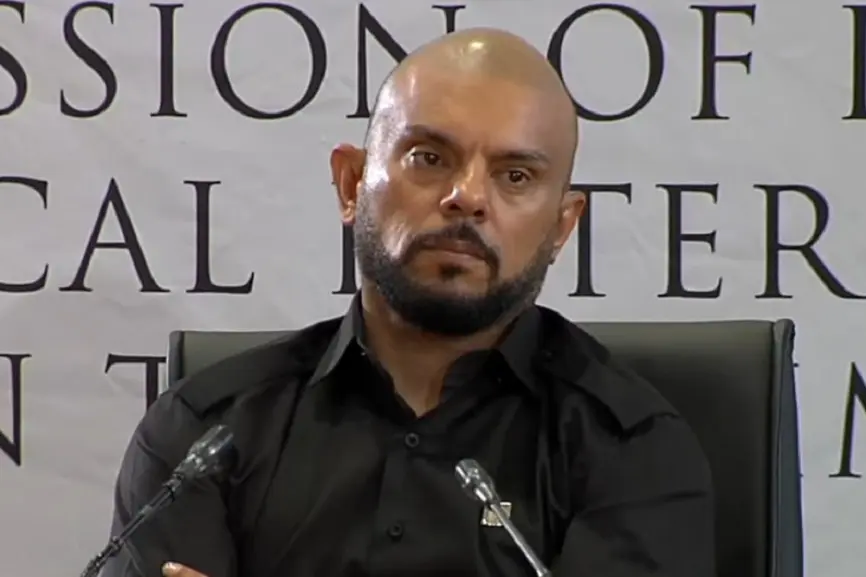
North-West businessman Suliman Carrim has been remanded in custody after the Pretoria Magistrate’s Court postponed his bail application to 28 October to allow the state to submit a transcript of his interview following his arrest at OR Tambo International Airport.
Carrim was arrested at the airport on 16 October, shortly before he was due to board a flight to Dubai via Pakistan. He is facing criminal charges related to his failure to return to the Madlanga Commission to continue his testimony, which he previously said he could not do for medical reasons.
The state has opposed his release on bail, arguing that he poses a flight risk and questioning why his doctor could clear him for a 15-hour flight but not for an eight-hour cross-examination at the commission.
“The health of the applicant is a challengeis a challenge over time when it suits him, particularly under cross-examination. When it’s during the examination-in-chief, the applicant is able to be coherent. The applicant does not raise any medical condition that affects his ability to give his side of the version,” the state advocate argued.
“I submit that the applicant had no intention of going back to the Madlanga Commission for the continuation of his testimony,” the advocate added.
The prosecutor also argued that South Africa Police Service (SAPS) would struggle to extradite Carrim from the United Arab Emirates because of the nature of the charges against him.
The state said Carrim had not informed police that his health was improving and only disclosed this after his arrest at the airport.
Although the state confirmed Carrim’s residential address and verified his return ticket, reportedly booked for 27 October, it maintained that these details were insufficient to justify his release.
“In as much as such was confirmed as positive, the state is still opposed to the release on bail of the accused,” the prosecutor said.
Testifying about the arrest, investigating officer Captain Kubayi said Carrim was facing charges related to his failure to return to the commission and had been instructed to inform police of any overseas travel.
Kubayi said Carrim produced a one-way ticket when he was arrested and was aware that a criminal case was pending against him. He argued that Carrim should have informed the police of his travel plans.
The investigating officer further argued that it would be difficult to locate Carrim if he were released, given that he had multiple residences in addition to his main home in Mahikeng.
Carrim told police that he was a businessman earning R200,000 a month. He said his main property was in Mahikeng and that he also owned two houses in Johannesburg.
He also told officers that he had previously travelled to Pakistan while under summons to appear before the Madlanga Commission. He said sweets and snacks accounted for about 70% of his luggage because he intended to distribute them to children during his religious pilgrimage.
Carrim told the court that he had been hospitalised for 45 days during his commission testimony. Although his condition had improved, he said he continued to experience anxiety and blackouts.
The state argued that a return ticket did not guarantee that Carrim would return to South Africa.
“The fact that the return ticket is only used if the person boarding the plane has the intention to board the plane does not serve as a guarantee that the person will be on the flight,” the state advocate said.
Appearing for Carrim, advocate Dawie Joubert confirmed that his client had a return ticket, which police had verified.
Joubert said Carrim’s pilgrimage involved distributing sweets and snacks to local children. He argued that the state had largely failed to refute his client’s evidence that he had a return ticket, a verified residential address and a business, and that he had no previous convictions.
Joubert also disputed the state’s claim that Carrim would interfere with the justice system or abscond.
“What must an accused person do more? He can simply tell the court, ‘I will stand my trial, I’m not a flight risk and I will not interfere’. And if there’s no evidence to the contrary, which there isn’t, then obviously there’s nothing more he can do,” Joubert said.
He urged the court to release Carrim on bail subject to conditions that would ensure his compliance.
Joubert argued that Carrim had not been told which police officer he was required to notify about his overseas travel. He added that his client had already surrendered his passport.
“But the mere fact that he knew there’s a possible charge pending against him does not place on him any obligation of any sort that he must inform an investigating officer, who he didn’t know, that he planned to go on a trip and return,” Joubert said.
He further argued that a bail application was not a mini-trial and that the court could impose conditions to ensure Carrim attended his trial, including requiring him to report to a police station and inform the investigating officer of his movements.
The magistrate postponed the bail application to 28 October for the state to provide the transcript of Carrim’s interview following his arrest at the airport.