


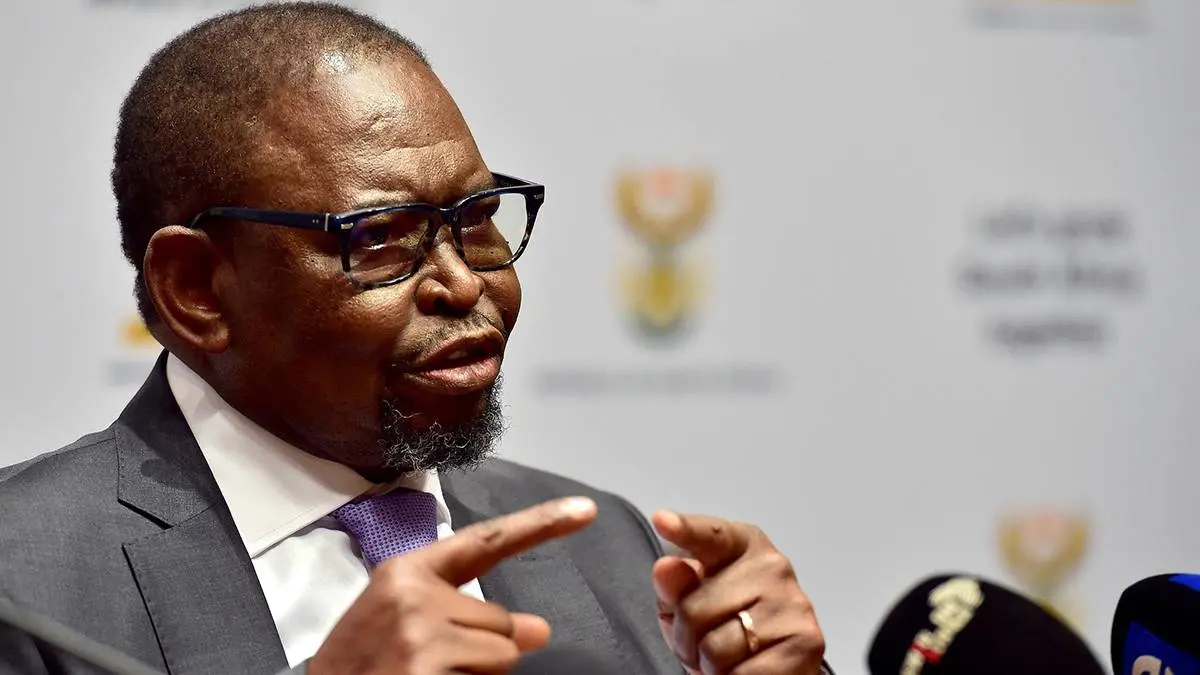
Finance Minister Enoch Godongwana has announced R10 billion in temporary fuel relief, offering households some respite from rising costs as the national treasury cuts its growth forecast and warns that part of the revenue supporting additional spending will not last.
The Medium Term Budget Policy Statement, tabled on Wednesday, provides more money for provincial and municipal services and places greater emphasis on infrastructure. But the economy is growing too slowly to generate the jobs and incomes needed to ease pressure on households.
The treasury now expects growth of 1.2% in 2026, down from the 1.6% projected in February. It forecasts a recovery to 1.6% next year and 2% in 2029. That leaves the government relying partly on stronger commodity earnings to support its finances while much of the economy struggles to expand.
Higher mining profits can bring in more tax without a corresponding improvement in employment or household incomes.
Dr Elna Moolman, Standard Bank’s group head of South Africa macroeconomic research, said treasury’s focus was shifting towards growth after years spent restoring fiscal credibility and stabilising debt.
The additional revenue was being used to a large extent for infrastructure, which the national treasury expects to support growth and employment, she said. For consumers, the clearest immediate benefit is the reduction in fuel levies.
From 4 November to 1 December, the levy will fall by R1.50 a litre for petrol and R3 for diesel. Smaller reductions of R1 for petrol and R1.50 for diesel will then apply until 5 January.
Someone buying 50 litres of petrol would initially save R75 against what they would otherwise pay. This does not guarantee a R1.50 reduction in the pump price, which will also reflect international fuel prices and the exchange rate.
The larger diesel reduction should ease costs for farmers, freight operators and other businesses. How much reaches consumers will depend on whether businesses pass on the savings and whether other costs continue to rise. Taxi fares and food prices will not necessarily fall.
Moolman welcomed the consumer relief. Its expiry in January, however, means households cannot count on it as a lasting reduction in their transport costs.
Godongwana said R10 billion previously transferred to the Central Energy Fund would be returned to the National Revenue Fund and placed in the contingency reserve to finance the levy reductions.
The arrangement redirects resources to offset the tax revenue the government will forgo. It provides temporary support without creating a permanent commitment to lower fuel levies.
The broader revenue improvement also has limits. The main budget revenue is R54.1 billion above February’s estimate for 2026/27 but the upward revision to gross tax collections accounts for R17.1 billion. The rest includes mining royalties, departmental revenue and national revenue fund receipts, with public entities required to surrender surpluses.
One-off receipts and surrendered surpluses help finance spending now but cannot be assumed to provide the same income every year. The treasury also expects much of the commodity tax improvement to fade over the medium term.
The distinction matters because commitments such as salaries and services must be funded every year, including when mineral prices weaken.

The government has made progress on debt. It stabilised at 78.4% of gross domestic product in 2025/26, below the 78.9% peak projected in February. The national treasury expects the ratio to decline to 76.6% by 2029/30.
A falling debt ratio means debt is becoming smaller relative to the economy. It does not mean the government has stopped borrowing or that its interest bill is falling in rand terms.
In 2026/27, main budget revenue exceeds expenditure before interest by R139.9 billion. This is the primary surplus. Interest costs of R441.5 billion more than absorb it, leaving a main budget deficit of R301.6 billion.
The government must therefore continue borrowing to cover the shortfall,
while refinancing debt as it falls due. The national treasury expects debt service to consume an average of about a fifth of revenue over the medium term. That is money unavailable for current services and investment.
Moolman said the statement should reassure investors and credit rating agencies by reaffirming the commitment to fiscal sustainability, potentially supporting further positive rating action.
Godongwana has nevertheless added funding for services facing immediate pressures. Over the medium term, provinces will receive another R20.5 billion through the equitable share to help meet higher health and education costs.
Local government will receive an additional R21.8 billion through its equitable share towards the bulk costs of free basic water, sanitation, electricity and refuse removal.
The general fuel levy allocation to metros will also increase by R13.4 billion, restoring their share to 23% over the medium term, Godongwana said.
These additions should help councils and provinces meet their costs. Whether they produce better services will depend on how much is absorbed by higher wages, supplies and bulk purchases and how effectively the money is managed.
More funding can prevent services from deteriorating without necessarily expanding them. For patients and pupils, the difference will be felt in staffing, available medicines and functioning facilities.
Other allocations have more specific aims. Godongwana announced R3.8 billion to employ more than 3 500 social workers and R1.6 billion over the medium term to address stunting and malnutrition.
Sexual offences courts and Thuthuzela Care Centres are also to be expanded. The treasury has identified R38.1 billion in savings over the coming spending period through departmental efficiencies, social grant verification and public entity surpluses, among other measures.
The package includes R7.8 billion from pausing a human settlements grant while a new delivery model is designed. For communities waiting for homes, the consequences will depend on what happens during that transition and whether the replacement programme delivers more effectively.
Infrastructure spending is intended to help lift growth. Payments for capital assets are projected to increase by 5.3% a year, faster than total expenditure, while R20 billion is earmarked this year for infrastructure projects under evaluation.
Godongwana’s own account shows why allocations alone offer limited reassurance. A review of R887 billion transferred through infrastructure conditional grants between 2017/18 and 2023/24 found that projects were often delayed, incomplete or failed to deliver their intended benefits, even when funds were spent.
Moolman welcomed the measures to improve municipal finances and services, while cautioning that their impact would take time to become visible.
For households, unreliable services carry a cost in alternative transport, purchased water and lost working hours. Completing projects and maintaining infrastructure would reduce those costs and help businesses expand, offering more lasting relief than a temporary reduction in fuel levies.