

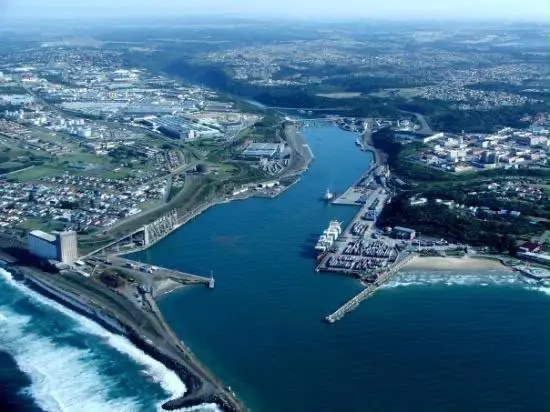
The ANC heads to its traditional final rally before elections, Siyanqoba, on Sunday at the Sisa Dukashe Stadium in Mdantsane, KuGompo in the Buffalo City Metropolitan Municipality facing the real prospect of another coalition government.
Buffalo City is the smaller of the Eastern Cape’s two metros, the other, Nelson Mandela Bay, lies just less than 300 kilometres south, and has been run through a coalition led by the ANC and included the EFF, National Alliance (NA), Defenders of the People, the PAC, African Independent Congress with the backing of the United Democratic Movement (UDM).
In the 2021 local government elections, the ANC won Buffalo City outright and obtained 59.4% of the vote but while the DA has no mayoral candidate for the metro, the EFF and the UDM are confident of a good showing.
UDM deputy president and Member of Parliament Nqabayomzi Kwankwa is the party’s mayoral candidate for Buffalo City and he indicated that should they receive an outright majority, he will resign from the national legislature and lead the municipality.
“If that does not happen, we will depend on a coalition government. We will do an assessment, we will enter any talks about forming a coalition if there is no party with an outright majority,” he said.
Kwankwa explained that his position after the municipal polls will solely depend on the outcomes of the post-election negotiations, should no party win Buffalo City decisively.
The UDM also campaigned in the King Sabata Dalindyebo Local Municipality, which includes party leader Bantu Holomisa’s hometown of Mqanduli.
EFF Buffalo City mayoral candidate Mkhululi Dlevu said the party was running a race to be number one.
“There will be an outright winner, that winner will be EFF,” he said.
ANC Dr. W.B. Rubusana (Buffalo City) regional secretary Anele Lizo did not respond to several requests for comment this week.
While the DA has no mayoral candidate in Buffalo City, in Nelson Mandela Bay it is fielding former mayor Retief Odendaal, who was removed in 2023 in a motion of no confidence submitted by the ANC and the EFF.
Odendaal was replaced by NA president Gary van Niekerk, who is now deputy mayor.
Van Niekerk was mayor until 2024 when he resigned and swapped mayoral chains with his then deputy and current mayor Babalwa Lobishe.
Lobishe, who is also ANC Nelson Mandela Bay regional chairperson, the region’s deputy secretary Nontombi Nama as well as controversial national executive committee member and former ANC Youth League deputy president Andile Lungisa have been nominated to be the party’s mayoral candidate in the metro alongside Xolani Vela.
However, the ANC dropped plans to announce mayoral candidates before the elections despite promising to do so across the country.
But Lungisa this week insisted he was the ANC mayoral candidate for Nelson Mandela Bay.
“I’m campaigning as a mayoral candidate as announced in Sandton,” he said, referring to the event held in August at the Sandton Convention Centre.
Lungisa added: “We are campaigning, we continue to ask the people of Nelson Mandela Bay to vote for the ANC”.
Earlier this month, the Gauteng High Court, Johannesburg ordered the ANC to reinstate Lungisa’s candidacy after secretary-general Fikile Mbalula removed him from the proportional representation list for Nelson Mandela Bay and the decision was declared unconstitutional, unlawful, invalid and of no force or effect.
Judge Nelisa Mali directed that Lungisa’s name be submitted as part of the ANC’s supplementary list after the elections.
Mbalula had informed the former Nelson Mandela Bay councillor that he failed to attend the vetting process for ANC candidates and that he was required to provide the record of the expungement of his criminal record after his conviction for assault with intent to cause grievous bodily harm for hitting DA councillor Rano Kayser with a glass jug during a heated council meeting in 2016, a crime for which he was sentenced to two years in prison.
The ANC’s current ally in Nelson Mandela Bay, van Niekerk, said the NA was confident that it would grow significantly beyond its current three seats.
Van Niekerk’s party is the third biggest in the ANC-led coalition government.
“Over the past term, our boots-on-the-ground approach has resonated deeply across the metro, not just in our traditional strongholds like the Northern Areas, but right across the wards. Residents have seen our track record; no gimmicks, just visible service delivery and constant presence in their communities,” van Niekerk added.
Northern Areas in Gqeberha refers to predominantly Coloured townships and suburbs created through the apartheid regime’s implementation of the Group Areas Act, which uprooted thousands across the country into segregated neighbourhoods.
Van Niekerk said the NA was experiencing energy on the ground daily, which showed that voters are ready to reward good work ethic over political slogans.
On whether he wants to return as deputy mayor or become mayor, he said the NA was contesting these elections to lead and to serve, not just to hold positions for the sake of it. “Whether I serve as mayor, deputy mayor, or in any other executive capacity will ultimately be determined by the mandate the voters give us on November 4 and the subsequent council vote. What I can guarantee you is that the NA will remain a central, decisive pillar in the governance of Nelson Mandela Bay,” van Niekerk stated.
According to van Niekerk, the NA’s position on coalitions has always been grounded in coalition realism and uncompromising service delivery.
“We do not enter discussions with ideological blinders or emotional baggage. We have shown that we can engage constructively across the political spectrum when it serves the residents of this city.
However, any potential coalition partner, whether the ANC, the DA, or any other party, must commit to two non-negotiables: zero tolerance for corruption and strict performance accountability for municipal administration. We will not sit in a government that sidelines poor communities or protects underperforming officials,” he said.
Dr Ongama Mtimka, acting director of the Raymond Mhlaba Centre for Governance and Leadership in the Nelson Mandela University’s Faculty of Humanities, told the Mail & Guardian that the internal drivers of loss of support for the ANC, including internal conflicts that cripple its campaign, and the external factors, such as, challenges in the quality of services delivered put it on a constrained growth trajectory.
Mtimka said the ANC is unlikely to recover lost ground.
Meanwhile, one of the four Eastern Cape local municipalities in which the ANC failed to timeously submit candidates, Port St. Johns, axed its mayor Cebisa Mazuza two weeks before the elections and replaced her with the party’s sub-regional chairperson, Nelson Nontlevu.
Mazuza is among the five ANC mayoral nominees alongside another former mayor Nomvuzo Mlombile-Cingo, Mamba Ncoyini, Ntombifikile Ngamlana including Speaker and ANC sub-regional secretary Eric Sicoto .