


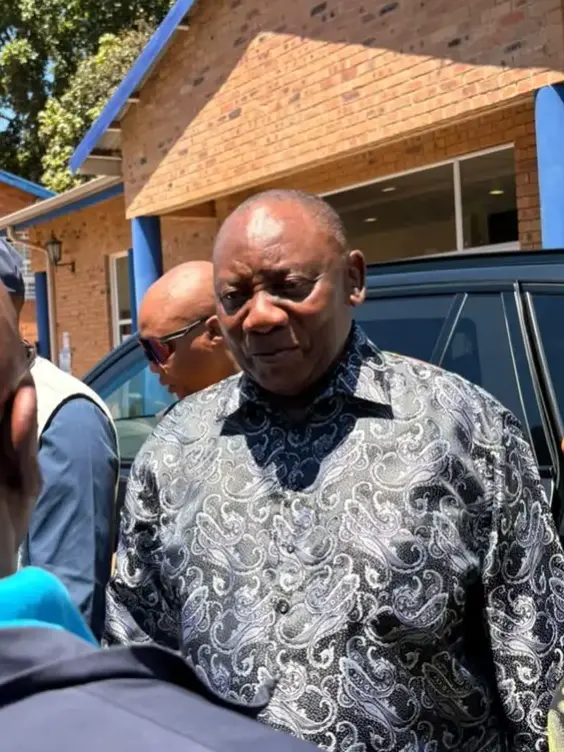
President Cyril Ramaphosa has acknowledged the persistent service delivery challenges facing Johannesburg and municipalities across the country, admitting that residents continue to struggle with water shortages, poor waste management and disruptions to essential services.
Speaking after casting his vote at Hyde Park High School in Johannesburg on Wednesday, Ramaphosa said service delivery was at the centre of the 2026 Local Government Elections, acknowledging that local governments needed to do more to meet the expectations of communities.
He acknowledged the rubbish accumulating on roads, municipal strikes, workers’ concerns and water shortages in different parts of the country as some of the problems affecting residents. He said efforts were being made to increase water supply to areas experiencing shortages but acknowledged that it was worrying and frustrating for people to go without water.
For many households, access to water, electricity, proper roads and reliable refuse collection is not an abstract political promise but a daily concern. These are also some of the issues that local government is expected to address, making the performance of municipalities an important consideration for voters.
Ramaphosa said the government was determined to rebuild local government structures and improve the way municipalities function. He expressed confidence that the elections would bring in a new group of councillors who would be more committed to serving communities, regardless of their political affiliation.
He said councillors needed to recognise that their responsibility was to the people they represented and that the newly elected councils should mark the beginning of a different approach to governance.
The president said the new councils would be inaugurated in the coming days, expressing hope that this would open a new chapter of better governance and service delivery. He added that government wanted to ensure that the promise of a better life, as outlined in the National Development Plan, became a reality for ordinary South Africans.
However, the challenges facing Johannesburg are not limited to the availability of basic services. Hyde Park resident Thamaga Ramofi said ageing infrastructure, political instability and coalition politics were among the factors affecting the city’s ability to deliver services consistently.
Ramofi said changes in municipal leadership and disagreements within coalitions could delay important decisions, including the approval of budgets, ultimately affecting the implementation of projects. He argued that instability at leadership level could have consequences for communities waiting for services and infrastructure improvements.
He also raised concerns about the vandalism and theft of public infrastructure, particularly equipment used to operate traffic lights. While acknowledging that some infrastructure was old and needed replacing, he said the government also needed to take responsibility for ensuring that public infrastructure was protected and that those responsible for damaging it were held accountable.
Ramofi said residents were sometimes left uncertain about which sphere of government was responsible for particular services. He argued that this confusion could make it difficult for communities to hold the right institutions accountable, while political parties could campaign on issues that did not necessarily fall within municipal responsibility.
His comments point to a wider challenge facing voters during local government elections: knowing which leaders and institutions should be held responsible when services fail, and whether those elected will be able to address the problems affecting their communities.
Alongside service delivery, Ramaphosa also renewed his call for action against gender-based violence, urging men to stop abusing women and take responsibility for changing behaviour that continues to put women at risk.
He said protecting women required more than having laws in place, stressing that these laws and the support available to victims needed to work effectively at police stations, in courts, public spaces and homes. He said victims needed to be able to access assistance and protection, while the country’s institutions had to respond more effectively to cases of abuse.
Ramaphosa said the government had been increasing police numbers over the past three years and would continue doing so to strengthen visible policing. He also pointed to additional funding allocated towards addressing gender-based violence, with further resources expected to be considered in the next national budget.
Ramofi described gender-based violence as an issue that South Africans needed to take seriously, regardless of gender. He called on men, particularly husbands and partners, to find better ways of communicating rather than resorting to violence. He also said that women who perpetrate abuse should be held accountable.
Despite acknowledging the challenges facing local government, Ramaphosa described the election turnout as encouraging and a sign that democracy remained active.
“This is democracy at work. And this is what our people wanted to see. That indeed, what the Freedom Charter writers said, that the people shall govern, is what we are seeing today,” he said.
He urged South Africans who had not yet voted to participate, saying citizens had both rights and responsibilities in determining the future of their municipalities.
For voters, however, the significance of the elections will ultimately be measured not only by the turnout, but by whether the promises made during the campaign translate into improvements in their everyday lives.