


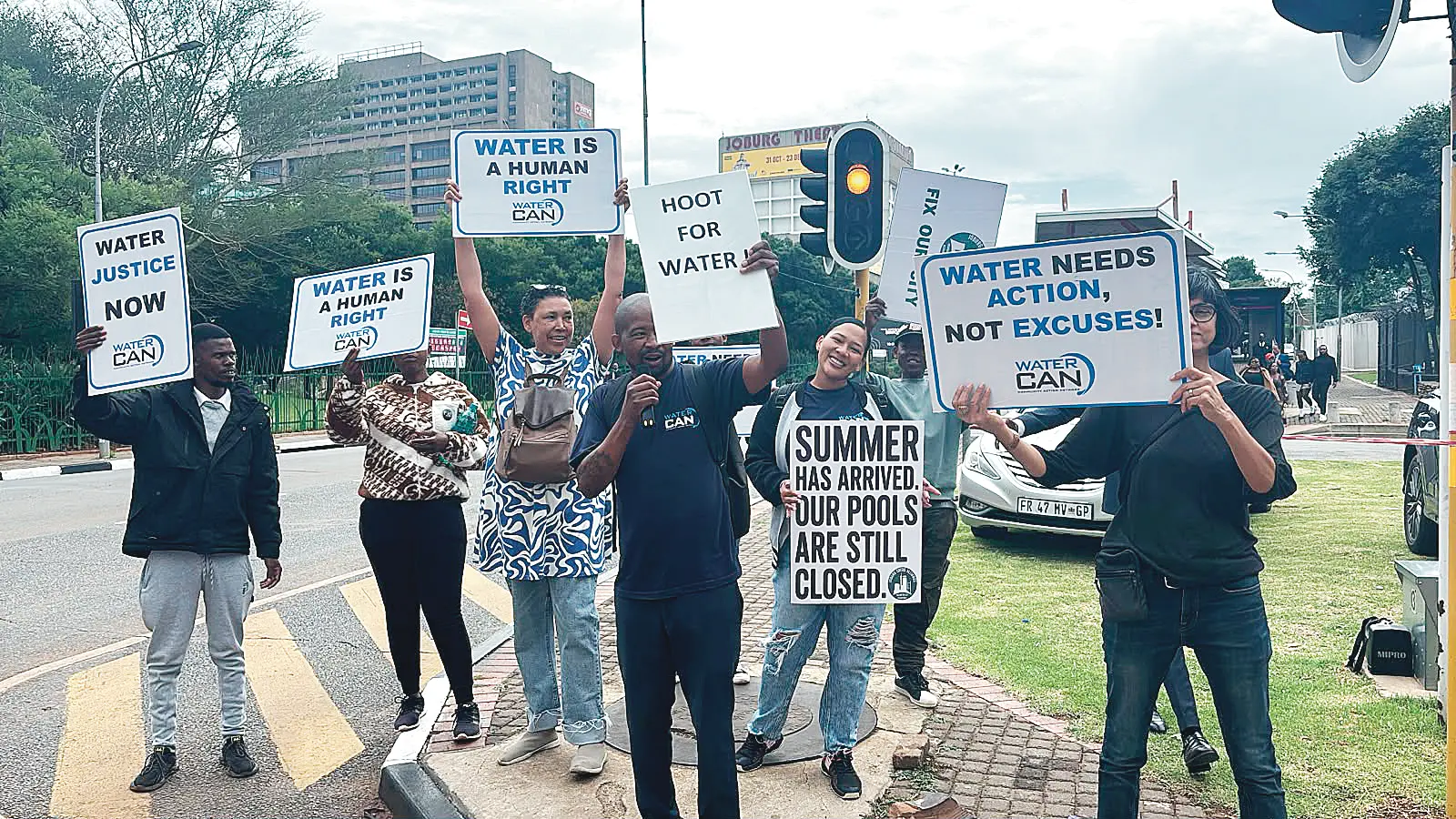
While politicians jostled over positions, Johannesburg residents were fighting for something far more basic this week: water.
The People’s Water Forum protested outside the Constance Conny Bapela Council Chamber on Monday, as coalition negotiations delayed the election of senior office-bearers, including the executive mayor.
The next council meeting is scheduled for Friday.
Johannesburg’s political leaders have spent days arguing over who gets which position, said Dr Ferrial Adam, the executive director of WaterCAN, a member of the People’s Water Forum.
“In parts of the city, families still have to plan their days around when they can get water. When do those families become the priority?”
“Our protest wasn’t about any particular political party,” added Ingrid Bester of the Water Crisis Committee (WCC).
“It was about putting water firmly on the new council’s agenda and reminding those elected to represent us that their responsibility is to the people of Johannesburg, regardless of their political differences.”
Johannesburg needed mature, informed leadership, Bester said, with political disagreements not allowed to come at the expense of service delivery.
Residents needed properly funded infrastructure, meaningful oversight and action, rather than more promises or political finger-pointing.
“Residents cannot keep being expected to adapt to a failing water supply system,” she said, pointing out that water tankers were emergency relief, not an alternative water network.
“We want reliable water flowing through our taps and we want to see the new council treating that as an urgent priority from day one.”
For residents, the crisis was not an abstract political debate.
It meant waking up unsure whether there would be enough water to wash, cook, clean and get ready for work or school. Businesses struggled to operate, schools faced basic sanitation challenges and elderly people who could not carry buckets were left particularly vulnerable.
“We see communities spending hours trying to establish what’s happening, reporting the same problems repeatedly and trying to find out when a tanker might arrive.”
Residents did not care which party got the credit for fixing the problem, Bester said.
“They want the people elected to govern Johannesburg to work together and actually deliver. Water is not a political luxury. It’s a basic service and a basic human need.”
The city’s problems were well understood, including ageing infrastructure, water losses, leaking pipes and illegal connections.
The failure lay in the gap between knowing what needed to be done and implementing it, she said.
“We don’t necessarily need another plan. We need to fund the work, implement the plans and hold people accountable for delivery.”
The city’s water crisis had been compounded by political instability, changes in municipal leadership and years of underinvestment, said Anja du Plessis, an associate professor and water management expert at Unisa.
Johannesburg Water’s 2026/27 business plan showed that investment was lower than it had been 15 years ago, pointing to a prolonged decline across successive administrations. Capital programmes required years of consistent implementation, but priorities and portfolios were repeatedly reshuffled when leadership changed, she said.
Du Plessis said the crisis involved resource constraints, failing infrastructure, municipal governance and political leadership, with each reinforcing the others.
Johannesburg Water puts its infrastructure renewal backlog at R26.4 billion, compared with proposed capital expenditure of R1.96 billion for 2026/27.
Adam said binding water commitments should be included in coalition agreements, municipal budgets and performance plans and made public. Those should include a funded programme to repair and replace infrastructure, with budgets, deadlines and officials responsible for each project.
Successive administrations had allowed maintenance and pipe replacement to fall severely behind, with water becoming a political priority largely around election cycles, Adam said.
She called for stronger safeguards against corruption in procurement, greater transparency and accountability when things went wrong.
The incoming council also needed to protect funded projects through leadership transitions, audit internal technical capacity and fill critical vacancies with qualified permanent staff. There should be a clear separation between politicians and officials so that work could continue when political leadership changed.
The city, through Johannesburg Water, remained the primary water services authority and should be directly answerable to residents, Adam said.
Johannesburg Water managed the local network, including repairs and maintenance, while Rand Water supplied bulk water and the Department of Water and Sanitation provided regulatory oversight and strategic planning.
But the scale of the crisis required a coordinated response from all those institutions, as well as from the national government.
“Their different mandates should not become an excuse for avoiding responsibility or delaying solutions. Residents needed collective leadership, not institutional finger-pointing.”
The incoming executive should present a fully funded and prioritised repair plan at an open council meeting, with clear timelines, budgets and named officials responsible for delivery.
“Access to safe, reliable water is a fundamental right. All prospective coalition parties must publicly agree to these core commitments prior to taking office and vote accordingly on municipal budgets.
“In practice, coalition partners must be held collectively accountable so that residents no longer have to structure their daily lives around uncertain water access.”
Bester said water shortages were being reported across the south, east and central parts of Johannesburg, as well as in Protea Glen, Melville, Mayfair and Sundowner. Some communities faced prolonged pressure-related problems, while others experienced infrastructure failures and repeated interruptions.
She cautioned that neighbouring streets could have very different experiences and that there was no verified, consolidated dataset to rank the worst-affected communities.
The crisis also exposed inequalities between households able to afford storage tanks, pumps and alternative water supplies and those without such resources. “Residents and businesses cannot conserve their way out of infrastructure failure.”
Level 2 water restrictions came into effect across Johannesburg on 21 November, after demand exceeded the available treated water from Rand Water and put pressure on the bulk supply system.
Johannesburg Water said consumption needed to fall by 200 million litres a day to help reservoirs recover and stabilise supply.
The restrictions also bring higher water tariffs, which take effect on 1 December.
Johannesburg Water spokesperson Nombuso Shabalala said the city continued to experience increased pressure on its water supply system.
“This is due to rising temperatures, which have been exacerbated by El Niño.”
This also placed additional pressure on the city’s water resources and supply systems because of higher consumption as a whole.
“The whole city is impacted by this,” she said. “Johannesburg Water is therefore experiencing significant strain on its water supply systems due to high consumption.
“This increased demand is placing pressure on the bulk water supply system and affecting the ability of reservoirs and towers to maintain sufficient storage.”
Shabalala said that managing the available water resources efficiently was critical to maintaining a reliable supply. The entity was implementing short-, medium- and long-term measures to reduce water losses, including repairing leaking reservoirs and towers, replacing ageing pipelines, meters and valves, and conducting leak detection.
It was also using pressure management to reduce bursts and leakage, while strengthening maintenance teams and introducing a field service management system to improve responses to service complaints.
Bester supported restrictions to reduce demand, particularly while the supply system was under pressure and the current El Niño event added another climate risk.
But she warned against confusing demand management with failures in the city’s ability to deliver water.
“There is a difference between being asked not to water your garden and having no water for days or weeks because your local supply system cannot deliver.”
Restrictions also needed consistent enforcement, including against illegal consumption, rather than focusing only on residents watering gardens or washing cars.
Within the incoming mayor’s first 100 days, the WCC wants to see which critical infrastructure projects are funded, what is being repaired, who is responsible and when the work will be completed.
It also wants a programme to address leaks, water losses, illegal connections and bypassed meters, alongside greater transparency on funding and progress.
Johannesburg needed a different political tone, Bester said.
“Councillors can disagree. They can challenge one another and hold one another accountable. That’s democracy.
“But they need to stop throwing insults across the council floor and start concentrating on what residents, businesses and schools urgently need now.”