


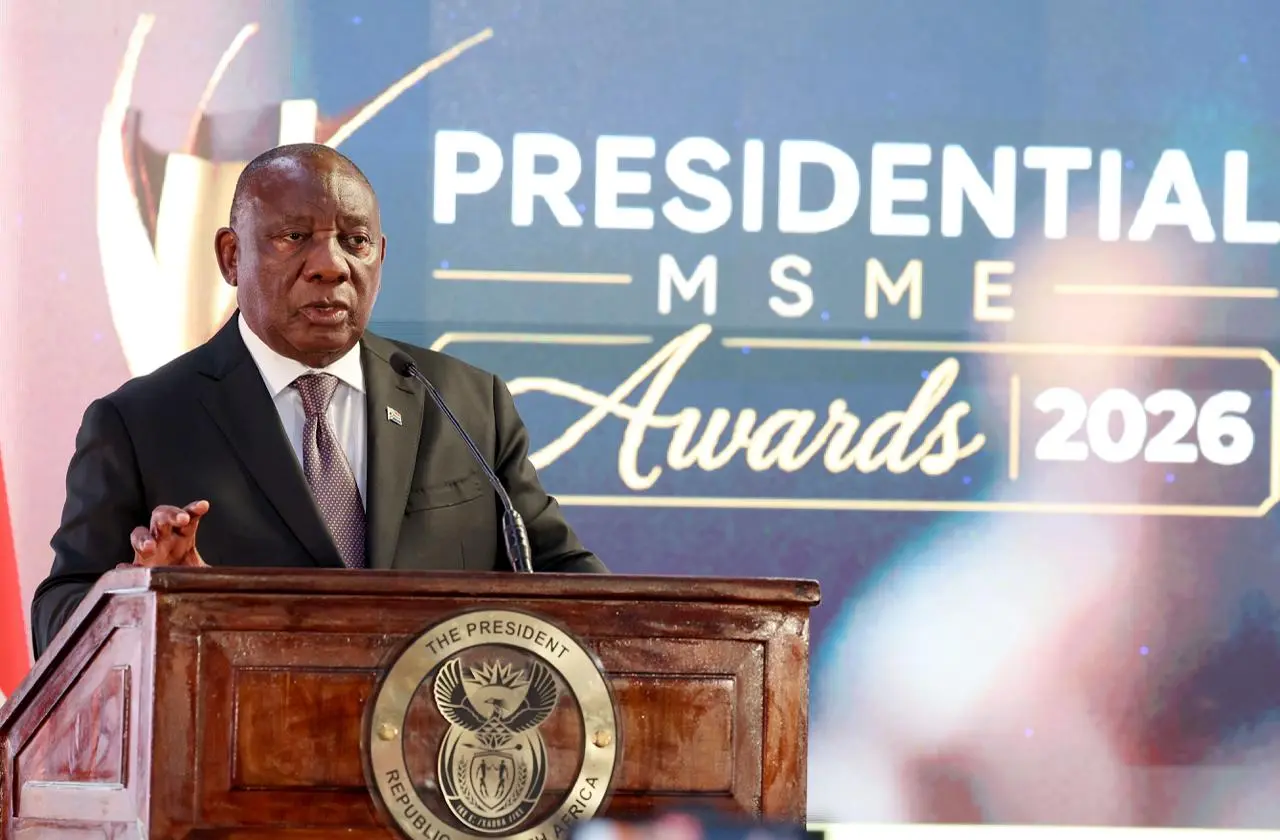
Determined to clear government bureaucratic barriers and urging private financial institutions to assist in making starting a business easier, President Cyril Ramaphosa has expressed confidence in the growth of the micro, small and medium enterprises (MSMEs) in South Africa.
In this year’s State of the Nation Address, Ramaphosa committed more than R2.5 billion in funding to over 180 000 MSMEs - alongside a further R1 billion in credit guarantees.
Addressing a business gathering in Sandton on Thursday - ahead of the 2026 MSME and Cooperatives Presidential Awards to take place in the evening at the Birchwood Hotel in Boksburg – Ramaphosa conceded that the sector faced a myriad of challenges.
He said sector representatives raised several issues - including access to finance, markets, being hampered by regulatory constraints and support needed to grow and sustain MSME businesses.
Issues, said Ramaphosa, needed to be foremost in the National MSME One Plan championed by Small Business Development Department Minister Stella Ndabeni “and be part of our broader programme of reforms”.
“Your experiences must continue to inform our policies, our programmes and our decisions. We commend the minister and her team for their commitment to recognising and supporting entrepreneurship. Since the Presidential MSME and Cooperatives Awards were introduced in 2022, we have seen remarkable enterprises emerge across a wide range of sectors,” said Ramaphosa.
“Thank you for your frankness and constructive spirit. I sensed a real urgency to put small businesses on a higher trajectory. Now in its fourth edition, the programme has become an important platform for recognising excellence and giving visibility to small enterprises. This year’s nominees reflect the diversity of entrepreneurial talent in our country. We see strong representation of women, young people and persons with disabilities. We see entrepreneurs from townships and rural areas who have succeeded despite barriers to finance, infrastructure and markets. We see enterprises in agriculture, manufacturing, financial services, technology and the green economy. They remind us that entrepreneurial ability is spread widely across our society. Our collective task is to ensure that this ability translates into enterprises that grow, employ more people and add to our nation’s prosperity,” he added.
A wide range of businesses in the MSME sector have been nominated for the prestigious award.
Ramaphosa said around R890 billion in investments was pledged at the South Africa Investment Conference earlier this year.
“These are welcome commitments, but we will not see sustainable economic change if small businesses are left behind. We know that many entrepreneurs still face significant barriers, with finance remaining hard to secure. Access to markets, infrastructure and technology is uneven,” he said.
Through the Department of Small Business Development and finance agencies, the government was working to remove constraints.

Said Ramaphosa: “We are also strengthening our partnership with the private sector. We extend our sincere appreciation to Absa, which has walked this journey with us and once again supports the Presidential Awards. We thank Huawei and the Wholesale and Retail SETA for their support of this year's awards. We encourage more companies to follow their example through supplier development, procurement, mentorship, technology transfer and access to finance.”
South Africa was “living through a period of profound technological change”.
“Artificial intelligence, advanced computing and automation are reshaping industries and creating new opportunities. During my recent engagements in Silicon Valley, I met some of the world's leading technology companies and innovators. One lesson stood out: innovation thrives where research is supported, investment is mobilised and entrepreneurs can bring their ideas to market. South Africa has many of these capabilities. Access to computing power can be one of the greatest levellers for small enterprises.
“That is why we are seeking to mobilise public and private resources to finance computing power dedicated to small enterprises. We plan to use development finance institutions, including the Small Enterprise Development and Finance Agency, to crowd in early-stage venture capital. We want to build partnerships with universities to establish centres of excellence in artificial intelligence and connect start-ups to a seamless system of support. Our ambition is to make South Africa a leading centre for artificial intelligence on the African continent. Small businesses must be at the heart of that ambition,” maintained Ramaphosa.
He said many award nominees built their enterprises under difficult circumstances.
He said: “They have navigated uncertainty, overcome financial constraints, built markets and earned the confidence of customers. Through determination, innovation and hard work, they are making a meaningful contribution to our economy. I congratulate each of you here on your nomination. I hope you will share your knowledge with other entrepreneurs, particularly young South Africans who are thinking of starting their own businesses. We need a society where successful businesspeople become mentors to those who follow. As we continue this conversation, we must ask what more we can do together. How do we make it easier for promising enterprises to access finance? How do we ensure that small businesses win a greater share of public and private procurement? How do we strengthen the links between established industries and emerging enterprises? And how do we prepare our entrepreneurs to take advantage of new technology and the African Continental Free Trade Area? South Africa's economic future will be shaped in no small measure by businesses like yours. Let us make it easier to start a business. Let us make it easier to grow one. And let us ensure that every entrepreneur with a good idea has a seat at the table.”
According to the National Development Plan forecast, 11 million additional jobs, with around nine million, are expected to emerge from small and expanding firms - creating by 2030.

“This is possible in a country like ours, which has around three million owners of micro, small and medium enterprises. This is a part of the economy that has enormous potential to expand production, strengthen local value chains, increase exports and create jobs on a far greater scale. I would like to see more of our small manufacturers supplying major industrial companies. I would like to see township enterprises grow into businesses that operate across provinces and across our continent. And I would like to see more South African technology companies developing solutions that are adopted around the world,” he said.
Ndabeni said the Department of Small Business Development received a budget allocation of R3.036 billion, of which R2.154 billion was allocated to transfers and subsidies - including R1.899 billion to the Small Enterprise Development and Finance Agency.
Said Ndabeni: “Our ambitions of growing the economy, addressing inequality and building a more inclusive and globally competitive South Africa cannot be realised without a thriving small business sector. In fulfilling this commitment, we continue to prioritise women and youth-led enterprises - as part of our broader economic empowerment and transformation agenda.”
She said it was under Ramaphosa’s leadership that the government, through the minister of Finance, increased the compulsory VAT registration threshold from R1 million to R2.3 million – “a significant victory for small businesses, reducing their administrative and regulatory burden”.
“These are indeed tangible actions towards creating an enabling environment in which small businesses can thrive. We continue to leverage partnerships with development finance institutions and financial partners to mobilise additional resources through co-funding, blended finance, credit guarantees and wholesale lending facilities. Since April 2023, our credit guarantees have unlocked R3.83 billion in financing from partner institutions, of which R730 million benefited women-owned businesses. Through our wholesale lending facilities to microfinance intermediaries, women-owned enterprises received R2.02 billion - representing 94% of microfinance disbursements. We are also making development finance more accessible and affordable, through selected funding programmes offering interest rates as low as 5%, blended finance - repayment terms of up to 60 months and repayment moratoriums of up to six months. We however, recognise that access to finance alone is not enough. It must be complemented by quality business development services, access to markets and post-investment support to enable enterprises to grow sustainably. These resources are instrumental in advancing our Medium-Term Development Plan commitment to support one million enterprises by 2030.”
The MSME sector makes up about 90% of the country’s businesses - contributing around 30% to 34% of the gross domestic product and accounting for up to 60% of employment.