

SummaryOpen the quick read
The DEVAC Infrastructure Summit highlighted the urgent need to move infrastructure projects from planning to implementation, with speakers emphasising financing, execution capacity and public-private collaboration
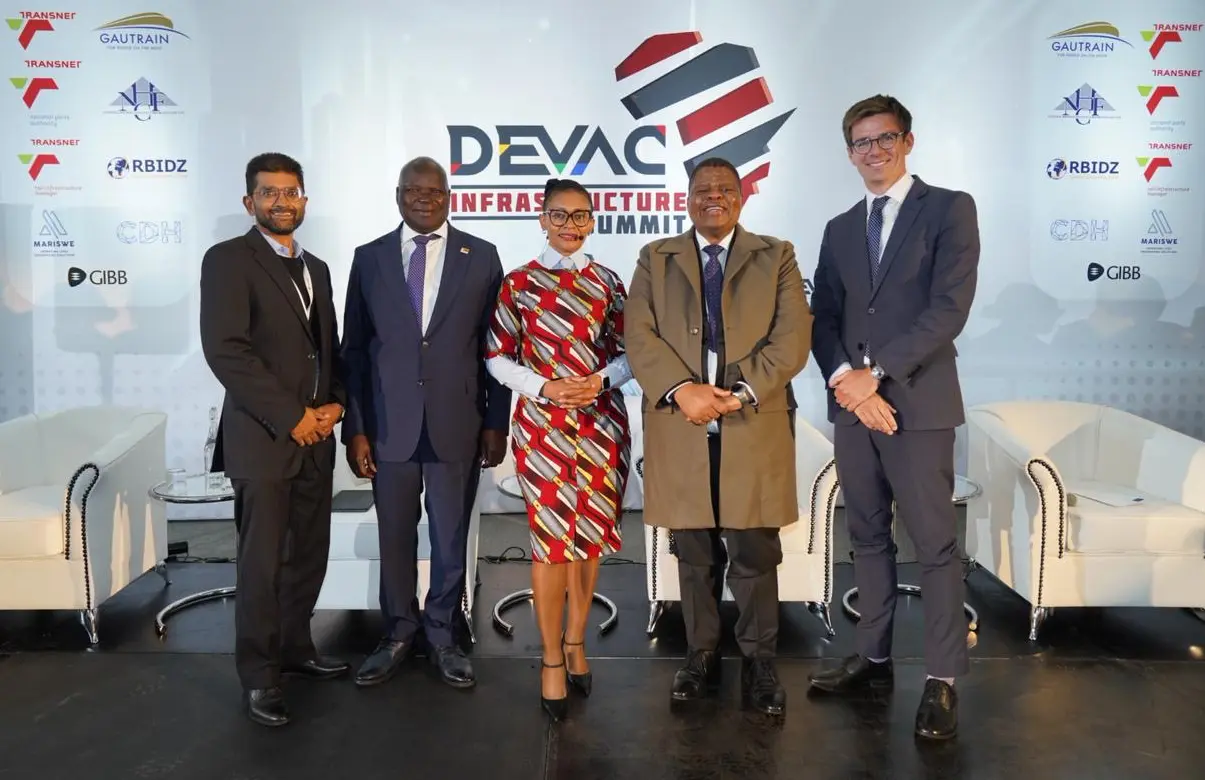
The 2026 DEVAC Infrastructure Summit, held in partnership with the Mail & Guardian on 27 and 28 May, convened global and local leaders at the Protea Hotel, Johannesburg. The conference tackled critical infrastructure problems, focusing on strategic solutions to ensure projects are delivered on schedule and within budget.
Discussions emphasised a strategic shift from simply announcing infrastructure projects to driving them towards active implementation, operational stability and the tangible delivery of reliable services that enhance economic productivity and the daily lives of people.
Furthermore, this annual strategic meeting unites African government officials, industry leaders, infrastructure investors and technical experts to collaborate on actionable, solution-driven execution.
Centred on the theme ‘Africa’s Infrastructure in Motion – From Projects to Progress’, this initiative directly addresses one of the continent’s most critical problems and significant opportunities.
It was highlighted during dialogue sessions that Africa does not suffer from a shortage of infrastructure plans, but the greater challenge lies in project preparation, financing, implementation capacity and long-term sustainability.
In his keynote address, Deputy Minister of Water and Sanitation David Mahlobo emphasised that infrastructure remains a vital catalyst for driving industrialisation, advancing regional integration, stimulating investment and unlocking economic growth.
Mahlobo said no modern economy can function efficiently without reliable infrastructure. He pointed out that roads, rail networks, ports, energy systems, digital connectivity, water infrastructure and sanitation systems form the productive backbone of every society because they enable mining, manufacturing, agriculture, logistics, housing development, tourism and trade, creating conditions for investment certainty.
South Africa has effectively resolved load-shedding through decisive reforms, regulatory changes and strengthened public-private partnerships. Building on this success, Mahlobo emphasised that the same collaborative and strategic approach will be applied to overcome the nation’s current water infrastructure and supply challenges.
The department of water and sanitation has allocated approximately R12.3 billion in the current financial year through municipal infrastructure grants to drive water and sanitation delivery. This funding supports 70 regional bulk infrastructure grant projects and 341 water services infrastructure grant projects, with roughly 175 projects targeted for completion this year.
Zimbabwe’s Minister of Energy and Power Development, July Moyo, said policy in action is critical and that governments must turn commitments into groundbreaking projects.
“Our focus extends beyond mere vision to the delivery of tangible outcomes, transitioning from theoretical agreements to physical infrastructure,” Moyo stated, adding that to attract investors and developers who prioritise certainty, speed, scale, policy clarity and regional integration, Africa must reframe its narrative.
“We are not a high-risk frontier, but a premium, high-return growth market. This strategy aligns with Zimbabwe’s overarching national mandate of achieving upper-middle-income status by 2030,” he added.
“Achieving universal energy access by 2030 is theoretically possible, but highly challenging. It requires overcoming severe financial and infrastructural deficits. Without drastically accelerated, targeted interventions, millions will remain unserved,” Moyo added.
According to Moyo, Africa has made commendable strides, with millions of households connected and renewable capacity expanded.
Moyo emphasised that although regional power pools are expanding, more than 600 million Africans remain without access to electricity, underscoring a critical infrastructure gap.
“To bridge this divide, stakeholders are prioritising targeted financing mechanisms, public-private partnerships (PPPs) and decentralised energy systems to ensure equitable power distribution across the continent,” he noted.
Transnet National Ports Authority (TNPA) chief executive Mohammed Abdool also participated in a panel discussion on the future of Africa’s infrastructure development.
During his presentation, he outlined TNPA’s infrastructure investment pipeline and strategic partnerships and emphasised the organisation’s focus on building a resilient port system through enhanced operational efficiencies, robust rail-to-port integration and sustainability initiatives designed to drive long-term trade and economic growth.
Vuyokazi Nomvalo, head of infrastructure fund at the Infrastructure Finance and Implementation Support Agency (IFISA), shared during discussions that many African infrastructure projects fail to attract private-sector funding because they lack bankability, meaning the risks are not properly allocated or mitigated. She said that to close the funding gap, there is a critical need to structure better project preparation frameworks and implement blended-finance models that share risks between public and private stakeholders.
“That’s one of the key aspects that we have to focus on, de-risking the projects, make sure that the risks are allocated to the party best suited to manage the risk, and then make sure that also we’ve got clear implementation frameworks and strategies,” she said, adding that one of the things funders look at is whether the project is bankable and how it will be implemented.
Presenting further on successful alternative financing models that offer viable, non-traditional solutions to conventional debt-reliant capital structures, Nomvalo stated that there are several, including the one the government has developed: the credit guarantee vehicle, which aims to address risk where the public and private sectors are still not comfortable participating in a project.
“So, ideally, when we look at structuring transactions, we use fiscal funding, but we want to minimise the use of fiscal funding because it’s constrained. We have to look at innovative ways of trying to bridge the viability gap that is there and then use public-sector funding. And that’s looking at the various sources of funding that are there, even from a government perspective.”
Panellists acknowledged that although the Medupi Power Station project faced critical challenges, the Gautrain stands as a defining flagship success that has fundamentally transformed South Africa’s infrastructure landscape.
Zeenat Ghoor, director at Aspire Consulting Engineers, emphasised that the Gautrain initiative has successfully broadened accessibility and unlocked significant opportunities for public transport commuters.
“I think expanding the Gautrain model can serve as a catalyst for developing an inclusive national public transport system in South Africa. While the Gautrain currently provides a premium service for middle- to upper-income commuters, scaling this efficient infrastructure and integrating it with broader metropolitan networks can help establish reliable transit options that benefit all economic classes,” she highlighted.
On the issue of balancing the speed of delivery with transparency, community consultation and environmental safeguards, Ghoor said: “Community engagement and transparency are the best ways to build trust, ensure project buy-in and clearly demonstrate your commitment to environmental responsibility alongside financial goals.”
His Majesty’s Trade Commissioner for Africa, Ben Ainsley, whose role is to increase trade and investment from the UK and UK companies into Africa, highlighted that conferences such as this one are important because they bring together the public sector, the private sector, policymakers, financiers, industry leaders and others to have honest conversations about challenges while also celebrating successes.
Ainsley noted that there are many geopolitical wins at the moment.
“What I felt in that room is that business and government were focused on delivering deals, thinking about opportunities and finding solutions despite the geopolitical wins. There is a real appetite to continue working closely with the UK on these opportunities, be it from a financing perspective or a supply-chain perspective, and thinking about how everyone can work creatively together.”
Ainsley pointed out that globally, whether in the UK, the US or Africa, infrastructure projects have faced challenges.
“I think what the UK actually does really well is our strength in the services sector around the infrastructure space. What we do particularly well is project management, cost management and time management,” he concluded.
