

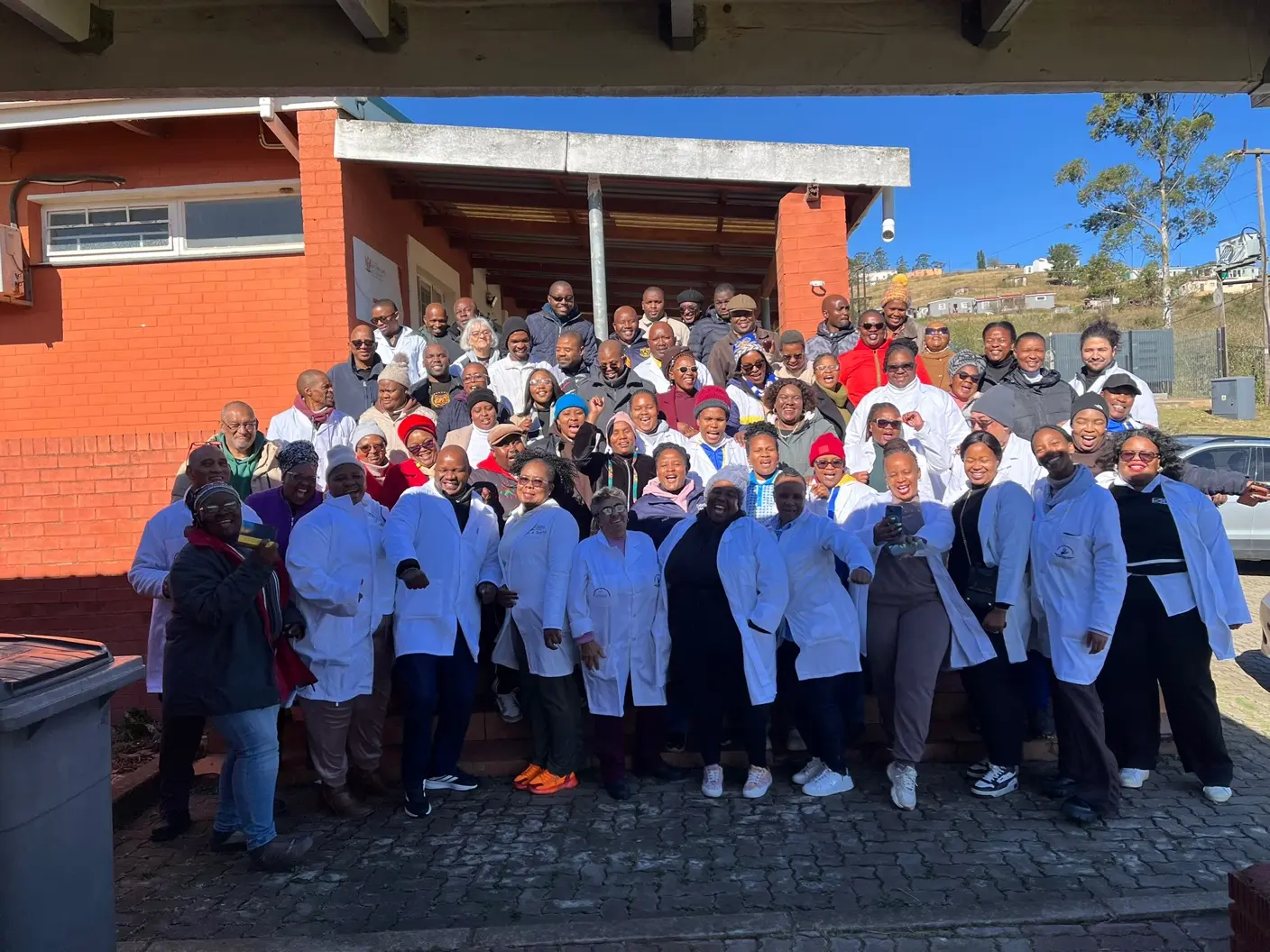
Nearly 60 Natural Sciences teachers from the Amathole East Education District in Eastern Cape are strengthening their ability to inspire scientific curiosity and critical thinking in classrooms through an innovative inquiry-based science education programme.
The three-day programme, presented by Advancing Knowledge NPC (AK NPC) at the district offices in Butterworth from 30 June to 2 July 2026, equipped Intermediate and Senior Phase teachers with practical strategies to transform Natural Sciences lessons from the memorisation of facts into opportunities for investigation, discovery, and problem-solving.
The programme formed part of the South African Council for Educators (SACE)-endorsed short course, Inquiry-Based Science Education (IBSE01), allowing teachers to earn Continuing Professional Teacher Development (CPTD) points while developing classroom-based scientific teaching skills. The voluntary participation of teachers during the mid-year school vacation reflected their commitment to improving science education and learner outcomes.
Inquiry-based science teaching places questioning and practical investigation at the centre of learning. Instead of simply providing answers, teachers are encouraged to guide learners to ask questions, develop explanations, test ideas, collect evidence, and communicate scientific conclusions. During the programme, teachers experienced this approach first-hand through practical investigations across the four Natural Sciences knowledge areas: Matter & Materials, Energy & Change, Life & Living, and Planet Earth & Beyond.
SACE Provincial Coordinator Mr Tobani Mlokoti, who monitored several sessions, praised the programme’s implementation and the active involvement of teachers in inquiry-based activities. He highlighted the professional manner in which the course engaged teachers with Natural Sciences content and practical teaching approaches.
Ms Lizeka Mpoposhe, Head of Curriculum at the Amathole East Education District, emphasised the importance of the partnership between the district and AK NPC in supporting teachers and strengthening Natural Sciences education.
Prof Shaheed Hartley, Academic Head of Advancing Knowledge NPC, encouraged teachers to apply the inquiry skills developed during the programme in their own classrooms. “When learners investigate, question, and discover scientific principles for themselves, they become active participants in the learning process,” he said.
Ms Lulama Ntshaba, Manager of the Albertina Nontsikelelo Sisulu Science Centre, emphasised the importance of inquiry-based science teaching in strengthening teachers' practical understanding, scientific skills and classroom practice. She also reaffirmed the value of the partnership with Advancing Knowledge NPC in providing teachers with access to a SACE-endorsed professional development course.
The AK NPC facilitation team included Mr Robert Solomon (Physics), Prof Shaheed Hartley and Ms Zaiboenisa Ahmed (Chemistry), Mr Fadli Wagiet and Ms Dawn Faroe (Life Sciences), and Mr Andrew Firth and Mr Mark Ogilvie (Astronomy). They were supported by AK NPC science interns and support staff Somila Dlakavu, Siphiwuthando Qeqe and Melissa Petersen.

Inquiry-Based Teaching Sparks New Energy in Natural Sciences
Natural Sciences teachers discovered that learning about Energy and Change is most effective when learners investigate, experiment, and ask questions. During Advancing Knowledge NPC's energy and change session, intermediate and senior phase teachers explored practical, inquiry-based strategies to make physics concepts more engaging and accessible in the classroom.
Instead of relying on traditional demonstrations, teachers became investigators themselves. They designed and tested electric circuits, explored how changes in voltage, resistance, and current affect circuit performance, and examined energy transfer through conduction, convection, and radiation. Each investigation challenged participants to make predictions, collect evidence, and explain their findings using scientific reasoning.
Using inexpensive, everyday materials, teachers constructed simple cells, demonstrated electrical conductivity, and created classroom resources that can easily be replicated in schools. Senior Phase teachers also gained experience using multimeters to measure electrical quantities and investigated the effects of heat transfer and forces through carefully structured experiments.
The workshop modelled an inquiry-based approach that encourages learners to develop scientific thinking by observing, questioning, testing ideas, and drawing evidence-based conclusions. Throughout the sessions, teachers collaborated enthusiastically, debated scientific explanations, and reflected on how these investigations could transform their own teaching.
One group of participants noted that the practical activities would keep learners actively engaged and encourage them to become confident problem-solvers rather than passive recipients of information.
By placing inquiry at the heart of the Energy and Change knowledge area, the programme equipped teachers with practical classroom strategies that will help learners develop curiosity, critical thinking, and a deeper understanding of the scientific principles that shape the world around them.

Inquiry Brings Life & Living Lessons to Life
Teachers experienced the excitement of learning through inquiry during the hands-on Natural Sciences session focused on the Life & Living knowledge area. The session demonstrated how practical investigations can transform science lessons by encouraging learners to ask questions, investigate, observe, and draw evidence-based conclusions.
Participants enthusiastically engaged in a range of activities, including designing habitats, constructing food chains, preparing microscope slides, observing plant cells, testing leaves for starch, conducting food tests, and exploring chromatography. Senior Phase teachers followed the full inquiry process by collecting leaves, investigating photosynthesis, and analysing the presence of starch in different plant and food samples.
One of the workshop's highlights was the opportunity to examine real sheep lungs, a trachea, and a heart. By inflating the lungs through the trachea, teachers gained a vivid understanding of how the respiratory system functions. They also built models of internal organs, demonstrating how practical experiences make complex biological concepts easier to understand and teach.
Throughout the workshop, teachers shared ideas and reflected on how inquiry-based learning encourages curiosity, critical thinking, collaboration, and scientific reasoning. The activities were carefully designed using accessible materials, making them easy to replicate in classrooms and aligned with the Natural Sciences curriculum.
Teachers described the workshop as both practical and inspiring. One participant commented, "I enjoyed working with the microscope and learning how to prepare plant tissue slides. I now feel confident using the microscope at school." Another teacher remarked, "Practical work has just been given a new meaning."
The workshop equipped teachers with practical strategies to make Life & Living lessons more engaging, ensuring that learners actively investigate scientific concepts rather than simply learning about them.

Inquiry-Based Chemistry Inspires Natural Sciences Teachers
Natural Sciences teachers discovered that chemistry can be both practical and engaging during the final session of Advancing Knowledge NPC's professional development programme for Intermediate and Senior Phase teachers. The session focused on teaching the Matter and Materials knowledge area through an inquiry-based approach that places investigation, questioning, and evidence at the centre of learning.
Facilitated by experienced science educators, the session immersed teachers in hands-on investigations using everyday materials to explore concepts such as chemical reactions, chromatography, acids and bases, the properties of matter, and the strength of materials. Rather than simply learning scientific facts, participants experienced how learners can develop understanding by asking questions, making predictions, conducting investigations, and interpreting evidence.
Senior Phase teachers extended their learning by applying the scientific method to solve problems, evaluate hypotheses, and analyse experimental data. Practical demonstrations, including the preparation of gases such as oxygen, hydrogen, and carbon dioxide, provided valuable experiences that strengthen the foundation for Physical Sciences in the FET phase.
The session generated enthusiastic participation as teachers collaborated, debated scientific ideas, and reflected on ways to make chemistry more meaningful in their own classrooms. Participants agreed that the inquiry-based activities were practical, curriculum-aligned, and easily adaptable for everyday teaching.
One teacher reflected, "Using everyday substances to demonstrate chemistry will make my lesson preparation much easier. When learners conduct these investigations themselves, they become active participants in the lesson, which improves both learning and interest in Natural Sciences."
By modelling inquiry-based teaching, the session equipped teachers with practical strategies to transform Matter and Materials lessons into opportunities for exploration, critical thinking, and scientific discovery.

Inquiry-Based Learning Illuminates Planet Earth and Beyond
Teachers explored the wonders of astronomy and Earth science through hands-on, inquiry-based learning during the session of Advancing Knowledge NPC's Natural Sciences professional development programme. The workshop equipped Intermediate and Senior Phase teachers with practical strategies to make the Planet Earth and Beyond knowledge area more engaging and meaningful for learners.
Rather than simply presenting scientific facts, the workshop encouraged teachers to investigate, question, and explore concepts through practical activities. Participants examined the Earth's place in the Solar System and the wider universe, investigated the phases of the Moon, explored Mars missions and rover technology, created fossil casts to understand fossilisation, and experimented with balloon rockets to discover the principles of rocket propulsion.
Senior Phase teachers used astronomy software, including Stellarium and Celestia, to explore stars, planets, constellations, and galaxies. These digital tools, installed on teachers' laptops during the workshop, will enable them to create interactive, inquiry-based science lessons that encourage learners to observe, predict, investigate, and explain natural phenomena.
Teachers welcomed the opportunity to build their confidence in teaching astronomy, an area many felt had received limited attention during their own training. One participant commented, "We appreciate the practical activities that we can take back to our classrooms so that learners actively participate instead of simply listening to theory."
By modelling inquiry-based teaching, the workshop demonstrated how curiosity, investigation, and evidence-based learning can transform the teaching of Planet Earth and Beyond, inspiring both teachers and learners to explore the world—and the universe—with greater understanding and enthusiasm.
Teachers receive Inquiry-Based Science Education (IBSE01) certificates at the end of this SACE-endorsed course. You are welcome to contact Prof Shaheed Hartley (shartley@skatt.co.za), Academic Head of Advancing Knowledge NPC, should additional information be required.