

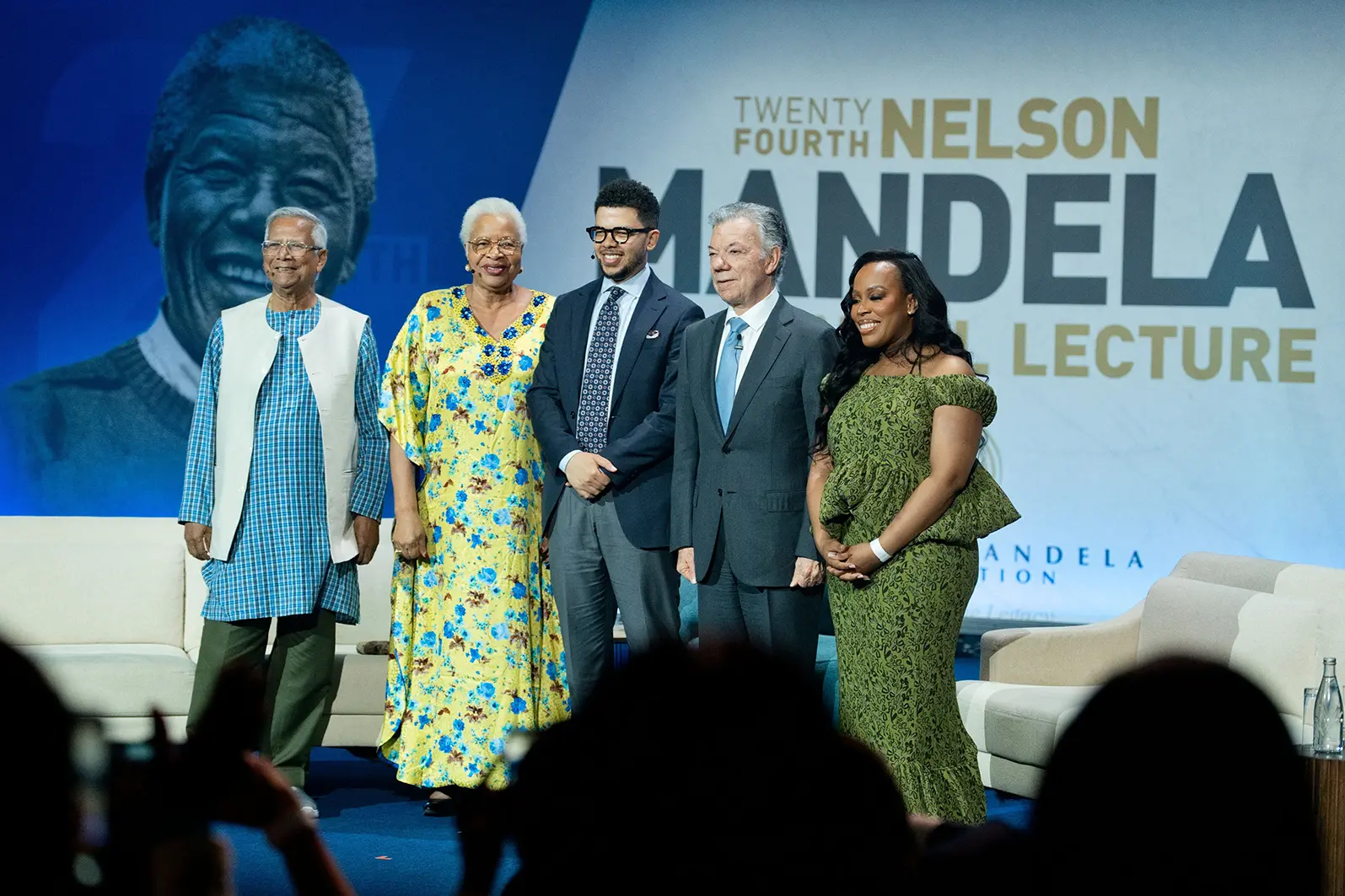
South Africa should defend its principles and values in its dealings with the United States, former Colombian president Juan Manuel Santos says, arguing that economic interests cannot be the only consideration in relations between countries.
In his address at the 24th Nelson Mandela Annual Lecture in Cape Town, Santos urged nations to defend human dignity and uphold international law, warning that political and economic interests could make governments reluctant to confront injustice.
The theme, “When is silence complicity?”, drew on Santos’s experience of Colombia’s decades-long armed conflict, his government’s negotiations with the Revolutionary Armed Forces of Colombia (FARC), and the challenges of implementing the 2016 peace agreement.

Santos, the 2016 Nobel Peace Prize laureate and chair of The Elders, delivered the 24th Nelson Mandela Annual Lecture at the Cape Town International Convention Centre on 6 November. The Nelson Mandela Foundation hosted the event in partnership with One Young World, whose summit brought young leaders from around the world to the city.
In an interview with the Mail & Guardian following the lecture, Santos applied that message to relations between countries.
“For me, the most important thing in life is to respect the dignity of others and to defend my dignity,” he said.
“Sometimes economic interests are very important, but there are other interests that are more important than economic interests.”
Asked about South Africa’s relations with Washington, Santos said his advice applied to any country or person.
He urged countries to persuade the more powerful party that short-term thinking would ultimately harm everyone’s interests.
“So I would say to South Africa: defend your principles, defend your values, and that is what every nation or every person should do always.”
His advice echoed the warning in his lecture: governments that fail to oppose injustice because doing so is politically inconvenient or economically costly help create a world governed by force.

Foundation chief executive Dr Mbongiseni Buthelezi opened the event by describing the annual lecture as a platform bringing together ideas, dialogue and memory to address critical social issues and inspire change.
In the lecture, Santos warned that international law was being disregarded, the International Criminal Court intimidated and civilians left to suffer while diplomacy retreated. Countries that could oppose injustice but chose inaction were complicit, he said.
Santos paid tribute to South African jurist Navi Pillay, whose work defending human rights demonstrated why peace depended on the strength of law rather than the will of the strongest.
But his argument also allowed for the discretion that negotiation requires. Silence could create room to listen; words spoken prematurely or in anger could close doors. The responsibility was to recognise when restraint helped resolve conflict and when it allowed injustice to endure.
His own understanding of that responsibility owed much to a conversation with Mandela in 1996, when a diplomatic visit became an encounter lasting nearly three hours.
He was handing over the chairmanship of the United Nations Conference on Trade and Development. That morning, he watched televised Truth and Reconciliation Commission hearings as South Africa confronted the violence of apartheid.
Colombia faced a different ordeal. Political assassinations, armed groups and the drug trade had left people so accustomed to violence that war seemed an unavoidable part of life.
Santos described the violence to Mandela. They discussed the wounds it left, the balance between peace and justice, and the courage needed to imagine a future in which an enemy had a place.
Santos recalled Mandela telling him that, without peace, Colombia would never take off. The conversation stayed with him through war and negotiations.
By 2010, when he became president, Santos had built his reputation through military operations against the FARC. Choosing negotiations meant confronting expectations that he would continue the war.
His family warned against talks. Previous efforts had failed; he risked being branded a traitor.
Advice from former Israeli foreign minister Shlomo Ben Ami helped him decide. Santos was urged to imagine looking back at the end of his life and asking how many people he might have saved had he taken the risk.
“Someone must seize the moment and lead the way by speaking out, even when silence offers the most secure and comfortable position,” he said.
The negotiations continued while the fighting went on. Every attack brought renewed pressure to abandon the table. Santos said he had refused to let violence determine whether Colombia could have a different future.
Listening to victims helped sustain him. Their accounts reminded him what was at stake when the negotiations became exhausting or politically isolating.
He told the story of Pastora Mira, whose father, husband, brother and son had been killed. Three days after burying her son, she cared for a wounded young man and allowed him to sleep in her son’s bed.
According to Santos’s account, the man later saw a photograph, recognised her son and confessed to torturing and killing him. Mira embraced him. She thanked him for telling the truth and taking responsibility, explaining that this had freed her from hatred.
Santos later invited Mira to accompany him to Oslo when he received the Nobel Peace Prize, which he accepted in the name of Colombia’s victims.
The peace process faced a further test when Colombians narrowly rejected the first agreement in a 2016 referendum. Santos acknowledged that his government had been overconfident and underestimated disinformation.
Young people took to the streets demanding an agreement. Santos said their mobilisation helped inspire the national dialogue that followed the defeat.
Talks with opponents followed. A revised agreement was negotiated and endorsed by Congress. More than 13,000 former FARC members entered the reincorporation process, and the organisation became a political party.
A decade after the peace agreement, Santos said many of its commitments remained unfulfilled, with communities still awaiting the benefits of peace. He attributed shortcomings in implementation to the two administrations that succeeded his.
Armed groups and criminal organisations had expanded their control, financed by drug trafficking, illegal mining and other illicit activities. Santos rejected claims that the agreement itself was responsible, arguing that its implementation remained essential to protecting communities and extending legitimate state authority.
“It is now more important than ever to speak out and demand the full implementation of the peace agreement.”
That meant addressing rural inequality, protecting communities and bringing effective institutions to areas where the state had long been absent. Peace required continued political commitment after the negotiators had left the table.
Santos acknowledged the differences between South Africa’s struggle against apartheid and Colombia’s conflict. South Africa had transformed its political order; Colombia had sought to make an existing democracy more equitable and accessible.
Both experiences demanded that former adversaries learn to share institutions and responsibility for the future. Santos said Colombia could learn from South Africa’s efforts to preserve and renew its democratic settlement.
Of Mandela, he said: “Through both his words and his silences, he showed us that wisdom means knowing when to listen, and when conscience demands that we speak.”
He also warned that artificial intelligence could amplify disinformation, deepen inequality and entrench authoritarian rule.
Addressing the young people in the audience, he acknowledged that his generation had not always given them the world they deserved. He urged them to stand up for what was right and refuse to accept war, injustice or division as inevitable.
“The destination is peace. We must defend our common humanity. And silence is not an option.”