


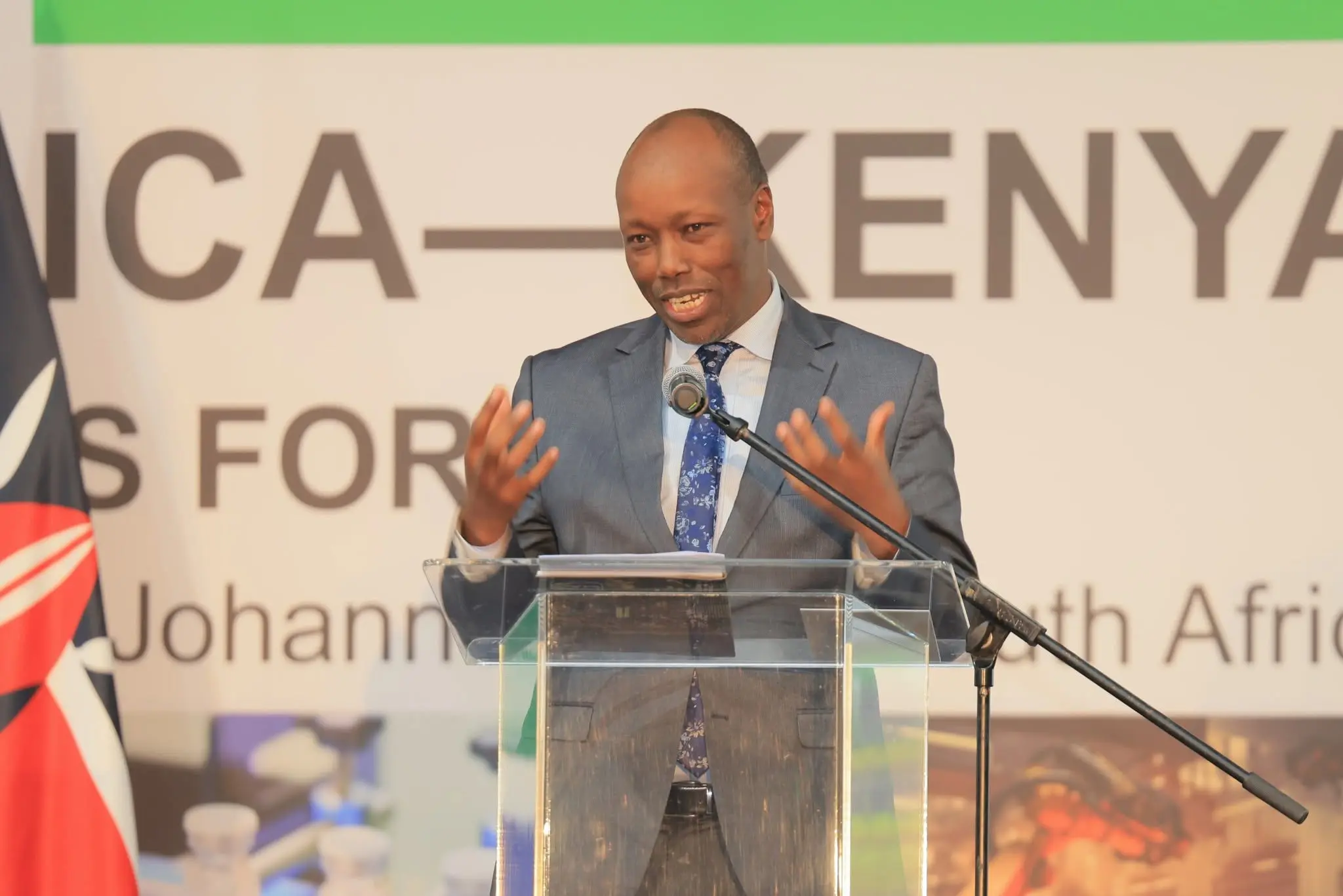
As South Africa moves to tighten immigration controls amid growing concern over undocumented migration, Kenya’s Trade and Industry cabinet secretary Lee Kinyanjui has called on African governments to establish clearer rules governing migrant labour and cross-border business to reduce tension.
In an interview with the Mail & Guardian, Kinyanjui said migration across African borders was an inevitable consequence of uneven economic opportunities between countries. Governments must create greater regulatory certainty to reduce tension over jobs, informal trading and access to economic opportunities.
“As long as there is economic opportunity in one place and it’s not available in the other, if there’s no restrictions, then you expect there to be movement of people,” he said.
“Sometimes it’s the movement of people and also competition for local resources and opportunities. It’s bound to be both truthful narratives and others that are also not true.”
Kinyanjui’s comments come a week after President Cyril Ramaphosa’s national address, in which he acknowledged South Africans’ concerns about illegal immigration while rejecting xenophobia and announcing tougher enforcement measures.
Ramaphosa said the concerns “are real. They deserve to be heard. They deserve to be addressed”, adding, “there is no space for xenophobia, racism, sexism, Afrophobia or any other forms of intolerance”.
The president outlined plans to strengthen border security, close legal loopholes in the immigration system, increase labour inspections and impose tougher penalties on employers hiring undocumented foreign nationals.
The measures come after growing public pressure and protests calling for stronger immigration enforcement. Ramaphosa warned that “illegal migration, if unchecked, poses a risk to South Africa’s security, stability and economic progress”.
This is as South Africa’s official unemployment rate stands at 32.7%, adding pressure on policymakers trying to balance domestic frustrations over jobs and economic exclusion with commitments to regional integration and trade.
Kinyanjui called on nations to refrain from broad stereotypes of migrant communities, saying criminality and economic hardship should not be reduced to nationality.
“It is not possible to say all Zimbabweans are bad, for example, all Ugandans are like this or Tanzanians are like this. No one group can think 100% the same way. So I think it’s good to judge everybody on their rights.”
Kinyanjui acknowledged frustrations around economic competition and said governments needed practical policy frameworks to clarify where migrants could work and how foreign-owned businesses should operate.
“The rules in areas where migrants are allowed to work, how they should work and what licenses they are allowed to operate would also help clarify some of these areas instead of waiting until when there’s a lot of investment in one area, then suddenly we want to kick everybody out.
“Clarity around areas or particular sections that are reserved for the locals and so on would be useful in this narrative.”
Kinyanjui said rules would help prevent uncertainty and reduce tension between communities and migrant entrepreneurs.
“There are lazy people on all sides, there are criminal people on all sides and it is not possible to brand one group of people in one particular bracket,” he said.
His intervention comes as African governments grapple with tension between deeper regional integration through trade agreements and freer movement on one hand and domestic pressure for tighter immigration controls and stronger border management on the other.
Kinyanjui said debates on migration could not be separated from broader questions of trade, tourism and investment.
“As long as we make it very difficult to travel across the country, it will become very difficult in the future for people to look at Africa from a tourism or even investment perspective.”
The minister pointed to Europe’s Schengen system as an example of how fewer travel restrictions could support regional growth.
“If I want to go to Germany, France, Portugal, all those countries you can imagine, I just need to apply for one. And out of that one, I can travel to all the 27 countries.”
A similar model in Africa could significantly boost tourism and business opportunities.
“You can imagine if in Africa you can apply for a visa in Kenya and end up travelling in 40 countries, 45 countries. Then it would increase the [tourism] in a very, very huge way.”
He added that there were obstacles that had been deliberately placed there to prevent open access to African countries. “The realisation that Africa can grow only by trading with itself, by opening its borders, has come and part of that will be realised once we allow free movement of people and goods.”
Kinyanjui said there was a need to revisit the long-term idea of a common African currency, saying it could strengthen economic integration but would require far greater coordination between governments.
“The issue of a monetary sort of union where within the entire globe or the entire continent, we’re using one currency would be ideally a good situation. However, there are many steps that must go into it before we get there, including one having monetary policies that are agreed at that level.”
African countries operated under widely different economic and monetary conditions.
“Each country has its own monetary policy right now. Some countries have strong currencies, others have weak currencies, sometimes designed, sometimes by default so all these issues place different countries at different levels of monetary policy and priorities,” he said.
The view echoes that held by the Economic Freedom Fighters, who argue that Africa should be open to all who live in it.
The remarks were made after Kenyan President William Ruto’s state visit to South Africa last week, during which the two countries signed six memorandums of understanding on trade facilitation, standardisation, maritime transport, skills development and other areas of cooperation.
Relations between Nairobi and Pretoria have strengthened since the introduction of 90-day visa-free travel for Kenyan citizens, with arrivals rising 18.7% to 58 000 in 2025.
Officials on both sides have described the relationship as an example of managed migration that supports trade, tourism and skills exchange.